
Trump’s January-to-February Policy Blitz Runs on Force, Not Proof
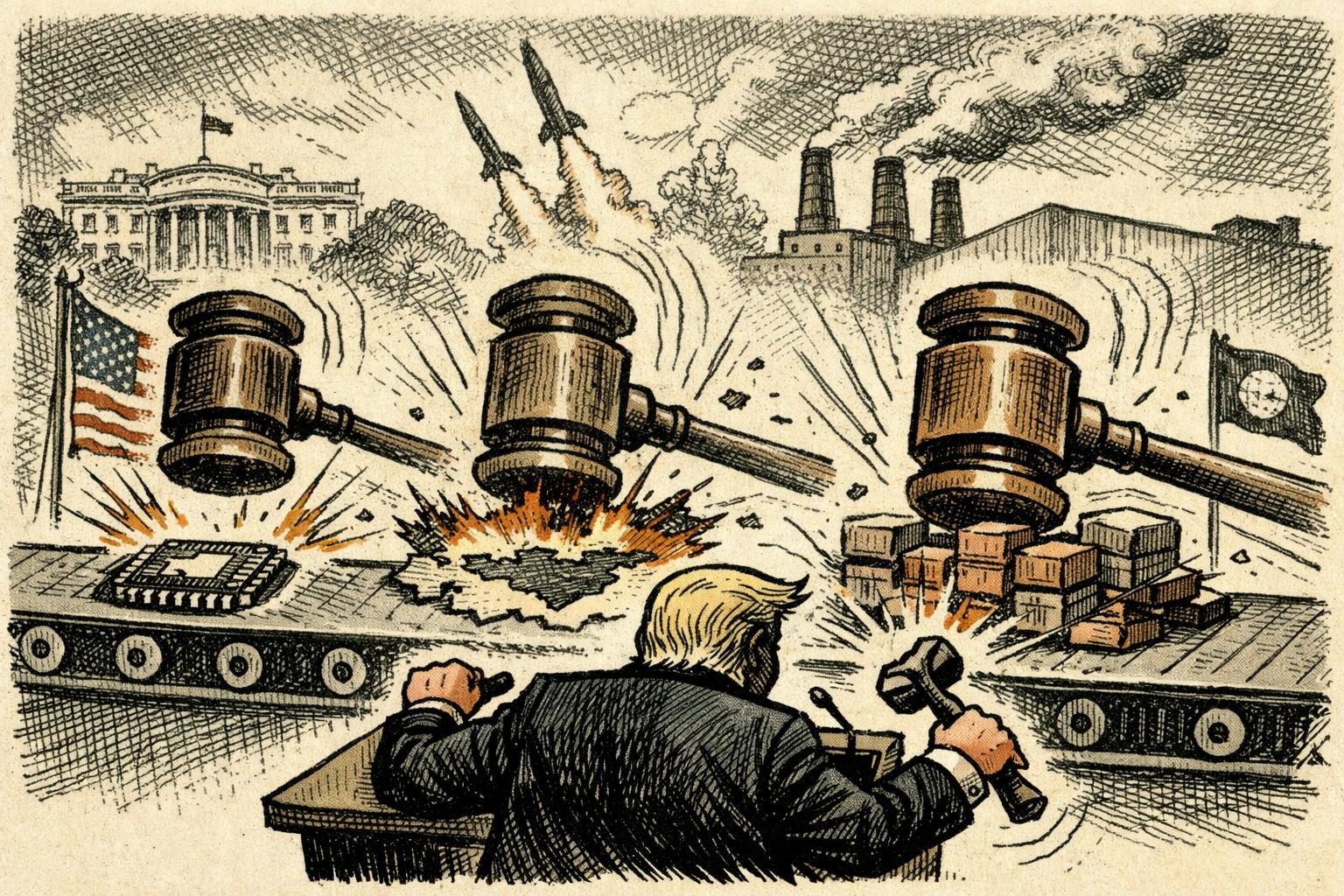
President Donald Trump’s White House spent the first weeks of 2026 making a familiar argument: use presidential power, trade barriers and emergency-style directives to show the government can move fast and hit hard. But the sequence matters. The semiconductor action came on Jan. 14, 2026. The Iran-related measure followed on Feb. 6. The temporary import duty arrived on Feb. 20. That is not one February blitz. It is a January-to-February run of separate actions, each presented as a forceful answer to a different problem.
The White House’s own descriptions make the pitch plain. The chip action was tied to economic and national security. The Iran measure was cast as a response to threats from the Iranian government. The import duty was framed as a fix for what the administration called fundamental international payment problems. In each case, the message is the same: if the threat is big enough, the president can act quickly and decisively.
That is also where the sales job runs into the facts. A fact sheet can announce pressure. It cannot prove that pressure will lower prices, stabilize supply chains or deliver a durable policy win. Tariffs can change incentives, but they can also raise costs and add uncertainty for businesses that have to buy, ship and plan months ahead. Semiconductor restrictions can be sold as protection, but they can also ripple through manufacturers that depend on predictable access to advanced chips. The White House says these moves are meant to protect national interests. The open question is whether they produce more than a short burst of political theater.
The bigger pattern is straightforward: the administration is leaning on visible presidential action to argue that it is solving hard problems. That can be an effective way to project control. It is a much harder case to make when the test is not a press release but results. If these measures are supposed to strengthen industry, improve security or steady the economy, the proof has to come later and in numbers the White House cannot spin away. Until then, the story is force first, payoff still unproven.
Comments
Threaded replies, voting, and reports are live. New users still go through screening on their first approved comments.
Log in to comment
No comments yet. Be the first reasonably on-topic person here.