
Trump’s White House keeps dressing up routine power grabs as emergencies
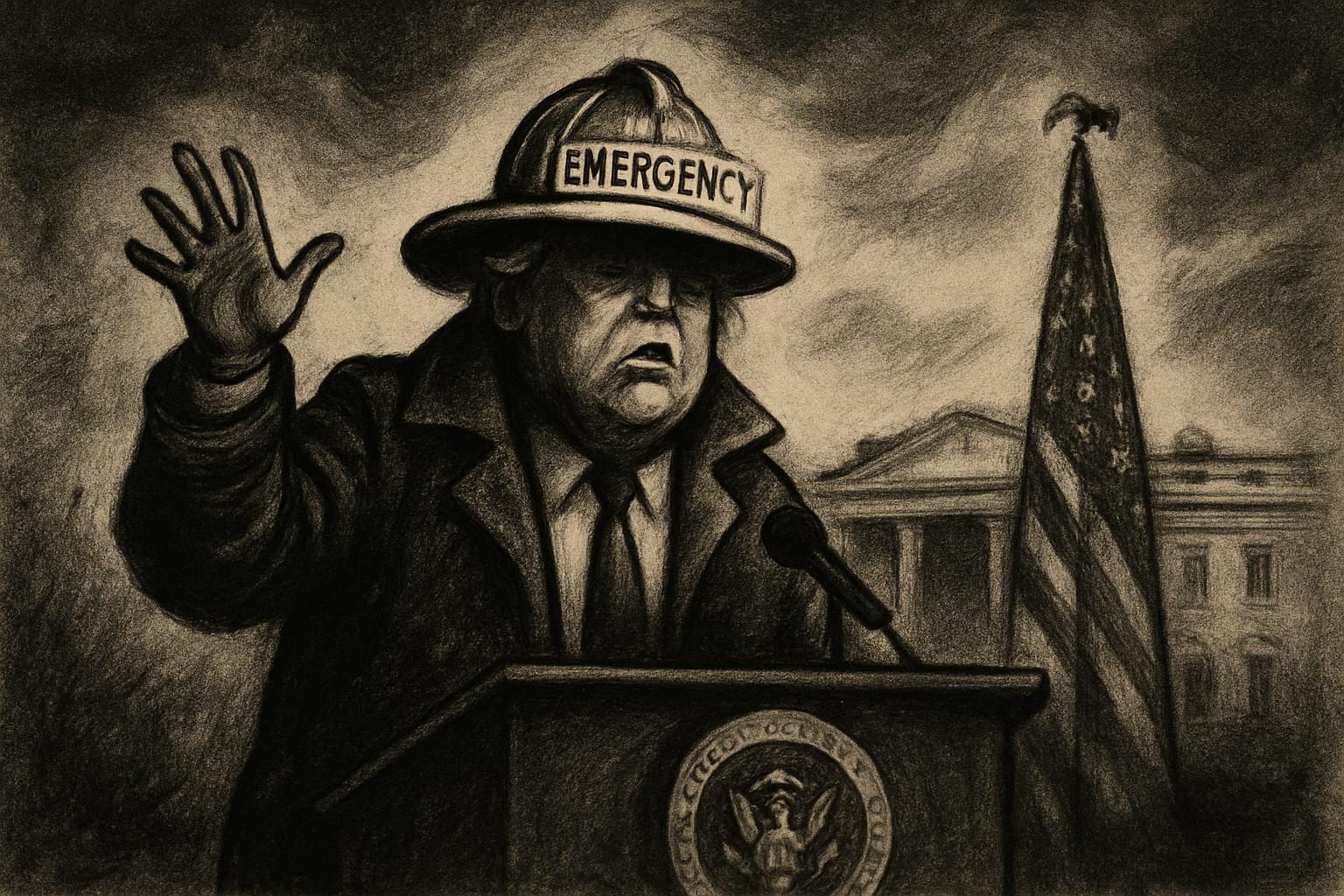
The Trump White House has spent the first stretch of the year leaning on a familiar bit of political theater: announce an action, drape it in the language of emergency, and invite the public to treat it as if the country had just stumbled into a crisis that only the president could defuse. In a run of actions dated Feb. 20, March 6, March 16, and April 18, the administration kept reaching for that framing even when the underlying moves looked more like standard executive-branch tools than answers to a singular national breakdown. The Feb. 20 proclamation imposed a temporary import surcharge tied to what the White House called fundamental international payments problems, with the measure taking effect on Feb. 24. The March 6 executive order turned to cybercrime, fraud, and predatory schemes aimed at American citizens. The March 16 order created a Task Force to Eliminate Fraud. And on April 18, the White House posted a video of the president signing an executive order. Taken together, the documents suggest an administration that wants its actions to be understood first as urgent intervention and only second, if at all, as policy choices that can be debated on their merits.
That matters because emergency language does more than add drama. It changes the starting point of the argument before the argument has even begun. A tariff can be presented not as a trade decision with winners, losers, tradeoffs, and likely retaliation, but as a necessary stabilization move that supposedly answers a larger system problem. A fraud crackdown can be sold less as a matter of administrative design and more as a sweeping cleanup campaign that any serious government would have to launch. A cybercrime directive can be cast as a broad shield against danger rather than a narrower set of enforcement steps targeting specific harms. None of that proves the administration is acting unlawfully, and none of it means the concerns behind the actions are invented. Cybercrime is real. Fraud is real. International payments problems are not imaginary just because they are wrapped in presidential prose. But the White House’s habit of packaging routine power in crisis language is still doing political work, because it makes disagreement easier to portray as carelessness and criticism easier to depict as weakness.
The Feb. 20 proclamation is the clearest example of the pattern. By describing the temporary import surcharge as a response to fundamental international payments problems, the White House placed the measure in the register of emergency stabilization rather than ordinary trade policy. That distinction is not cosmetic. Trade actions can be defended on strategic, economic, or diplomatic grounds, but they still invite the ordinary questions that come with public policy: How long will the measure last? Who pays the cost? Who benefits? What happens to prices, supply chains, and foreign retaliation? When the administration frames the surcharge as something forced by a payments crisis, it implicitly narrows that debate. The move begins to sound less like a choice than a necessity, and necessities are harder to challenge without looking irresponsible. That is the rhetorical advantage of emergency framing, and it is especially powerful in an area like tariffs, where the president already has broad room to maneuver and where the public often struggles to distinguish short-term shock from long-term strategy.
The March 6 and March 16 actions use a similar strategy in a different policy lane. The cybercrime order speaks to threats that are very real and often very expensive, but the phraseology is broad enough to make the danger feel expansive and immediate. That helps place the president in the role of protector, not just decision-maker. The fraud task force order pushes that same logic further by creating a coordinating body inside the Executive Office of the President to accelerate anti-fraud efforts. Structurally, that is a recognizable bureaucratic move, the kind of thing administrations do when they want agencies to work in closer alignment or to elevate a priority. But branding matters, and the term task force is not accidental. It suggests a problem so serious that existing systems are not enough, and it gives the White House a chance to present a coordination exercise as an act of national rescue. The April 18 signing video is even simpler, and for that reason it is useful in its own way. A video of the president signing an executive order is not the order itself. It is presentation, staging, and image management. Yet it reinforces the same visual formula the White House keeps returning to: danger, urgency, presidential intervention, and the promise that only the top of the executive branch can restore order.
That is the larger story here. When nearly every major action is cast as an emergency response, urgency stops sounding exceptional and starts becoming the background noise of governance. Oversight starts to look like delay. Skepticism starts to sound like drift or even hostility. The White House gets to argue not only for the substance of its actions, but for the idea that those actions should be judged under crisis conditions, where resistance can be framed as recklessness and hesitation as failure of nerve. The documents at issue do not prove that every problem named by the administration is fake, and they do not show that each move is illegitimate. They do show a consistent effort to convert ordinary executive power into the language of alarm. That is a political choice, not a legal conclusion, but it is an important choice because it shapes how the public is asked to see power itself. In this White House, the first move is increasingly not to govern quietly and explain later. It is to declare urgency up front and let the crisis framing do much of the governing for it.
Comments
Threaded replies, voting, and reports are live. New users still go through screening on their first approved comments.
Log in to comment
No comments yet. Be the first reasonably on-topic person here.