
Trump’s economy talk is still all victory lap, no actual clean-up plan
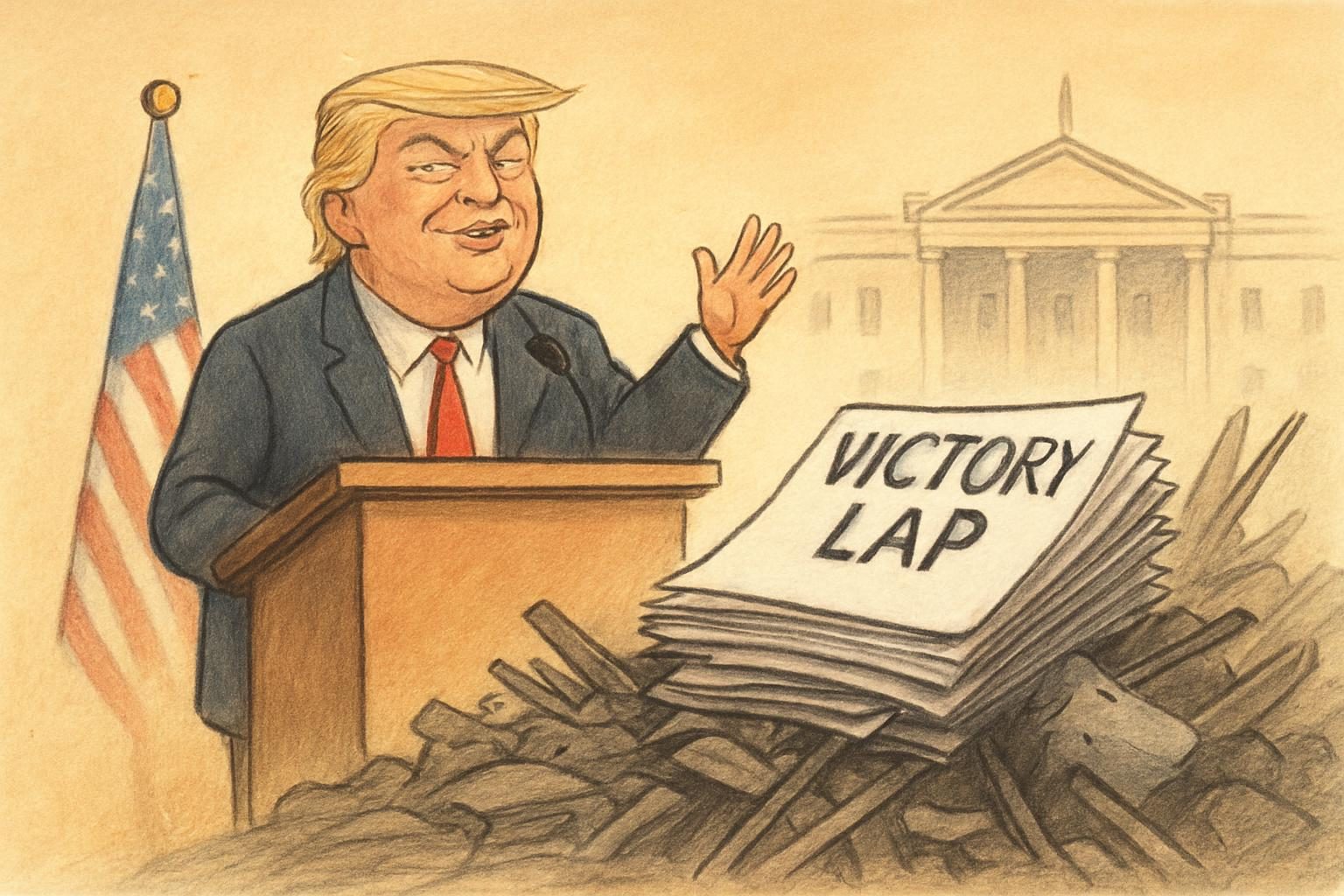
The Trump administration is trying to keep the spotlight on the upside of its economic agenda: lower taxes, bigger refunds, and a more aggressive posture on trade and industrial policy that it says is designed to help working families. Treasury officials have been pushing a familiar message that tax filing season is running smoothly and that recent tax changes are already showing up in the form of returns processed, refunds issued, and new deductions claimed. On paper, that is the cleanest possible pitch for a White House that wants the public to see competence and momentum at once. The problem is that the brag sheet and the bill are not lining up. The more aggressively the administration advertises its wins, the more visible the unfinished cleanup work becomes behind them.
The Treasury’s own materials frame the tax season as proof that the administration’s approach is delivering tangible benefits. Officials have highlighted the number of returns processed, the dollar value of refunds delivered, and the way new deductions are being taken up by filers. That kind of accounting is politically useful because it turns a sprawling tax code into digestible proof points, the sort of thing that can be repeated at a podium and clipped for social media. Yet those numbers do not answer the harder question: whether the underlying system is actually becoming simpler, fairer, or more stable for the people using it. A refund arriving on time is good news for a household, but it does not erase uncertainty created by shifting rules, last-minute implementation changes, or broader economic turbulence caused by other administration decisions. The public relations strategy is to present every operational milestone as evidence of a successful policy era. The policy record, however, keeps generating reminders that processing paperwork is not the same thing as solving structural problems.
Trade policy is where the mismatch becomes most obvious. Trump’s tariffs have been sold as leverage, protection, and a way to force better outcomes for American industry, but the practical result has often been legal fights, administrative confusion, and continued cleanup efforts rather than durable certainty. The administration has had to defend the tariffs in court, respond to adverse rulings, and figure out how to manage a policy that is still producing consequences long after the slogans were rolled out. That is not what a clean policy landing looks like. A clean policy landing would mean predictable rules, limited legal exposure, and a sense that businesses and consumers can plan around the government’s actions. Instead, companies, importers, and government agencies are left trying to interpret a shifting environment while the White House keeps describing the same environment as proof of toughness and success. The mismatch matters because tariffs are not just an abstract economic theory exercise; they affect prices, supply chains, and planning decisions in real time. When the administration sells these moves as a victory lap but has to keep mopping up the fallout, the cleanup itself becomes part of the story.
That is why the broader political problem is not simply whether the administration can point to a few favorable data points. It is whether those data points are strong enough to outweigh the accumulating evidence of friction, confusion, and legal vulnerability. Administrations routinely try to frame the economy in the best possible light, especially when they believe tax policy or trade policy can be packaged as proof that they are on the side of ordinary workers. But voters and businesses experience policy through the full chain of effects, not through a press release. They notice when tax benefits are marketed as universal wins but are uneven in practice. They notice when trade policy is advertised as strength but keeps triggering uncertainty, litigation, and administrative housekeeping. They notice when the government’s language sounds like it is describing a finished success while the actual work looks incomplete. In that sense, the administration is not just fighting criticism from opponents; it is fighting the basic arithmetic of implementation. The more it insists that its policies are already delivering stability, the more it invites scrutiny of the instability those policies have generated. That is a hard problem to spin away, because messaging can sharpen a narrative but cannot substitute for a coherent governing result.
So the real headline is not that the administration has nothing to brag about. It does. It can point to tax processing benchmarks, refund delivery, and the rollout of claims about new benefits for filers. It can also argue that its trade posture is meant to protect American interests and force a better outcome in the long run. But a government that keeps celebrating the promise while leaving behind unresolved damage starts to look less like a manager of economic progress and more like a producer of recurring cleanup projects. That gap between the public celebration and the policy residue is becoming the main economic story, because it reveals how fragile the administration’s own claims of competence can be. If the White House wants credit for the upside, it also has to account for the mess left in the wake of its interventions. Right now, the administration is asking the country to applaud the victory lap while ignoring the tow truck parked just out of frame. That is not a persuasive definition of economic strength, and it is getting harder to pretend otherwise.
Comments
Threaded replies, voting, and reports are live. New users still go through screening on their first approved comments.
Log in to comment
No comments yet. Be the first reasonably on-topic person here.