
Trump’s AI orders speed federal adoption while limiting censorship, bias, and unlawful surveillance
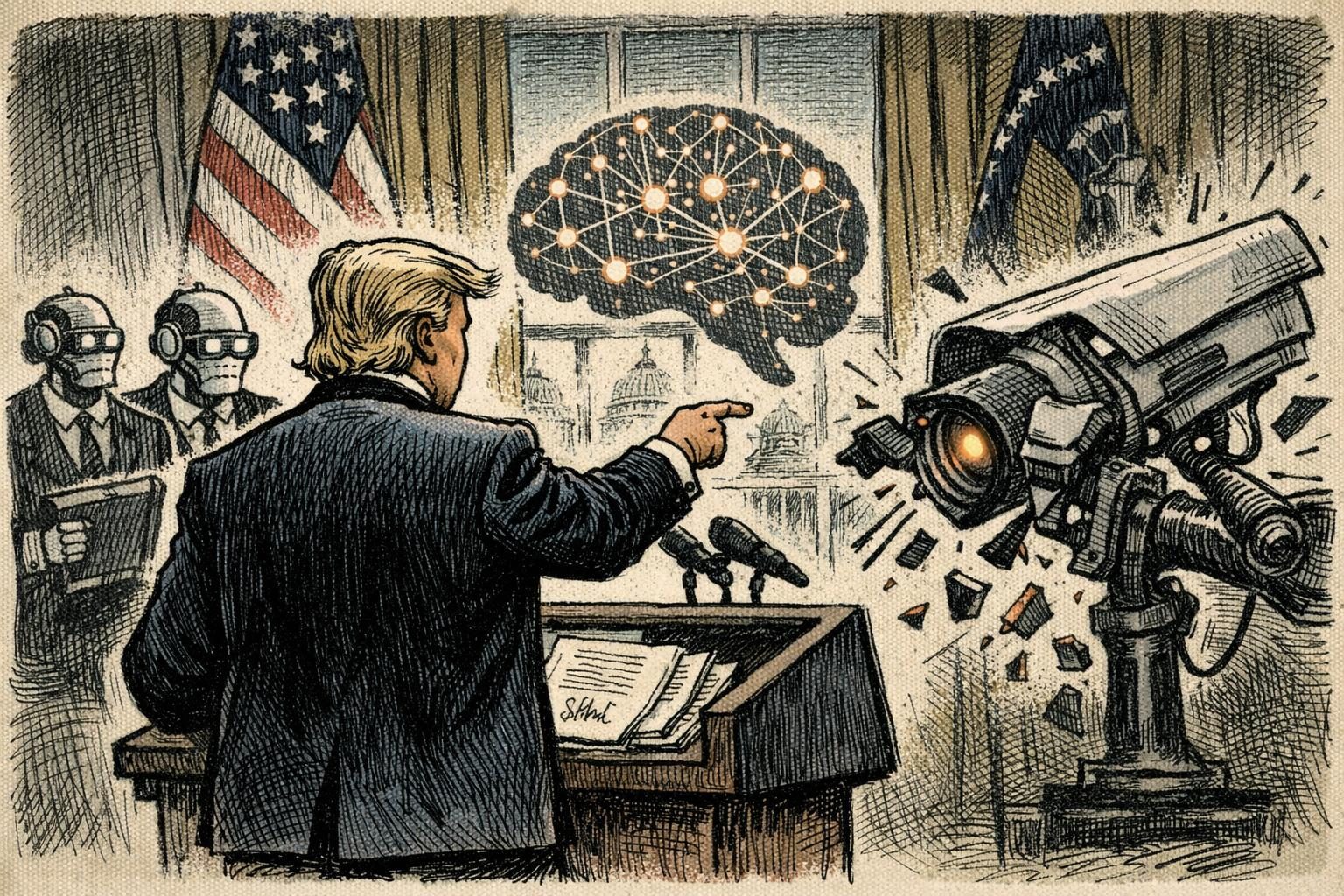
President Donald Trump opened June with two fresh directives that together sketch out his administration’s answer to a fast-moving artificial intelligence race: push federal use of AI harder, but do it under rules that stress security, discipline, and political control. On June 2, he signed an executive order focused on advanced AI innovation and security. On June 5, he followed with a national-security memorandum aimed at the intelligence and defense side of the government. The two actions are aimed at different parts of the federal machine, but they point in the same direction. The White House wants agencies to adopt AI more quickly, and it wants that adoption to come with guardrails that reduce cyber risk, limit wasteful procurement, and curb uses the administration views as abusive or ideologically tainted. In practice, that puts Trump in a familiar position: demanding speed from a bureaucracy he often portrays as sluggish, while simultaneously tightening the hand of the people who will have to implement his directives.
The June 2 executive order is the broader and more civilian-facing of the two moves. According to the White House, its purpose is to accelerate the adoption of advanced AI while strengthening cyber defense and protecting critical infrastructure. It directs agencies to improve coordination, set benchmarking processes, and expand access to AI-enabled cybersecurity tools not only for federal users but also for state, local, and critical-infrastructure partners. That framing suggests the administration sees AI as something more than a private-sector innovation story; it is also treating it as a public-sector operating tool, a defensive asset, and a procurement issue. At the same time, the order is notable for what it does not do. The White House says it does not create a mandatory licensing system, pre-clearance process, or permitting regime for AI models. That is a meaningful choice because it avoids putting a formal federal gate in front of model development, even as it increases expectations that agencies move faster and coordinate more closely. In other words, the order is pro-deployment without being openly permissive, and it tries to encourage widespread use without building a licensing bureaucracy around the technology. Whether that balance actually produces faster adoption will depend on how agencies interpret the order and how much room they believe they have to innovate without triggering future scrutiny.
The June 5 memorandum is narrower in scope but sharper in tone, especially because it focuses on the national-security enterprise, where the government’s use of AI can quickly collide with civil liberties and questions of military authority. The White House says the memo bars federal AI systems from being used to censor free speech, embed ideological bias, or carry out unauthorized or unlawful surveillance. Those are broad prohibitions, and they signal that the administration wants to draw lines around some of the most politically charged fears surrounding AI in government hands. The memo also directs updated policies for autonomy in weapons systems, which places it in the center of an issue that has become increasingly important as defense planners weigh how much decision-making can be delegated to machines. Beyond the speech and surveillance rules, the memo tells agencies to take action against contractors that repeatedly show conduct inconsistent with the policy, including termination for default or for convenience where the law allows it. That enforcement language matters because it suggests the White House wants not just a statement of principles but a compliance regime with consequences. The memo replaces earlier guidance that the administration says is no longer fit for purpose, which implies the new approach is meant to reset the ground rules rather than simply add a few extra cautions on top of old policy.
Put together, the executive order and the memorandum look like an attempt to define a Trump-era AI doctrine: accelerate adoption, centralize the boundaries, and make the federal government a larger and more disciplined user of the technology. The basic message is that AI should not be left to drift in the hands of agencies, contractors, or outside experts with their own priorities. Instead, the White House is trying to define what counts as acceptable federal use, what kinds of systems should be favored, and what kinds of misuse should be treated as out of bounds. That is why the two directives are both deregulatory and controlling at the same time. The civilian order rejects a mandatory licensing regime, which will likely please industry and other backers of rapid development. But the national-security memo is packed with instructions about acceptable conduct, contractor accountability, and updated autonomy policy, which gives the administration more authority over the systems and people operating in sensitive settings. The result is not a free-market AI doctrine and not a pure regulatory clampdown either. It is something more characteristic of this White House: a hands-on, highly centralized push that argues speed and control can be pursued together if the government keeps a firm grip on the terms.
That approach may appeal to officials who think Washington has been too slow to adapt to AI and too cautious about using available tools. It may also appeal to those who worry that federal agencies are already tempted to deploy new systems without enough discipline, oversight, or transparency. But the tension inside the policy is obvious. The White House is asking agencies to move quickly while also issuing detailed instructions about what they may not do, how they must coordinate, and how they should respond to vendors that fail to comply. It is not yet clear how much of this will depend on follow-on rulemaking, internal guidance, or agency-by-agency enforcement. The real test will come when departments have to translate these directives into actual procurement standards, internal controls, and operational limits. That is where the administration’s broad political goals will meet the ordinary frustrations of federal implementation. If the rules are written loosely, the speedup may be real but the constraints may be uneven. If the rules are written tightly, the guardrails may be stronger, but the promised acceleration could slow down under its own weight. For now, the White House is betting that it can have both: a faster federal AI rollout and a more tightly controlled government use case, all without forcing civilian model developers into a formal licensing line.
Comments
Threaded replies, voting, and reports are live. New users still go through screening on their first approved comments.
Log in to comment
No comments yet. Be the first reasonably on-topic person here.