
White House UFC event on Trump’s 80th birthday drew criticism over America 250 branding
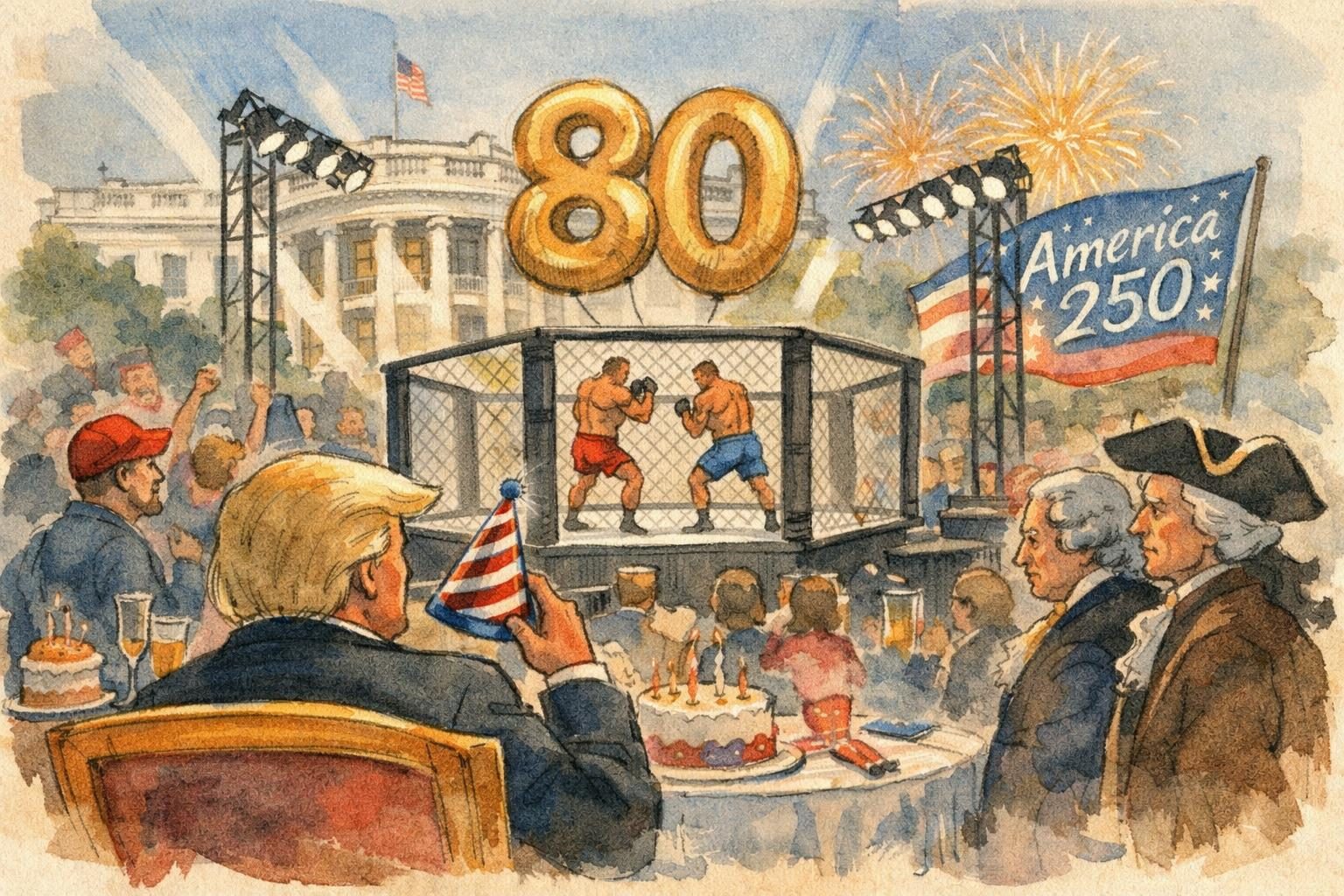
The White House really did turn its South Lawn into a fight-night backdrop, and it did so with the kind of theatrical confidence that has become a defining feature of the Trump era. UFC Freedom 250 took place on Sunday, June 14, 2026, after a fan-fest was staged the day before, and the timing was impossible to ignore: the event landed on President Trump’s 80th birthday. It was also wrapped in the broader America 250 branding the administration has used around the semiquincentennial year, which gave the whole thing a strangely overloaded feel. On one level, it was a sports spectacle at the presidential residence. On another, it was a public celebration of the nation’s 250th anniversary. And on a third, unavoidable level, it was a birthday-stage spectacle for a president who has never been shy about treating the presidency as a performance space.
That combination is what makes the episode feel less like a routine ceremony and more like a political misfire. The White House has plainly put out materials and presidential actions describing 2026 as a yearlong celebration of America’s 250th birthday, and there is no mystery about the general America 250 framing. But the official record does not show the UFC fight card itself being formally designated as an America 250 program item. That distinction may sound technical, but it matters a great deal once the branding gets loud enough to blur the edges. When a government is publicizing a national milestone, the public has a reasonable right to know what is officially part of that program and what is simply adjacent to it. In this case, the branding created a strong impression of official blessing that the paperwork does not clearly support. That gap between the public image and the documented status is exactly where the criticism starts to sharpen.
Supporters can, of course, make a straightforward argument that the event was a flashy but harmless way to lean into a major national anniversary. It is easy enough to say that a 250th-birthday year ought to include big, popular events and that a mixed martial arts card can be folded into a broader celebration of American culture and sports. But critics are likely to see something else entirely: a White House using patriotic packaging to make a highly personalized spectacle look like civic programming. A fight card on the South Lawn is not a traditional anniversary observance, and it is especially jarring when placed on the president’s birthday, where the visual symbolism practically writes itself. The optics are not subtle. Instead of looking like a sober institution marking a historic milestone, the White House can look like an events venue with security barriers and a national seal. That is not a small concern in an administration already known for collapsing the distance between public office and private branding.
The deeper issue is that this kind of event encourages the exact confusion that political operations usually try to avoid: the mixing of national identity, presidential image management, and quasi-official messaging until nobody can quite tell where one ends and the other begins. The White House’s America 250 materials and presidential actions suggest a broad, yearlong commemoration, but a broad commemoration is not the same thing as a blanket authorization to turn every high-profile spectacle into an anniversary program. If the fight card was not formally designated as part of America 250, then the branding is doing a lot more work than the underlying record. That is not just a communications issue; it is a credibility issue. The administration can insist, with some justification, that America 250 is meant to be expansive and celebratory. Fine. But the more it leans on patriotic language to cover events that mainly function as display, the more it invites the obvious question of whether the presidency is being used to elevate the country or to elevate the brand. On June 14, the answer looked uncomfortably close to the latter.
That is why the fallout here is mostly reputational but still meaningful. No one is pretending a UFC card on the South Lawn changes the machinery of government by itself. What it does do is reinforce a broader impression that the administration is willing to wrap almost anything in national symbolism if it helps sell the moment. For critics, that is less a one-off gimmick than another example of the Trump White House treating governance as content, ceremony as marketing, and official space as a stage. For supporters, it will likely read as bold, entertaining, and unbothered by the pearl-clutching of traditionalists. But the split itself is part of the problem. When a presidential event is so easily interpreted as either patriotic celebration or self-regarding spectacle, the institution has already paid a price in clarity. The White House can say America 250 is a broad national project, and that may well be true. Yet the more the administration blurs the line between public commemoration and personal showmanship, the more it leaves itself open to the simplest criticism of all: is this actually government, or just another very expensive performance?
Comments
Threaded replies, voting, and reports are live. New users still go through screening on their first approved comments.
Log in to comment
No comments yet. Be the first reasonably on-topic person here.