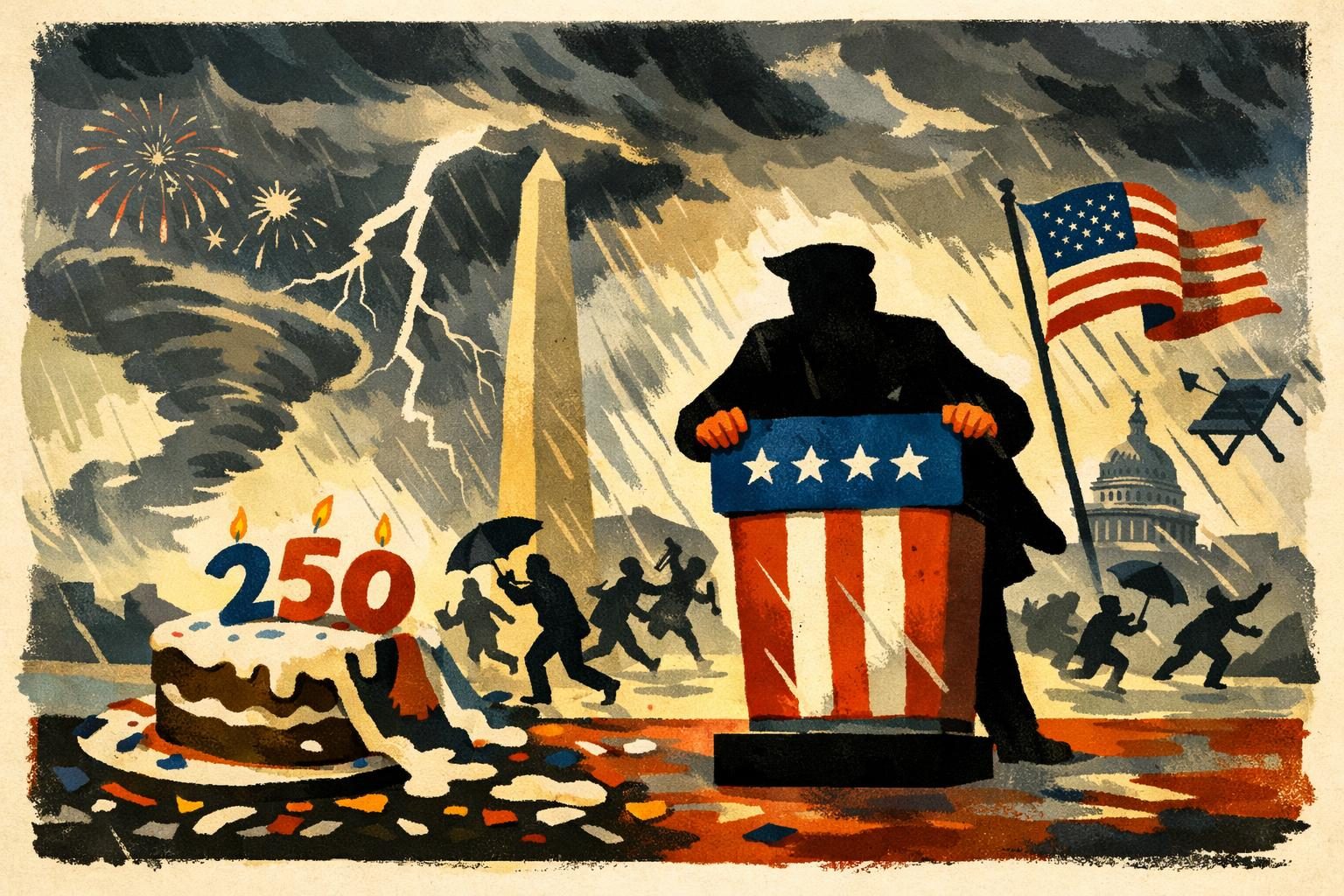
Storms blow up Trump’s big America 250 celebration on the Mall
The most immediate embarrassment in the July 4 window was not a policy failure, a legal setback, or some fresh internal revolt. It was weather. Severe storms forced a roughly two-hour evacuation of the National Mall during the America 250 celebration, interrupting the carefully staged holiday moment just as Trump was trying to frame it as a triumphant display of national strength and his own command of the scene. The evacuation was a meteorological event, not a political one, and nobody had to pretend otherwise. Still, in the blunt theater of presidential image-making, the effect was hard to miss. The day that was supposed to project permanence, order, and momentum instead revealed how quickly even the most expensive public pageantry can be overtaken by something as ordinary and uncontrollable as a storm system.
That mattered because Trump has long treated spectacle as a form of governing, or at least as a substitute for the parts of governing he would rather not emphasize. He likes big crowds, live television, dramatic settings, and moments that can be turned into proof that he is at the center of events. The America 250 celebration fit neatly into that instinct. It offered a chance to wrap himself in the symbols of national identity while presenting the administration as the custodian of a grand, unified civic moment. But the weather did not cooperate, and in that refusal lay the real embarrassment. A president cannot be blamed for thunderstorms, of course, but he can be exposed by them when the whole political project depends on the illusion that everything is under control. The interruption cut against the image Trump wanted: a seamless, choreographed holiday tableau in which he seemed to preside over both the nation’s birthday and the machinery of the state. Instead, the event had to pause, the crowd had to move, and the performance had to yield to reality.
The disruption also resonated because the celebrations across the East Coast were already being affected in other places, with some cities canceling or delaying fireworks and public gatherings. That broader pattern made the moment feel less like a one-off inconvenience and more like a reminder that public rituals are fragile, even when they are designed to feel monumental. The administration had invested symbolic capital in turning July 4 into a kind of proof-of-concept for America 250, a signal that the milestone could be celebrated with confidence, scale, and a sense of inevitability. Instead, emergency planning and shelter orders became part of the story. That shift matters in politics because optics are never just optics for Trump; they are the substance from which he tries to build authority. The more tightly his brand is tied to command, the more any interruption reads as a crack in the picture. Nobody serious would argue the storm was his fault, and there is no reason to pretend the weather was a moral judgment. But the disruption still punctured the fantasy that a president can simply will order into existence by arranging enough flags, speeches, and cameras.
Trump did eventually return to the crowd and tried to project defiance, which was consistent with how he usually responds when an event slips away from the script. The return itself was a reminder that he understands the need to reclaim the frame, to push back against the idea that the moment belongs to anything other than him. Even so, the interruption had already done its work. The dominant memory of the day was unlikely to be the intended triumphalism, but the sight of a major national celebration being paused because people had to get out of the weather. That does not amount to a scandal, and it does not change policy, but it does say something about the limits of spectacle as a political tool. The administration wanted a clean, muscular civic show. What it got was a reminder that logistics are part of governance, that large public gatherings are vulnerable to forces no leader controls, and that pageantry is a fragile substitute for actual command. For a president who thrives on the claim that he alone can bend events to his will, that is a small humiliation with an outsized symbolic sting.
The larger political damage is reputational, but reputational damage is often the kind that sticks longest with a figure like Trump. He has always understood that memory can be curated through repetition, through images, through the impression of dominance created over and over again until it feels inevitable. The America 250 celebration was supposed to feed that machine, giving him a visual he could point to as proof that he stood at the center of the nation’s story. Instead, the image that cut through was people being told to leave the Mall because of severe weather. That will not alter legislation or shift a court case, but it does alter the emotional texture of the holiday and the narrative around it. The day that was meant to look unstoppable briefly looked vulnerable and contingent. In the end, that may be the entire lesson of the storm: Trump can stage the scene, shape the lighting, and claim the credit, but he still cannot command the forecast.
Comments
Threaded replies, voting, and reports are live. New users still go through screening on their first approved comments.
Log in to comment
No comments yet. Be the first reasonably on-topic person here.