
Oval Office branding remains the administration’s default mode
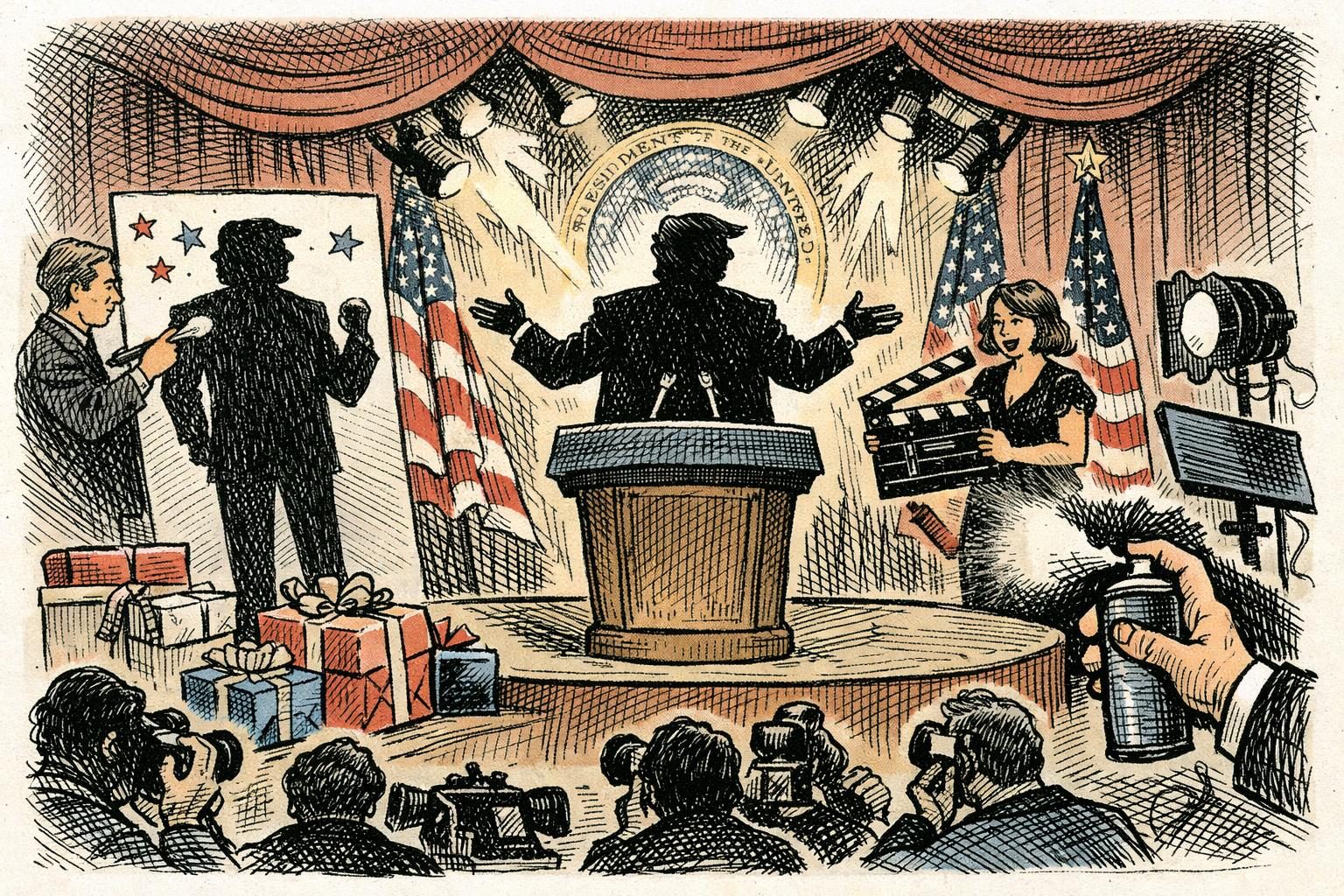
The Trump Accounts rollout was, on paper, a government announcement about a new savings tool for children. In practice, it looked a lot more like a campaign-style production number staged inside the machinery of the federal government. The White House used the Oval Office to host an opening-bell ceremony linked to the New York Stock Exchange and Nasdaq, turning what Treasury describes as a tax-advantaged account into a camera-ready spectacle. The program itself appears to be real, and Treasury says the account system and app are already live. But the administration did not stop at describing the policy. It wrapped the policy in the president’s image so tightly that the launch became inseparable from the man at the center of it. That is the familiar Trump formula: take an institutional action, drape it in branding, and present the branding as evidence that the institution is working.
That framing matters because the substance of the program is supposed to be boring, practical, and measurable. Children’s savings accounts are not supposed to depend on a dramatic reveal or a celebrity-grade rollout. They are supposed to be judged by whether families can enroll without confusion, whether the account structure is understandable, whether contributions are easy to track, and whether the promised benefits actually reach the people who are supposed to receive them. Treasury’s materials, at least, do focus on those basics. They describe accounts that can be opened at no cost, with contributions tracked through an app and a federal seed deposit for eligible children born within a defined window. Those details are the real policy content, and they are the part that will determine whether the program has any lasting value. The Oval Office theatrics did not add to that substance. They just tried to make the president look like the product that powered it.
That is where the criticism starts to become more than a complaint about bad taste. The White House keeps using presentation to blur the line between governance and promotion, and that has consequences even when no obvious legal line is crossed. A rollout built around pageantry invites the public to react to the spectacle before anyone has a chance to assess the mechanics. People see the ceremony, the branding, the staged symbolism, and the larger-than-life claims about a new era of prosperity. What they do not see, at least not immediately, is whether the system will be simple enough for parents to use, whether enrollment will be smooth, and whether the account will function the way the administration says it will. A polished launch can create momentum and attention, but it cannot guarantee execution. It can also distract from the harder work of implementation, which is where many government programs succeed or fail. If the launch is all glow and no grit, the public is left to wonder whether the policy is built to be useful or merely to be photographed.
The deeper issue is that this kind of presentation reinforces the sense that the White House sees public administration as a permanent branding opportunity. In that model, policy is not just something the government does; it is another chance to turn the presidency into a marketable identity. That may be effective politics in the narrow sense. Supporters can read it as strong messaging, disciplined repetition, and a government that knows how to sell its wins. Critics can read it as self-promotion dressed up as governance, with the state’s authority used to boost the image of one person. Both interpretations are available, and the truth may include pieces of each. What is harder to dispute is that the administration continues to treat the president’s personal brand as the visual center of policy itself. The question is not whether the accounts exist. The question is whether the policy can stand on its own once the ceremony ends and the cameras shut off. For now, that remains unresolved, which is why the launch leaves behind less clarity than it does a very recognizable Trump-world message: the government may be doing policy, but the branding still wants credit for the work.
Comments
Threaded replies, voting, and reports are live. New users still go through screening on their first approved comments.
Log in to comment
No comments yet. Be the first reasonably on-topic person here.