
White House keeps making policy rollouts feel like launch events, and that is the point
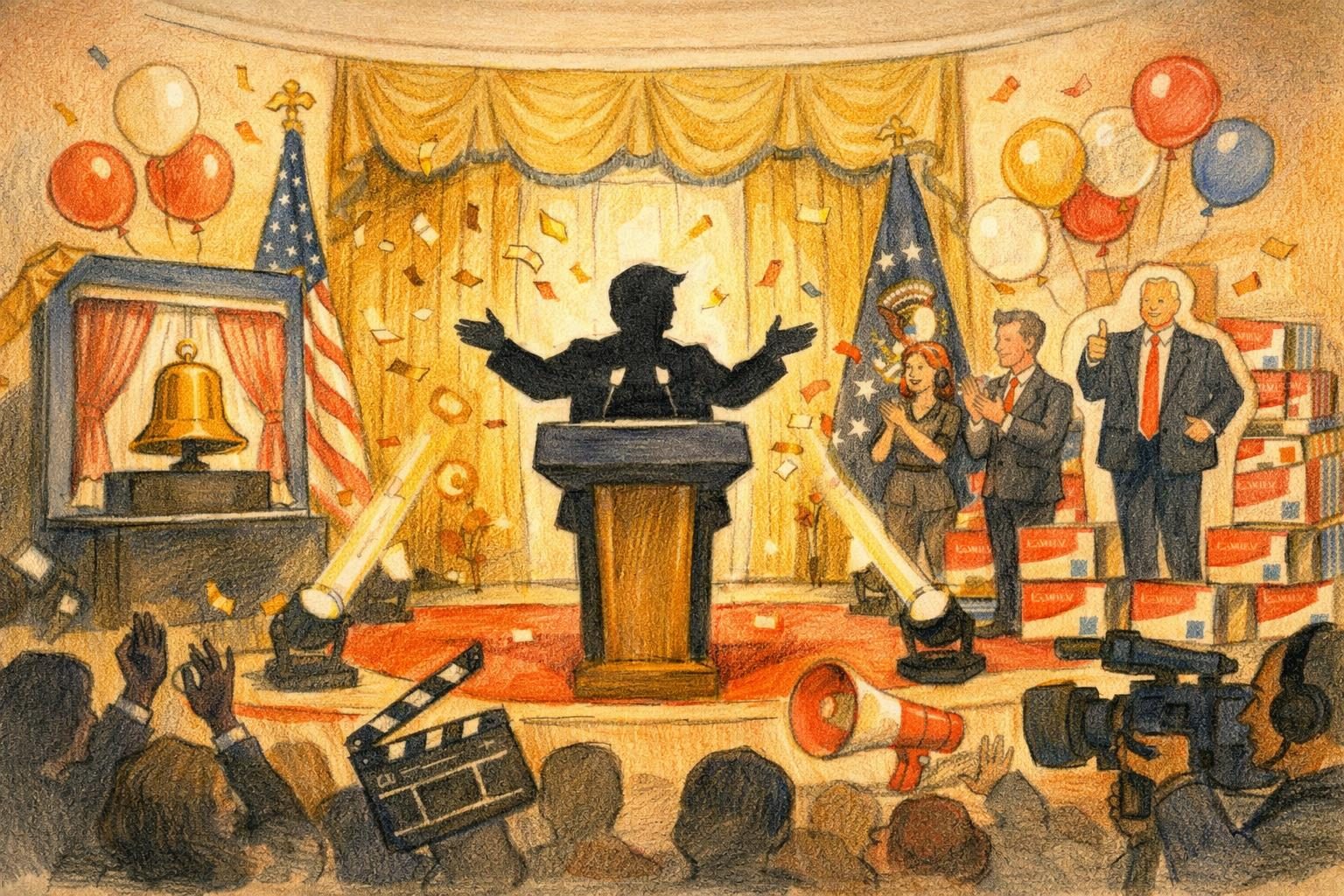
The White House is not hiding the fact that it wants policy rollouts to land like events. On July 6, 2026, President Donald Trump used the Oval Office to ring the opening bells of the New York Stock Exchange and Nasdaq as part of the launch of Trump Accounts, a tax-advantaged savings program created under the Working Families Tax Cuts Act. Treasury said the accounts are now available through a federal rollout aimed at building savings for children, with automatic seed money for eligible newborns. The administration’s own wording made the spectacle part of the substance: this was presented not just as a policy update, but as a milestone moment built for cameras, clips, and repetition. ([whitehouse.gov](https://www.whitehouse.gov/releases/2026/07/president-trump-rings-in-trump-accounts-with-historic-opening-bell-ceremony-from-the-oval-office/))
That does not make the policy fake, and it does not make the message unusual in the broadest sense. Every White House tries to shape how its actions are understood. But the Trump team is leaning hard into a style where the presentation is inseparable from the announcement itself. The president is centered. The visuals are tightly controlled. The language is built to travel fast. The effect is less like a dry agency briefing and more like a branded reveal, with the presidency acting as the headline identity for the program. That is an interpretation, not a docket item, but it is the clearest reading of the staging on July 6. ([whitehouse.gov](https://www.whitehouse.gov/releases/2026/07/president-trump-rings-in-trump-accounts-with-historic-opening-bell-ceremony-from-the-oval-office/))
A separate White House action from July 3 adds to that picture, but it should be kept distinct from the Trump Accounts launch. On that date, the president issued a proclamation titled for the 250th anniversary of the adoption of the Declaration of Independence. The proclamation marked July 4, 2026, as the observance day. It was commemorative, not a policy debut, yet it still fit the same communications style: heavy presidential imprint, tight framing, and a clear sense that the White House wanted the moment experienced as a managed national message rather than a loose collection of official paperwork. ([whitehouse.gov](https://www.whitehouse.gov/presidential-actions/2026/07/250th-anniversary-of-the-adoption-of-the-declaration-of-independence/))
Taken together, the July 3 proclamation and the July 6 Trump Accounts rollout show a White House that is comfortable packaging governance as presentation. The advantage is obvious: a complicated policy becomes easier to describe when it arrives with a strong image and a simple hook. The downside is just as obvious: once every announcement is treated like a launch, the line between governing and marketing gets thinner. In this case, the administration appears to think that line is worth crossing, or at least worth blurring, because the brand itself is part of the governing message. That is the story the White House is telling about itself in early July, and it is telling it loudly.
Comments
Threaded replies, voting, and reports are live. New users still go through screening on their first approved comments.
Log in to comment
No comments yet. Be the first reasonably on-topic person here.