
Trump’s aircraft tariff gambit adds more uncertainty, not less
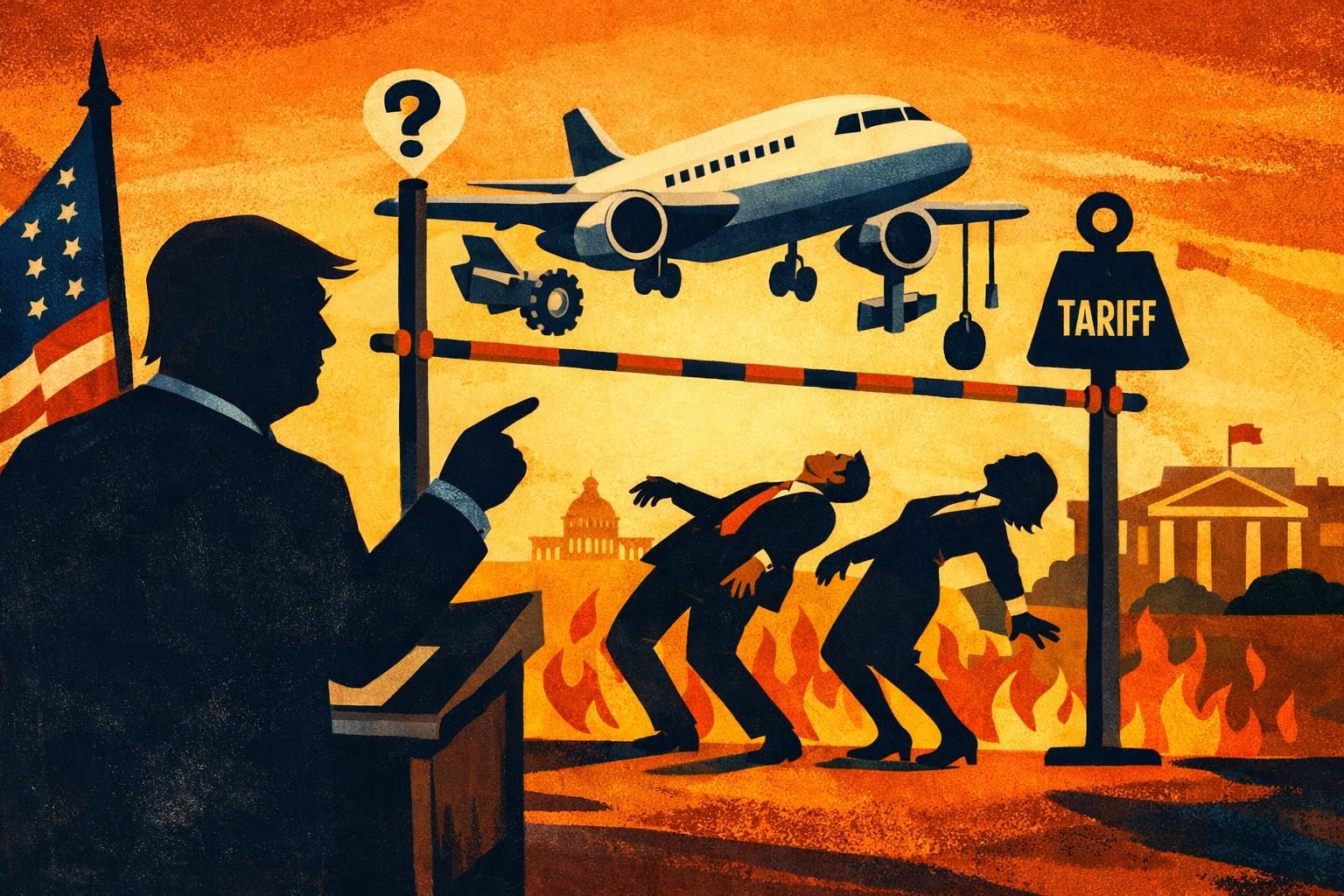
The White House’s new aircraft action is not a tariff order in the immediate sense, and that is precisely why it matters. Announced on July 9, the proclamation does not slap duties on commercial aircraft, jet engines, or aircraft and engine parts today. Instead, it directs the Commerce Department and the U.S. Trade Representative to begin negotiations with trading partners under Section 232 of the Trade Expansion Act, a national-security tool the administration has already leaned on repeatedly this year. The message is familiar: the imports are being treated as a strategic concern, and tariffs remain on the table if talks do not produce the outcome the White House wants. For the aerospace industry, that means the policy question has not been answered so much as postponed. Companies that build, repair, buy, lease, and finance aircraft now have to plan around a threat that may or may not become a tax, which is a particularly awkward way to run a capital-intensive industry. In practical terms, the proclamation creates another period of waiting in which the government holds the leverage and the private sector absorbs the uncertainty. That is not a small thing in a market where lead times are long, contracts are sticky, and parts often cross borders many times before an aircraft is complete. The White House’s own framing leaves the door open for further action if negotiations stall, so the industry is being asked to behave as though tariffs are possible without knowing when, how large, or under what conditions they might arrive. That kind of ambiguity can be almost as disruptive as an actual duty, because it forces firms to hedge decisions before policy has even fully landed.
What makes this aircraft move especially notable is that it fits neatly into a broader pattern the administration has been building all year. Section 232 has become a recurring instrument in Trump’s trade playbook, with the White House using the same basic sequence on aluminum, steel, copper, and pharmaceuticals: declare a national-security concern, open a negotiation track, and preserve the option of tariffs if the other side does not move quickly enough. On paper, that structure gives the administration flexibility. It can claim to be negotiating rather than simply imposing new costs, while still retaining a coercive backstop. In practice, it turns the trade system into a rolling pressure campaign, one sector after another, with business leaders never quite sure whether a proclamation is the opening bid or the beginning of a final bill. The aircraft industry now finds itself inside that same machine. The administration can argue that aviation matters to military logistics, industrial capacity, and supply-chain resilience, and none of that is implausible. But once the tariff lever is being pulled again and again across unrelated sectors, the national-security rationale starts to sound less like a carefully bounded legal theory and more like a standing invitation to escalate first and negotiate later. That may be politically effective for a president who likes to present himself as decisive, but it is less useful for companies that need predictability to finance inventory, allocate production, and plan maintenance cycles. The result is a trade policy that creates leverage for Washington while exporting risk to the rest of the economy.
The uncertainty is especially punishing in aerospace because the industry is both global and highly specialized. Aircraft are not simple consumer goods that can be rerouted quickly when policy changes. They are built through long supplier chains, with components sourced across multiple countries and production decisions locked in years ahead of delivery. A shift in tariff policy can ripple through procurement contracts, pricing models, warranty obligations, and repair operations almost immediately, even if the tariff itself has not yet taken effect. Airlines and lessors, meanwhile, have to think about fleet planning and financing costs. Manufacturers have to worry about input prices and whether existing contracts need to be rewritten. Maintenance shops and parts distributors have to guess whether a new round of trade friction will change the economics of keeping aircraft in service. That is why the difference between an announced threat and an imposed duty is not academic. It determines whether businesses can model their costs with any confidence or whether they have to reserve capital for a policy shock that may still be weeks or months away. The White House may present the move as a defense of domestic industrial strength, but the first-order effect is to make the operating environment harder to forecast. For a sector that depends on precision, certification, and long-term investment, this kind of policy noise is expensive.
The politics of the move are straightforward enough, even if the economics are not. Supporters of the administration will say the threat itself is the tool, that tariffs are being used to bring trading partners to the table and to extract concessions that might otherwise be impossible to obtain. They will argue that if foreign suppliers or governments know the White House is willing to escalate, they will have more reason to negotiate seriously. Critics will respond that perpetual tariff brinkmanship is not the same thing as a stable industrial policy, and that repeated uncertainty can erode the very supply chains the administration says it wants to strengthen. Both claims can be true at once, at least in part. The administration is clearly trying to wield leverage, and leverage can matter in trade talks. But leverage that never resolves into a durable rule still exacts a cost, because every major actor in the sector has to treat new announcements as potential shock events. That is why this proclamation is best understood not as a clean policy outcome but as another stage in a continuing tariff limbo. The government has not yet imposed the new duties, but it has made clear that the threat remains active, and that may be the point. For now, the aircraft industry gets neither certainty nor relief, only another round of strategic waiting while Washington decides whether the opening bid becomes the final answer.
Comments
Threaded replies, voting, and reports are live. New users still go through screening on their first approved comments.
Log in to comment
No comments yet. Be the first reasonably on-topic person here.