
DOJ’s Florida Threat Case Lands While Trump’s Team Keeps Pushing a Broad Anti-Left Frame
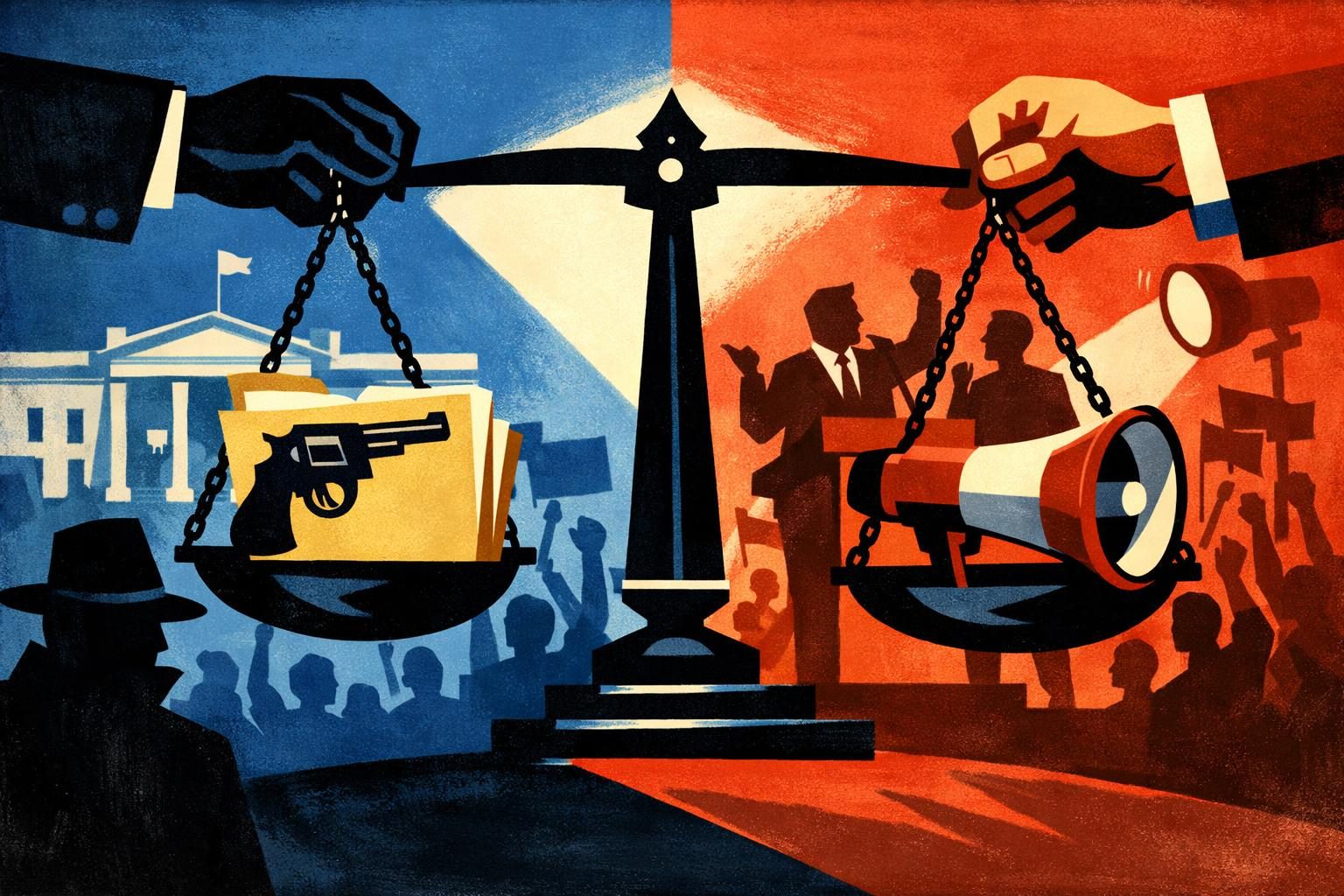
Federal prosecutors in Florida say they have charged William L. Upham with threatening to kill the president, turning what might otherwise have been another grim online menace into a case with immediate legal consequences. According to the Justice Department filing, Upham was arrested and charged by criminal complaint after investigators reviewed material they say included videos with explicit threats and statements about “declare war” and killing President Trump at a time of God’s choosing. That is the hard, concrete part of the story: a specific defendant, a specific allegation, and a criminal process that now has to run on evidence, procedure, and whatever a judge makes of the government’s proof. A complaint is not a conviction, and the accusation still has to survive scrutiny, but it is at least a defined legal matter rather than a cloud of political insinuation. The facts are narrow, and that narrowness matters because it is the only part of this episode that has been formally tested enough to belong in the record. If the government believes the threat was real, it has the burden to show that in court, not merely in a press release. That distinction should be obvious, but in this news cycle it is also the first thing getting blurred.
The blur comes from the White House’s decision to keep pressing a much larger message on the same day, one that frames the administration’s fight not around one charged suspect but around what it calls “Radical Left terrorism.” That is a political line, not a judicial finding, and it does not automatically grow out of the Florida case no matter how useful the timing may be. The administration has every incentive to spotlight a threat case while it tells supporters that a broad ideological enemy is at work, because the visual and emotional logic is easy to sell: danger, enemies, urgency, action. But the ease of the message is exactly what makes it slippery. The complaint against Upham does not establish a nationwide left-wing conspiracy, does not prove that opposition politics are equivalent to violence, and does not convert every hostile slogan or protest chant into a criminal enterprise. Still, the White House appears eager to fold the criminal case into its broader campaign narrative, letting one concrete allegation stand in for a much more expansive theory of political decay. That is where the spin starts to outrun the facts. It is one thing to say the government is prosecuting a threatening individual. It is another to imply that the prosecution confirms a sweeping ideological war that has not been shown in anything like the same way.
That overlap is politically convenient, and not just because it creates a dramatic news hook. A real threat case gives the administration a vivid example to cite whenever it wants to argue that it is under siege and that harsh language is justified. It also allows the White House to cast a wider net over dissent by keeping “left” and “terrorism” in the same sentence often enough that the distinction begins to dissolve in public conversation. The problem is not merely semantic. When officials blur the line between a criminal complaint and a political narrative, they make it harder for ordinary people to tell what is actually being alleged, what has been proven, and what is just messaging. That matters because the words “terrorism,” “violence,” and “threat” carry different legal and civic meanings, and those meanings are supposed to be preserved precisely so the government cannot redefine opposition as criminality on the fly. If there is a genuine threat, prosecutors should pursue it with the seriousness it deserves. If there is a broader network of coordinated political violence, the administration needs to produce evidence that stands on its own. Jumping from one to the other may be effective television, but it is not a substitute for proof. It also creates an atmosphere in which every hardline statement from the White House looks less like a response to danger and more like a pretext for escalating partisan warfare.
The procedural reality is the part that keeps this story grounded. A complaint is the opening move, not the finish line, and it invites defense counsel to challenge the government’s evidence, the interpretation of the statements, and the circumstances around the alleged threat. If the case is solid, it will advance through the ordinary channels of federal criminal process. If it is not, it can fall apart in the usual ways, which is how the system is supposed to work even when the subject is politically charged. The White House’s rhetoric, by contrast, is a choice, not a legal conclusion, and there is no court order that transforms it into fact just because it comes packaged alongside an arrest. That difference should not be hard to hold in mind, but the administration seems determined to test how much public confusion it can generate by keeping the two in close proximity. The result is a muddier public record, where an actual allegation of violence risks being absorbed into a broader propaganda frame before the legal facts have had a chance to breathe. In that sense, the real damage may not be to one defendant or one slogan but to the public’s ability to separate crime from politics. The government can and should prosecute threats. It should also resist the temptation to treat every threat prosecution as a permission slip for sweeping ideological theater. When those lines collapse, public safety becomes part of the branding exercise, and the law starts looking like one more prop in a partisan campaign.
Comments
Threaded replies, voting, and reports are live. New users still go through screening on their first approved comments.
Log in to comment
No comments yet. Be the first reasonably on-topic person here.