
Trump’s AI Push Is Already Tangled in Retaliation Claims
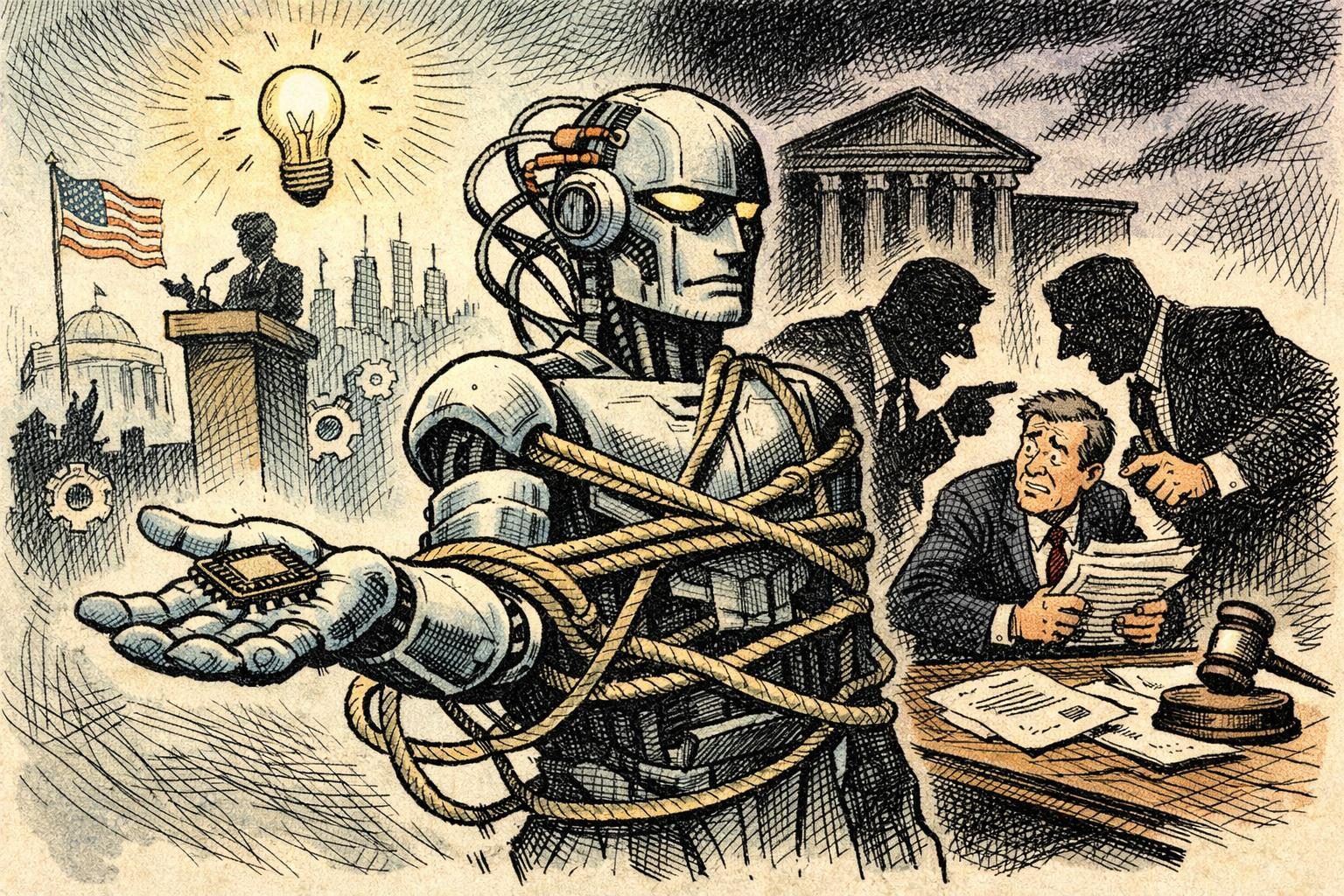
Trump’s latest push on artificial intelligence is meant to sound like a clean, forward-leaning strategy: speed up adoption, buy better tools for the federal government, and use those tools to strengthen cybersecurity and national security. On June 2, the White House rolled out an executive order and fact sheet framing AI as both an economic engine and a defense asset, promising faster deployment across government and industry while emphasizing “responsible” use. A few days later, the administration followed with a national-security memorandum designed to push advanced AI systems deeper into the hands of warfighters and intelligence personnel. In official language, the pitch is all opportunity and no downside, the kind of messaging that treats AI as a public good that can be scaled without much friction. But the administration’s own sales job is already colliding with a dispute that makes the whole effort look less like disciplined modernization and more like a test of power. The contradiction is not subtle: the White House says it wants innovation, but it is also being accused of using pressure when a company declined to bend to Pentagon demands.
That fight centers on Anthropic, one of the major firms in the AI race, and on claims that the government retaliated after the company resisted requests tied to military uses of its chatbot. The White House has denied unlawful retaliation, and that denial matters in the narrow legal sense. Still, a denial does not erase the political damage, especially when the government is simultaneously asking private firms to help reshape defense and cyber capacity. The appearance problem is obvious enough that it does not require a court ruling to matter. If a major AI company says it was punished for drawing a boundary, the administration’s claim that it can encourage broad collaboration while respecting limits starts to sound shaky. The message becomes muddled in the simplest possible way: companies are being asked to innovate for the state, but they may also be learning that saying no can carry a cost. That is not exactly the confidence-inspiring foundation a supposedly pro-business AI agenda wants.
The irony is that Trump’s team is trying to sell an image of competence, speed, and technological seriousness at the exact moment the story threatens to undercut all three. The White House wants to present itself as the kind of government that can move quickly enough to keep pace with private-sector AI development and strong enough to use those tools in defense settings without hesitation. Instead, the dispute makes the administration look like it is reaching for the upside of private innovation while keeping old-fashioned Washington leverage close at hand. That combination is especially awkward in AI, where public trust is already fragile and the line between partnership and coercion is easy to blur. Civil-liberties advocates are likely to read the episode as a warning sign about pressure tactics. Industry executives are likely to see unstable rules and a political environment where compliance matters more than technical merit. Federal buyers, for their part, may begin to wonder whether the government is looking for the best tools or just the most obedient vendors. None of those reactions help a White House that wants to frame itself as the steward of a new technological era.
The deeper problem is that even if the retaliation claim never becomes a formal finding, it still attaches a suspicion tax to everything that follows. Every procurement, every partnership, every directive tied to AI and national security can now be viewed through the lens of whether the government is asking for cooperation or demanding loyalty. That is a costly place to be for an administration that needs companies to trust that its rules are real, stable, and not selectively enforced. If the White House wants the federal government to become a faster AI customer and a more aggressive national-security actor, it also needs credibility to travel with that ambition. Instead, the Anthropic dispute suggests a dynamic in which cooperation may come with implied threats, and that is a bad look whether you care about innovation, defense readiness, or simple governance. The administration can still argue that the United States needs to move faster than its rivals and that AI should be integrated into national-security planning. But if the public takeaway is that partnership with Washington is really a loyalty test, then the result is likely to be more caution, more legal review, and fewer companies willing to volunteer for the next round of government enthusiasm.
Comments
Threaded replies, voting, and reports are live. New users still go through screening on their first approved comments.
Log in to comment
No comments yet. Be the first reasonably on-topic person here.