
Judge checks the immigration freeze that left thousands in limbo
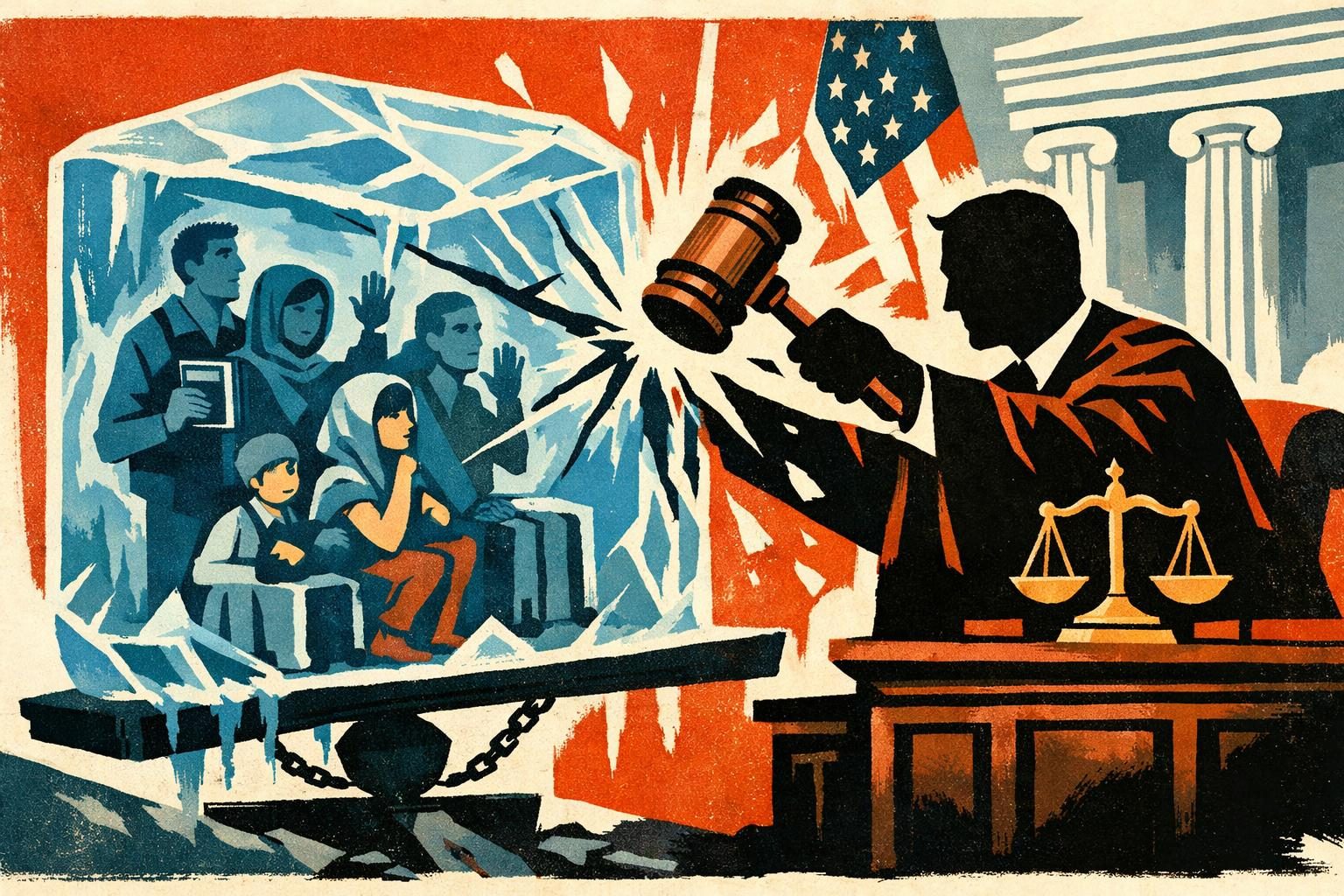
A federal judge on Tuesday struck down the administration’s sweeping decision to freeze immigration processing for people from 39 countries, saying the government had overreached and failed to follow the law. The halted categories included asylum decisions, work permits, and green card applications, leaving thousands of people in a kind of legal suspension where they could not move forward but also were not told when, or whether, the process would resume. The court’s ruling said the policy was arbitrary and capricious, the kind of administrative-law phrase that sounds tame until you translate it into plain English: the government cannot simply slam the brakes on major parts of the immigration system and expect that to count as legitimate policy. The freeze had been imposed after the killings of two National Guard members in Washington, and the administration pointed to that attack as part of its justification. But the decision suggests that even a deeply emotional national-security moment does not give the executive branch a blank check to improvise around the law.
The case matters because it reaches beyond one temporary pause and into a broader pattern that has defined the administration’s immigration strategy. Officials have repeatedly leaned on border fear, emergency framing, and public safety language to defend aggressive restrictions, but courts keep asking a more basic question: what statute authorizes this, and where is the reasoned explanation? That question has become a recurring problem for a White House that often presents immigration as an area where speed and toughness should be enough. Judges, however, keep treating it like what it is: a legal system with rules, procedures, and limits that do not disappear just because the politics are hot. The ruling also exposes a familiar tension in the tough-on-immigration posture. The administration wants deference when it acts aggressively, but it does not want the scrutiny that comes with having to explain why a broad freeze is lawful, necessary, and proportionate. When those explanations are thin, courts have been increasingly willing to say so.
The human consequences of the policy were immediate, even if they were easy for officials to talk around in broad national-security terms. A processing freeze does not just affect people who are waiting on paperwork; it affects families trying to plan their lives, employers trying to keep jobs filled, schools trying to understand who will be able to stay, and local governments trying to serve communities that suddenly have no timeline to rely on. Applicants were left stranded in limbo, with important decisions paused and their futures tied to an administrative standoff they had no power to influence. That uncertainty is not a side effect; it is the policy. Advocates have argued for months that the freeze was both overbroad and discriminatory, especially because it treated entire groups of applicants as if they were interchangeable risks rather than individuals with separate cases and statutory rights. The court did not have to embrace every argument from critics to agree that the government’s approach could not stand. It was enough that the policy appeared to ignore governing law and that the process used to impose it did not pass basic administrative scrutiny.
The larger political lesson is less flattering than the administration would like. Sweeping immigration decrees often sound forceful in the moment, especially when they are packaged as responses to violence, disorder, or public fear. But forcefulness is not a substitute for legal durability, and that is why so many of these moves keep colliding with the courts. The ruling forces the government to reopen the immigration pipeline it had closed and to do the unglamorous work of actually justifying its actions under the statute books rather than under the pressure of the news cycle. It also adds another entry to the growing list of legal reversals that have made the administration’s immigration program look less like a coherent system than a series of high-stakes improvisations. That may be politically useful in the short term, since disruption can play well with voters who want to see action. But it is a dangerous way to govern, because every time the courts say the same thing in a slightly different form, the message gets clearer: the law is not impressed by panic, and administration by slogan is still not administration at all.
Comments
Threaded replies, voting, and reports are live. New users still go through screening on their first approved comments.
Log in to comment
No comments yet. Be the first reasonably on-topic person here.