
Trump’s AI Push Keeps Moving Fast Enough to Create Its Own Accountability Problem
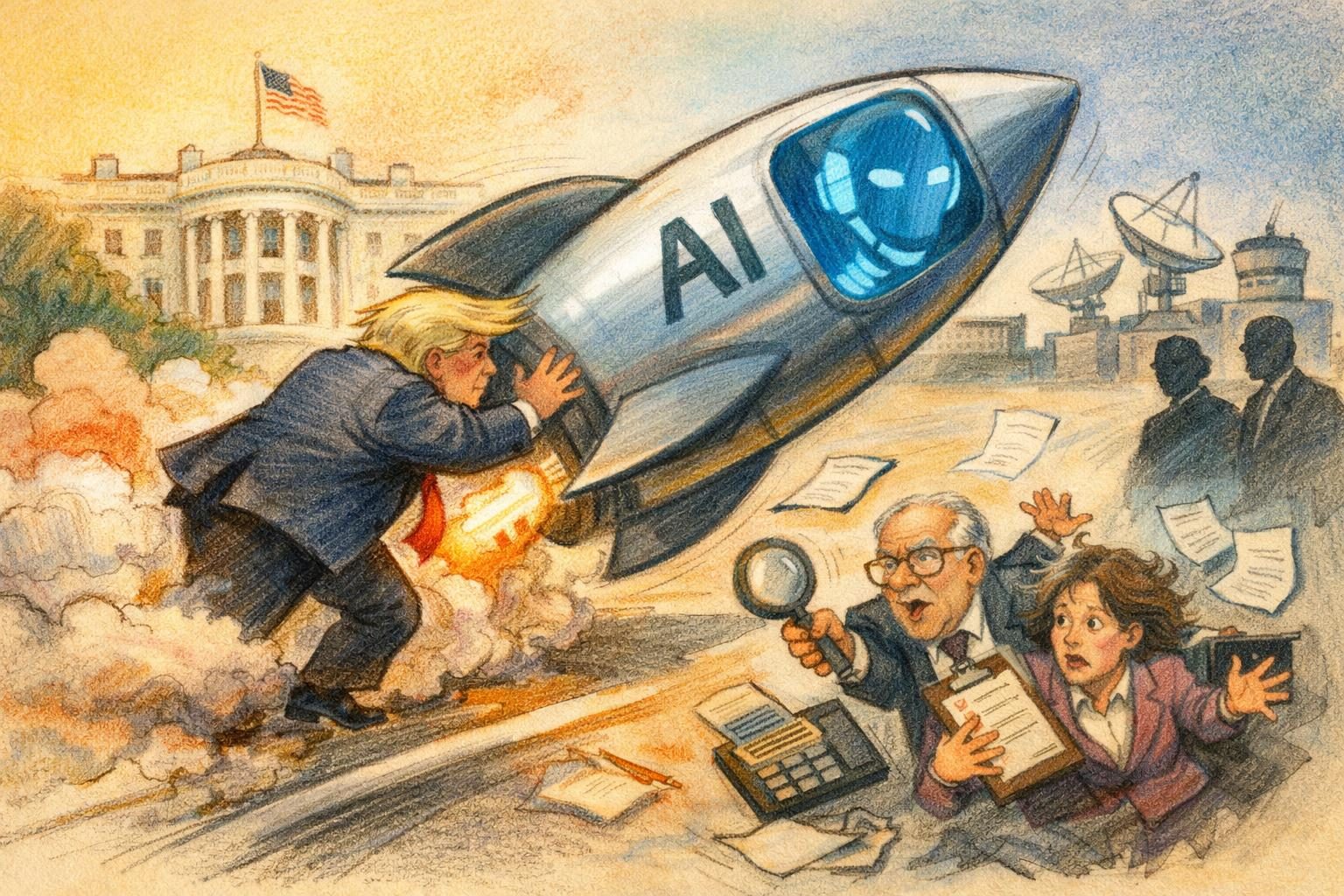
Trump’s latest artificial intelligence drive is moving on two tracks, and both are designed to make the federal government use AI faster than it has time to fully absorb the consequences. One directive, issued June 2, focuses on innovation and cybersecurity. Another, released June 5, pushes frontier models deeper into the national security world, where the stakes are higher and the paper trail is often thinner. The White House says the point is to accelerate adoption, strengthen cyber defenses, protect critical infrastructure, and ensure that national security users can work with the best commercial and open-source systems available. It also says the government will not use AI to censor speech, embed ideological bias, or carry out unlawful surveillance. That is the public promise. The less flattering interpretation is that the administration is trying to normalize a much larger federal appetite for AI before anyone outside the system has a clear way to see how those systems are tested, audited, or unwound when they inevitably change.
This is not mainly a story about one flawed chatbot or a single embarrassing output. It is about the governing style behind the rollout, which treats speed as its own kind of proof. The national security memorandum directs agencies across the defense and intelligence enterprise to move faster on AI adoption, to work more closely with private vendors, and to build the high-security computing infrastructure needed to support future systems at scale. The accompanying fact sheet says the administration wants to widen access to the most advanced models and expand a reserve of outside experts who can help agencies use them. That can sound reasonable, even prudent, if the goal is to keep the United States ahead in a strategically important technology race. But it also means the federal government is tying itself more tightly to systems that are often difficult to inspect, difficult to explain, and difficult to roll back once commanders and agency leaders start using them as ordinary operational tools. The White House has not conceded that this creates a danger. The concern follows from the structure of the policy itself, and from the sheer scope of the access it is trying to create.
The political logic is easy enough to see. Trump and his allies want to frame the AI agenda as a no-nonsense modernization project, one that rejects what they portray as ideological capture in the technology sector while also promising a more muscular federal posture on cybersecurity and national defense. That message gives them something they can sell to business leaders, to national security hawks, and to voters who think Washington moves too slowly. But the administration is also asking the public to accept two ideas at once: that AI adoption must accelerate immediately, and that the resulting systems will somehow remain under firm human control without a mature oversight regime to match. Those claims do not sit comfortably together. The White House says commanders and agency heads remain responsible under the constitutional chain of command, which is the kind of sentence that sounds reassuring in a press release and much less so once a serious procurement failure, misuse incident, or attribution dispute forces someone to explain who actually signed off on what. The problem is not that the administration is openly discarding accountability. The problem is that it keeps treating “responsible use” like a slogan rather than an operational discipline, as if the phrase itself could substitute for testing protocols, audit rights, incident reporting, and clear rollback procedures.
That gap between aspiration and oversight is where the real political risk lives. If federal agencies begin relying on frontier AI models for sensitive national security work, then questions about validation, error rates, vendor lock-in, and system transparency will stop being abstract policy concerns and start becoming operational headaches. Who verifies the model’s behavior under stress? Who documents failures? Who decides when a system is too opaque to use in a classified environment? Who has the authority to pull it back if it behaves unexpectedly after deployment? The administration’s answer, at least so far, is to push forward and trust that the existing chain of command will catch up. Maybe that works in the short term. Maybe the combination of high-security computing, private-sector partnerships, and expanded expert support really does improve readiness and resilience. But the more the government embeds advanced models into daily national security operations, the more it risks creating a dependency that few people fully understand and fewer still can fully supervise. That is not yet a scandal, and it may never become one in the dramatic sense. It is, however, an increasingly familiar pattern in Washington: build first, explain later, and hope the first real crisis arrives after the system is mature enough to survive the scrutiny. On AI, that is a dangerous way to define maturity. The administration appears convinced that it can move fast enough to secure a strategic advantage without pausing long enough to build an accountability regime that can keep pace. The public may eventually be asked to treat that as competence. The harder question is whether it will instead turn out to be the beginning of a problem the government no longer knows how to audit.
Comments
Threaded replies, voting, and reports are live. New users still go through screening on their first approved comments.
Log in to comment
No comments yet. Be the first reasonably on-topic person here.