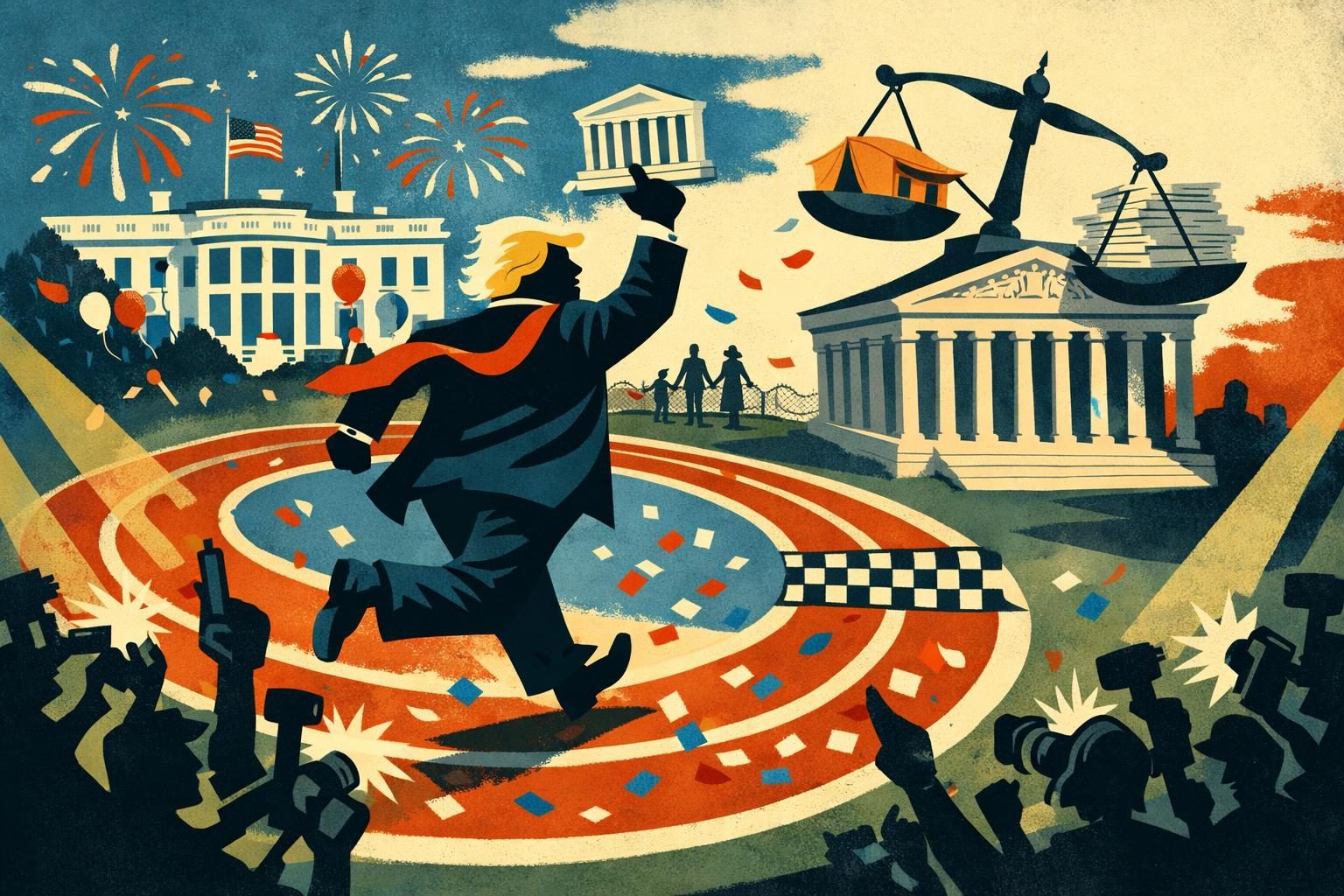
Trump claims a Supreme Court win on TPS, but the political fight is not over
On June 26, the White House treated a Supreme Court ruling on Temporary Protected Status as the kind of clean, emphatic political win that can be replayed across speeches, social feeds, and fundraising copy for days. The administration said the Court had upheld its authority to terminate TPS for Haitian migrants, and it quickly cast the decision as confirmation that its immigration program rests on solid constitutional ground. In the White House version of events, the ruling was not just a legal outcome but a vindication of the broader Trump approach to migration: act aggressively, challenge the limits, and insist that the courts are finally catching up to what the president says the law should have meant all along. That framing fits neatly into a larger pattern the administration has leaned on since returning to power, one in which each court fight is presented as a test of strength rather than a check on it. The trouble is that a victory lap does not change the fact that TPS remains one of the most politically charged and morally fraught corners of immigration policy. Even when the White House gets the result it wants, the underlying case is still about the government’s power to remove legal protections from people whose home countries remain dangerously unstable.
That is why the celebration around the ruling says as much about the administration’s political style as it does about the law itself. Trump and his aides have long favored the same formula across immigration battles: push the most aggressive version of a policy, force opponents to go to court, and then portray any surviving piece of that policy as proof that the original vision was correct all along. The strategy is useful because it turns legal conflict into political theater. It allows the White House to tell supporters that every injunction, lawsuit, or delay is evidence that the system is rigged against them, and that every partial success is a breakthrough against entrenched resistance. But that same strategy also means the administration often governs in a state of permanent litigation, relying on sweeping assertions of executive authority that invite judicial scrutiny in the first place. The TPS fight fits that pattern almost too neatly. It is not simply that the White House won a case; it is that the case itself emerged from an effort to press the bounds of presidential control over immigration benefits, even in a setting where the humanitarian consequences are impossible to ignore. For the administration, the legal fight becomes a message discipline exercise. For everyone else, it remains a real policy dispute with real people in the middle of it.
The humanitarian stakes are what keep this from being just another technical immigration ruling. TPS exists because the United States has long recognized that some foreign nationals cannot safely return home when natural disasters, armed conflict, or other extraordinary conditions make removal untenable. Haiti has been at the center of that logic for years, and the status has served as a lifeline for migrants who built lives, jobs, and families in the United States under repeated assurances that protection could continue while conditions remained severe. Ending that status is not a symbolic act. It carries the possibility of uprooting communities, separating families, and forcing people to weigh a return to dangerous circumstances against an increasingly uncertain legal future. The White House can describe the Court’s decision as a straightforward institutional endorsement, but the political reality is more complicated. A ruling that allows termination does not resolve the question of what happens to people who have depended on TPS for years or what the broader social cost will be if the administration uses the decision as a template for more aggressive removals. That uncertainty is part of why TPS fights generate such fierce reactions. They are not abstract arguments about administrative power; they are arguments about whether the government should be able to strip away protection from people who have organized their lives around it. The administration’s eagerness to turn that into a triumphal talking point may energize its base, but it also risks underscoring just how severe the policy is in practice.
The White House’s response also reflects a broader habit of converting courtroom wins into campaign-grade spectacle, regardless of how narrow or qualified those wins may be. In an environment where every legal development is immediately filtered through partisan messaging, the administration has a strong incentive to present the ruling as larger than it is and more final than it may actually feel to those affected. That is especially true on immigration, where Trump has built much of his political identity around the promise to restore control, restore order, and prove that the government can still act with force. Yet the same hard-edged posture that gives the administration its rhetorical edge also keeps the fight alive. Critics are likely to continue pressing on the legality, morality, and human consequences of ending TPS protections. Advocates are likely to keep arguing that the decision exposes the limits of a governing style that treats vulnerable people as props in a political contest. And the courts are not the only arena that matters. Congress, public opinion, and the practical realities of implementation all remain part of the story, even if the White House would prefer to tell it as a simple tale of final vindication. So yes, the administration can claim a Supreme Court win and use it to reassure supporters that its immigration agenda is on firm ground. But the deeper lesson is less triumphant: on TPS, as on so many other immigration battles, a legal victory does not end the political fight, and it certainly does not erase the human cost of making that fight a centerpiece of presidential theater.
Comments
Threaded replies, voting, and reports are live. New users still go through screening on their first approved comments.
Log in to comment
No comments yet. Be the first reasonably on-topic person here.