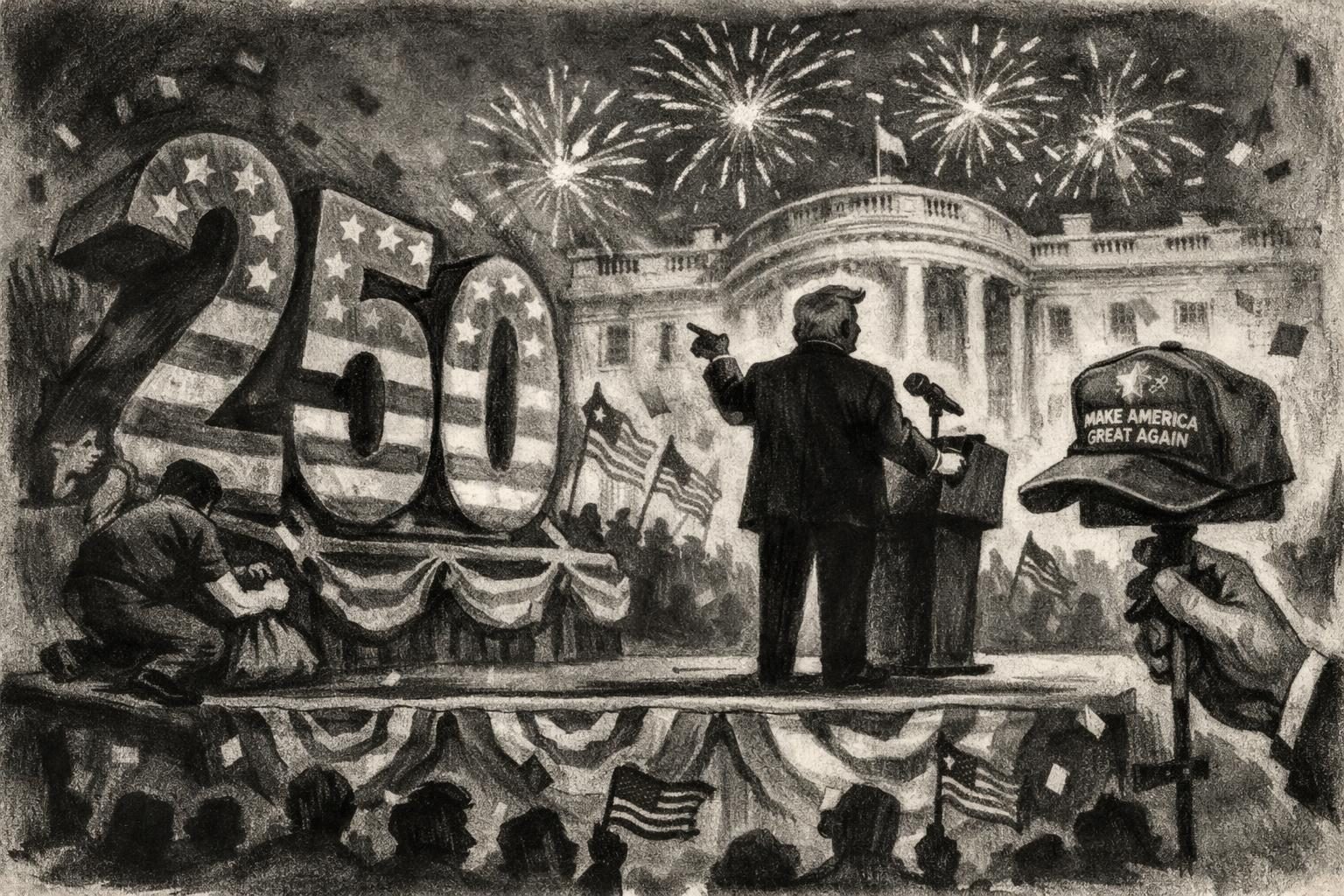
Trump Keeps Turning the 250th Anniversary Into a Permanent Political Stunt
The Trump White House spent the July 2 window doing what it has increasingly made a habit of doing with the country’s 250th anniversary: turning a civic milestone into a piece of branded political theater. The administration’s Freedom 250 page and related White House materials present the coming celebration as a sweeping national revival, with federal agencies, planning structures, and even foreign participation folded into a sprawling calendar of events. On paper, that is not an inherently strange thing for any administration to do. Presidents routinely help mark major anniversaries, and a semiquincentennial is the kind of date that naturally invites ceremony, historical reflection, and a fair amount of patriotic pageantry. But the way this White House is framing the project gives it a different feel. The language is inflated, the imagery is heavy on restoration and national rebirth, and the whole thing sits comfortably inside Trump’s familiar style of overselling everything as if it were a triumphant final act. That may work just fine for a rally backdrop or a fundraising appeal. It works less well when the task is supposed to be public commemoration rather than self-celebration.
What stands out is not simply that the White House wants to promote America 250, but that it keeps wrapping the anniversary in the same kind of all-caps grandeur and loyalty-coded symbolism that has defined Trump’s political brand for years. The official pitch is that this will be a once-in-a-generation patriotic moment, one that restores pride and unifies the country around a shared story of national greatness. But the administration’s presentation keeps making that claim harder to believe. Instead of looking like an event designed to belong to the public at large, the celebration risks feeling like an extension of Trump’s own persona, with the president cast less as a steward of history than as its supposed author. That is a subtle difference, but it matters. National anniversaries can handle ceremony, even theatricality. What they do not handle nearly as well is the sense that attendance comes with an unspoken requirement to admire the politician in charge. Once a civic milestone starts to look like a campaign-adjacent loyalty pageant, it stops feeling inclusive and starts feeling like a test of allegiance. That is the kind of framing problem that can sour a project long before the first official event even begins.
The administration’s defenders would likely argue that this is all just high-energy patriotic branding, and that the country should be glad to see the White House investing in a major anniversary with ambition rather than caution. There is some logic to that view. A 250th anniversary should not be treated as an afterthought, and a president of any party would want the federal government to help make it visible, accessible, and memorable. The problem is that Trump rarely stops at visible, accessible, and memorable. He tends to push everything toward maximal spectacle, then act surprised when the spectacle becomes the story. That pattern is especially risky here because the anniversary belongs to the whole country, not just to the president or the movement around him. The more the administration uses branding language, overripe symbolism, and patriotic performance to define the event, the more it invites skepticism from people who may be perfectly willing to celebrate the nation but not willing to treat Trump as the main exhibit. Historians, civic organizers, and even ordinary voters who are not looking for a fight can see the basic problem: the White House is not just marking the date, it is trying to own the mood around it. That is a much harder task than simply planning a celebration.
There is also a built-in vulnerability in Trump’s tendency to promise more than any event can possibly deliver. If the White House describes America 250 as the grandest celebration in history, then anything less than extraordinary will look like failure by comparison. That is one of the oldest Trump dynamics in politics: overpromise first, inflate expectations, then blame someone else when the applause is merely decent. The administration’s own messaging makes that risk worse by leaning so hard into restorationist language and national mythmaking that it leaves very little room for an ordinary, grounded celebration to be seen as sufficient. If the logistics are solid, the event might still go smoothly. But smooth logistics are not the same thing as successful politics. A carefully planned anniversary can still become a public relations liability if it feels like it is trying too hard to turn citizens into an audience for presidential self-regard. The White House can insist that it is promoting unity and national pride, but the more it saturates the project with Trump’s brand of excess, the more it teaches people to see the whole undertaking as partisan scenery dressed up as civic purpose. That is exactly the sort of overreach that produces backlash even when the underlying idea is defensible.
None of this amounts to a crisis on its own. The country is not facing a constitutional emergency because the White House is being heavy-handed about its semiquincentennial marketing. But it is still a meaningful political mistake, and one that seems almost designed to irritate the people most likely to appreciate a serious national commemoration. The administration keeps saying that it wants the 250th anniversary to restore confidence in America and project strength abroad, which is why the event is being folded into a wider presidential message about pride, resilience, and national renewal. Yet the more Trump frames the celebration as something that reflects his own instincts and his own leadership style, the more he undercuts the claim that it is meant to belong to everyone. There is a real difference between honoring the country and turning the country’s birthday into a mirror for the president. The White House appears determined to blur that line anyway. And once that happens, the anniversary stops being a shared civic moment and becomes another reminder of Trump’s favorite impulse: making every room, every ceremony, and every historical marker revolve around him. That may be useful for politics in the narrowest sense. It is a much worse way to treat a national milestone that was supposed to rise above politics in the first place.
Comments
Threaded replies, voting, and reports are live. New users still go through screening on their first approved comments.
Log in to comment
No comments yet. Be the first reasonably on-topic person here.