Story · August 2, 2026

Trump heads back to the Supreme Court again, and the calendar itself is starting to look like a defeat

Court triage Confidence 4/5
★★★☆☆Fuckup rating 3/5
Major mess Ranked from 1 to 5 stars based on the scale of the screwup and fallout.
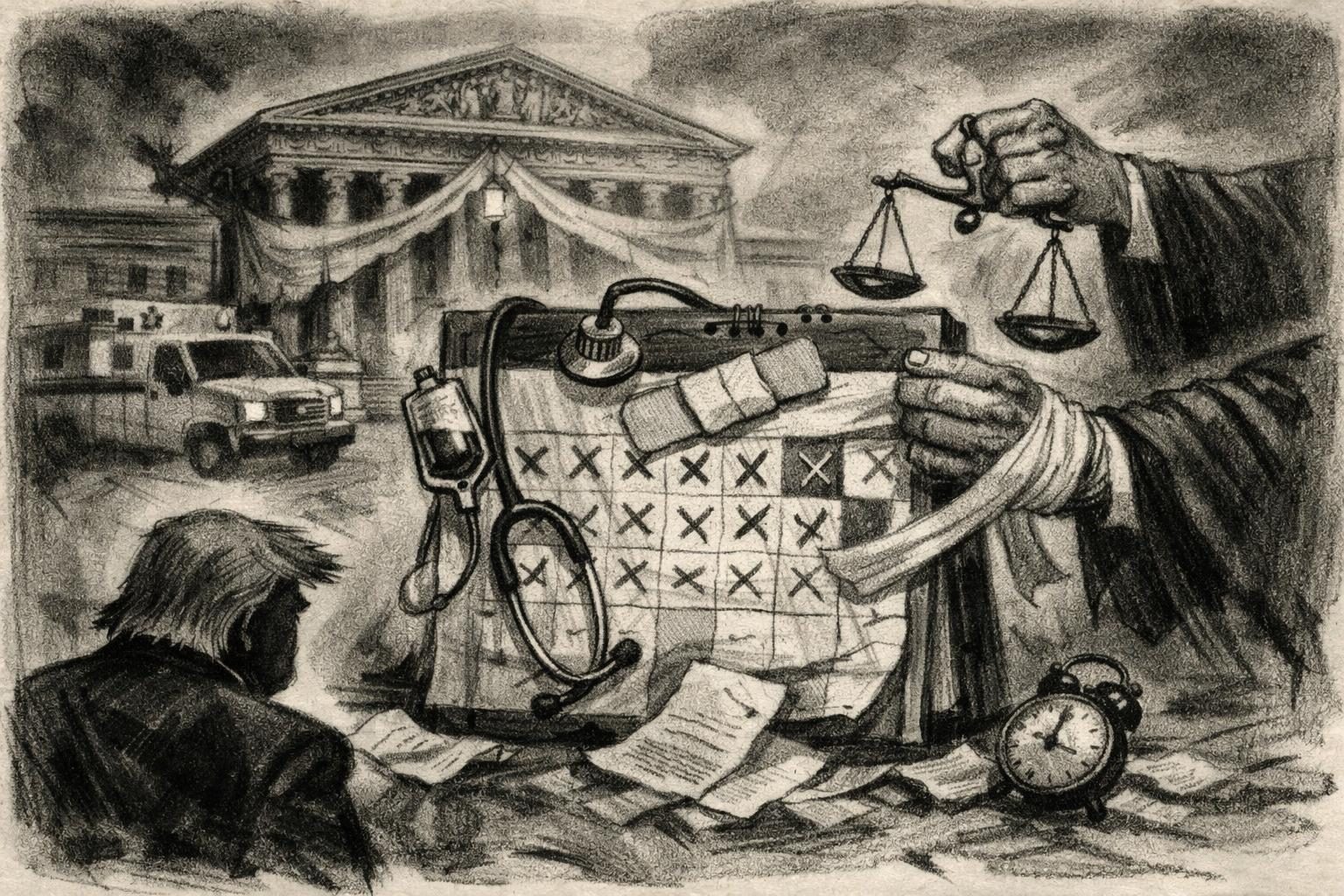
Trump heads back to the Supreme Court again, and the calendar itself is starting to look like a defeat reader image
Reader image selected by automatic review and community voting.

The Trump administration is back at the Supreme Court with yet another emergency request, this time asking the justices to step in quickly and halt lower-court proceedings before they run their full course. The filing, docketed July 27, 2026, is tied to a case involving California, and the response deadline is set for 4 p.m. Eastern on August 3. On its face, that makes it just one more item on a growing emergency docket that has become a regular feature of the Court’s work. But the larger significance is harder to miss. The administration is increasingly leaning on judicial triage to keep parts of its agenda alive, which suggests not only a preference for speed but a dependence on speed because ordinary litigation is not producing the outcome the White House wants.

That matters because emergency applications are supposed to be exceptional, not a governing strategy. In a system with separated powers, some amount of courtroom friction is inevitable, and even a burst of emergency filings can sometimes be explained as the normal messiness of a large administration trying to move quickly through a dense legal system. But when the requests start piling up, the pattern itself becomes politically revealing. The calendar begins to look less like a neutral sequence of deadlines and more like a running commentary on the administration’s legal standing. Instead of waiting for a final ruling and defending a policy on the merits, the White House is again asking the Court to freeze the action before a lower-court decision fully takes effect. That is a tactical move, but it is also a sign that the government is spending more time trying to stop losses than banking on durable authority. Emergency relief can preserve a policy for a while, but it can also expose how fragile that policy may be once the ordinary legal process is allowed to work.

The California filing fits squarely into that broader picture. The particulars of the underlying dispute still matter, and the justices will have to decide whether the administration has made the case for immediate intervention. But the filing’s broader message is almost more important than the case itself: the White House believes it needs the Supreme Court to step in early because the usual machinery of litigation is not moving in its favor. That creates a kind of uncertainty that spills well beyond the courtroom. State officials have to decide whether to act as if a rule is already in force or as if it could be paused any day. Federal agencies have to adjust their enforcement plans and brief staff on possible contingencies. Private actors trying to comply with shifting rules are left to guess whether to move ahead, hold back, or join the next challenge. Ordinary people feel that confusion too, especially when a policy is announced with confidence and then slowed, altered, or suspended before anyone can tell what is actually binding. This is what legal triage looks like in practice: a stop-and-start governing environment where the main product is uncertainty.

Politically, the optics are not ideal for a president whose brand has long rested on certainty, speed, and the promise of results. Trump has always marketed himself as a decisive operator who can bulldoze resistance and force outcomes that others cannot. But repeated trips to the emergency docket tell a different story, one in which the administration’s lawyers are repeatedly signaling vulnerability rather than strength. The public does not need to follow every procedural wrinkle to understand the basic pattern. Lower courts keep creating enough trouble that the White House has to rush to the Supreme Court for help, and that is not the same thing as governing from a position of confidence. It suggests a political operation that is often reacting to setbacks rather than steadily advancing a settled program. Sometimes the strategy will work, at least temporarily. The justices may grant emergency relief, and the administration will claim another win. But the broader effect is cumulative. Each new filing reinforces the sense that major pieces of the agenda are spending more time being defended than implemented, and that the administration is running not on settled authority but on a series of procedural alarms.

That is why the calendar itself now feels like part of the story. A single emergency application would barely register in a busy term, and even several might be dismissed as a normal consequence of contentious national policy. But when the filings become regular enough to track as a pattern, they begin to function like evidence. They show an administration whose legal posture is not simply aggressive, but frequently reactive, with each new dispute forcing another scramble for temporary protection. The Supreme Court can buy time, and in some cases that may be enough to keep a policy afloat while the merits are sorted out later. Yet time bought in this way is not the same as a legal foundation, and it is certainly not the same as a policy that has already cleared the courts. That distinction is what gives the current moment its edge. Even before the justices say a word, the fact of the filing suggests that the government is still operating in emergency mode. And when the emergency docket starts to look less like an exception and more like the main route through which policy survives, the appearance of strength begins to look a lot like evidence of strain.

Support the work

Help keep this site going

If this story was useful, help support The Daily Fuckup. Reader donations help pay for hosting, archives, publishing, email, and AI costs.

Donate

Reader action

What can you do about this?

Call or write your members of Congress and tell them the exact outcome you want. Ask for a written response and refer to the bill, hearing, committee fight, or vote tied to this story.

Timing: Before the next committee hearing or floor vote.

This card only appears on stories where there is a concrete, lawful, worthwhile step a reader can actually take.

Reader images

Upload a relevant meme, screenshot, or photo. Automatic review rejects spam, ads, and unrelated junk. The top-rated approved image becomes the story's main image.

Log in to upload and vote on story images.

Trump heads back to the Supreme Court again, and the calendar itself is starting to look like a defeat reader image 1
Score: 95 AI / 0 community
By: mike
Current main image

Comments

Threaded replies, voting, and reports are live. New users still go through screening on their first approved comments.

Log in to comment


No comments yet. Be the first reasonably on-topic person here.