
Trump’s Michigan pitch for tariffs is still a claim, not a verdict
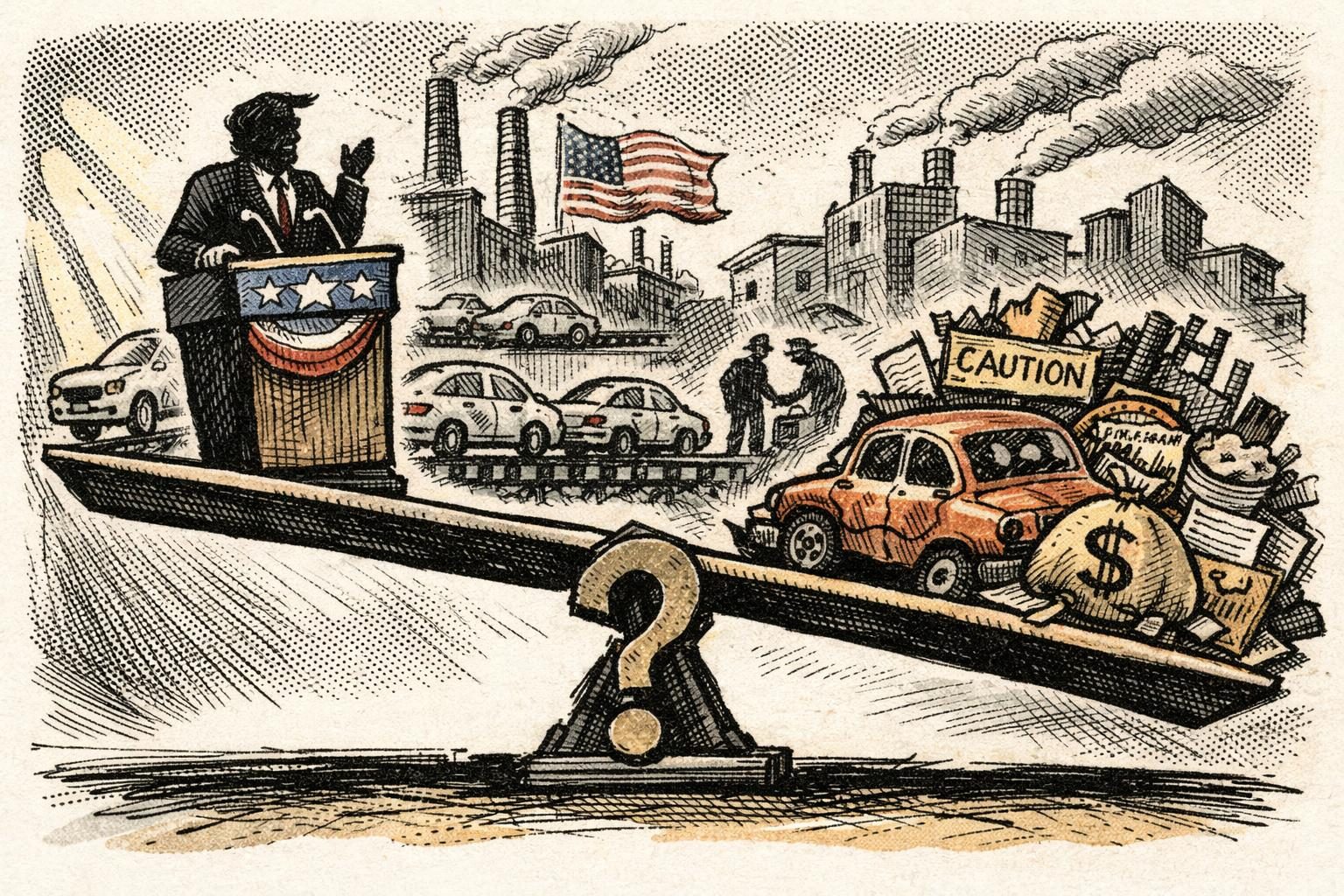
Donald Trump’s July 27 stop in Milford, Michigan, was designed to look like a victory lap for his tariff strategy, and in a narrow sense it worked exactly that way. The White House framed the visit as evidence that its trade agenda is reviving American auto manufacturing, pointing to visible signs of production and investment as proof that tariffs are doing what Trump promised they would do. That is a powerful political message in a state where cars, trucks, suppliers and factory jobs carry real economic and symbolic weight. It is also a message that is much easier to stage than to prove. A plant visit, a row of workers, and a few favorable announcements can create the impression of momentum, but they do not by themselves establish that the entire auto sector is experiencing a durable rebound. For now, the administration’s Michigan pitch remains an argument, not a final accounting.
The setting itself helped the president make that case. Reporting around the stop identified the event as taking place at General Motors’ Milford Proving Ground, a long-running vehicle testing site outside Detroit, which made the appearance feel less like a generic campaign rally and more like a showcase for industrial policy. Trump used the visit to tell workers and guests that tariffs had protected the industry and helped bring production back toward the United States. On the official White House page for the trip, the administration presented the visit as confirmation that its trade agenda is strengthening auto manufacturing and rewarding companies that build domestically. That framing matters because it is the clearest version of the White House’s own theory of the case: tariffs are supposed to pressure companies into investing, sourcing, and building more in the United States, and the Michigan stop was meant to show that theory in action. But a theory becoming a headline is not the same as a theory being vindicated. The White House can point to selected wins, but it has not shown that those wins add up to a broad, economy-wide turnaround.
The harder part of the story is what sits behind the applause lines. The basic tariff argument is simple enough: if imported parts and foreign-made vehicles become more expensive, companies will have a reason to shift more work into the country. In practice, that shift is messy, slow, and often expensive, because auto manufacturing runs through a deeply interwoven supply chain that stretches across borders and depends on a huge number of components, materials, and specialized suppliers. That means the costs of tariffs are not confined to some abstract trade ledger; they show up in real business decisions, in procurement bills, and in the prices that manufacturers pay long before a finished vehicle reaches a showroom. The administration wants the public to focus on the visible side of the ledger, where factories, jobs, and investment announcements can be photographed and celebrated. But the less visible side can be just as important, especially if companies face higher costs even while trying to adjust to the new policy environment. General Motors itself has said tariffs add to its costs, which underscores the basic tension at the heart of Trump’s pitch: a policy can encourage some domestic activity and still impose significant burdens on the companies operating within it. That is why one positive announcement or one upbeat factory appearance cannot settle the broader question of whether tariffs are helping more than they are hurting.
AP’s coverage of the Michigan stop put those competing realities side by side. The president’s remarks were unambiguous in their celebration of tariffs as a tool that has protected the industry and revived production. At the same time, the reporting noted that some businesses say the levies have hurt Michigan and that tariff costs continue to weigh on companies. That combination is crucial, because it shows how the same policy can produce both political wins and economic friction at once. Trump can credibly claim that tariffs have pushed some companies to rethink where they make things, and he can point to examples that look favorable in a state like Michigan, where manufacturing gains are politically potent. But critics do not need to prove that tariffs create no winners at all; they only need to show that the costs are real, persistent, and potentially broad enough to offset some of the gains. The difficult question is not whether a few firms are adapting in ways the White House can celebrate. It is whether those adaptations are part of a durable, broad-based resurgence in American manufacturing, or whether they simply reflect a complicated and costly rearrangement of production under pressure.
That distinction is what makes the Michigan stop more useful as a political performance than as economic proof. Trump’s team clearly wanted the public to see the visit as a kind of exhibit A for his trade strategy, and the setting offered plenty of material for that purpose. A president surrounded by manufacturing workers, speaking at a well-known auto testing site, can make tariffs look like a tangible tool rather than a theoretical policy. But visible examples are not the same as a verdict. A company announcement can be genuine without being representative. A factory adjustment can be important without signaling a nationwide trend. A few jobs tied to a new investment can exist alongside broader price pressures, supply chain strain, and higher costs for other businesses. That is why the most careful reading of the Michigan event is not that Trump proved his case, but that he restated it with the confidence of someone who knows the optics are favorable. The administration has certainly made its argument loudly and repeatedly. What it has not done is establish, on the basis of one stop and a few selected signs, that tariffs have already delivered the full industrial revival it wants to claim.
So the real test remains ahead of the rhetoric. If tariffs are truly supercharging American auto manufacturing, the effects should be broad, durable, and visible across more than a handful of headline-friendly moments. They should show up not just in presidential remarks, but in sustained investment, stable employment, healthier supply chains, and a manufacturing base that is stronger without leaning on constant political spin. If, instead, the evidence remains a mix of isolated wins and continuing cost pressures, then the Michigan trip will stand as another example of how easily a policy can be marketed as settled fact before the ledger is fully written. Trump’s supporters may take the stop as proof that his approach is working. His critics will see the same event as another attempt to turn selective gains into a sweeping conclusion. Based on what is publicly on the record now, the safest reading is narrower and more cautious than the White House’s. The president has found examples that fit his story. He has not yet closed the case.
Comments
Threaded replies, voting, and reports are live. New users still go through screening on their first approved comments.
Log in to comment
No comments yet. Be the first reasonably on-topic person here.