
Trump Picks Will Scharf as White House Counsel, Tightening the Inner Circle Again
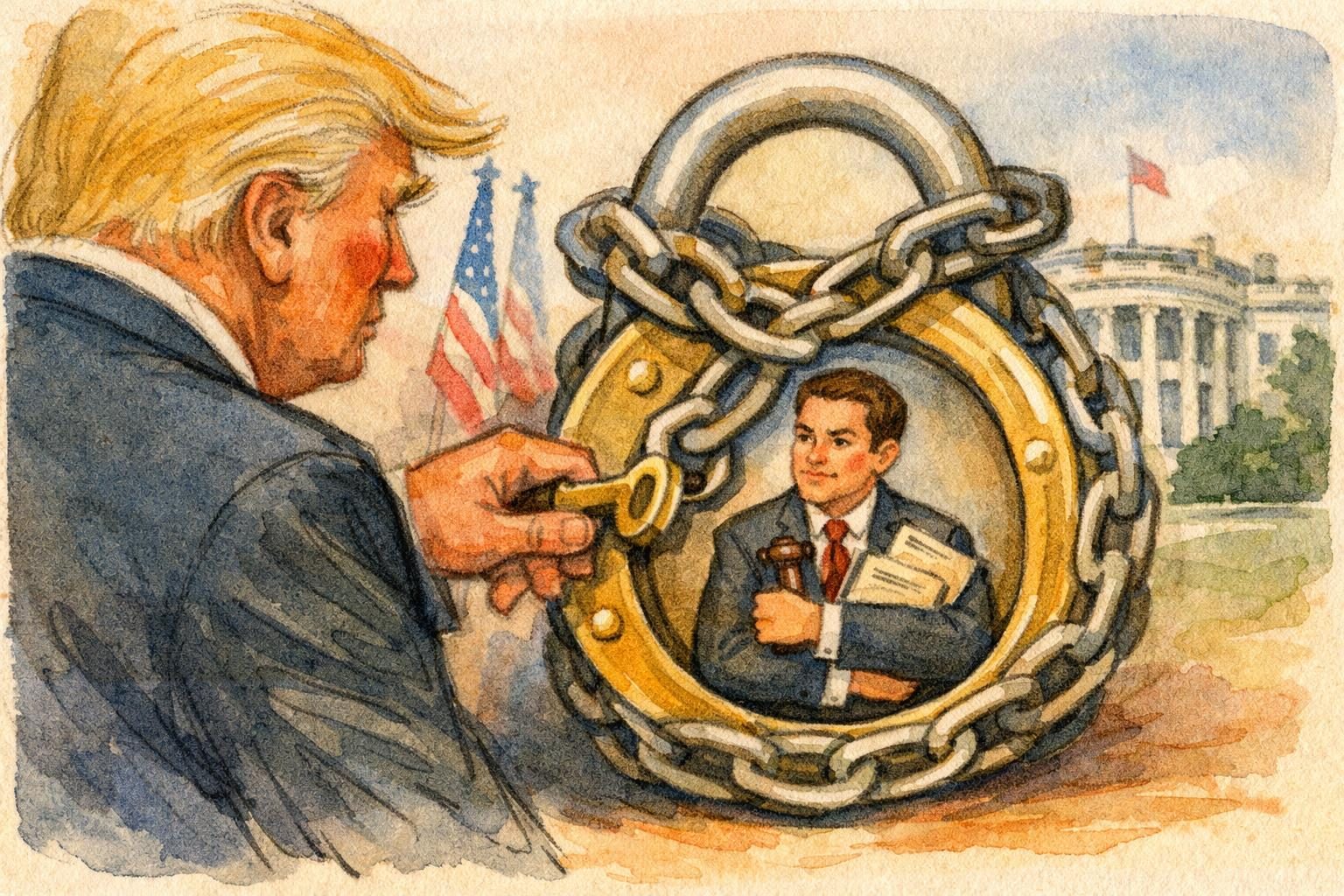
President Donald Trump said Sunday that Will Scharf will move from staff secretary to White House counsel, taking over on September 1 from David Warrington. The personnel switch is not just a matter of labels on an org chart. It puts one of the president’s most trusted aides into a job that sits close to the center of legal decision-making inside the executive branch. Scharf has already been deeply embedded in Trump’s second-term operation, serving in a role that places him near the daily flow of papers, approvals, and internal coordination. His elevation suggests the president is still choosing familiarity and loyalty over any instinct for distance or insulation in the people who help manage legal risk.
White House counsel is one of the most consequential jobs in Washington because it is where politics and law meet in real time. The office helps guide how the administration responds to investigations, subpoenas, ethics questions, executive authority disputes, and the countless legal problems that arrive when a president tests the limits of power. It is also the place where the White House decides whether to slow down, push ahead, settle, fight, or simply ignore objections until they become bigger problems. In that sense, putting Scharf in the job is about much more than replacing one lawyer with another. It is about placing someone already trusted by Trump into a position where judgment, loyalty, and speed can matter as much as legal caution. The result is a counsel’s office that may be less likely to operate as a brake and more likely to function as an internal enabler of the president’s preferred course.
Scharf’s rise also reflects how much of this administration’s legal apparatus appears to be concentrated in a relatively small circle of familiar hands. He has been involved in work tied to the National Capital Planning Commission and the ballroom project, which underscores how closely intertwined policy, planning, and the president’s personal priorities can become inside the same operation. That kind of overlap may be efficient from Trump’s point of view, especially in a White House that prizes speed and loyalty. But it also reduces the space for internal resistance when a proposed move raises legal questions or creates institutional risk. The danger is not only that a bad idea gets approved; it is that fewer people are positioned to argue against it with real force. When the same network of trusted aides keeps turning up in sensitive roles, the legal system inside the White House can start to look less like an independent checkpoint and more like a management layer built to keep the machine moving.
That matters because the costs of these choices usually show up later, after the announcement has faded and the paperwork starts piling up. Lawsuits do not wait for a convenient moment, and subpoena fights, regulatory disputes, and constitutional clashes can quickly turn into crises that test how much restraint the White House is willing to accept. If the counsel’s office is staffed by someone whose rise has been tied to the president’s inner circle, it may be harder for that office to deliver unwelcome advice when the president wants a fight. It may also be easier for the White House to treat law as another instrument of governance rather than as a boundary that can force a pause. That does not guarantee a particular outcome, and it does not mean every future legal decision will be driven by personal allegiance alone. But it does reinforce a pattern that has become difficult to miss: Trump continues to build a governing structure in which trusted operators are preferred over institutional distance, and where consolidation itself is treated as a strength. In the short term, that may make the operation more disciplined. In the longer term, it can make the fallout from mistakes much harder to contain, because a tightly sealed circle tends to hear too little dissent when the stakes are highest.
Comments
Threaded replies, voting, and reports are live. New users still go through screening on their first approved comments.
Log in to comment
No comments yet. Be the first reasonably on-topic person here.