
Todd Blanche takes over Justice after a confirmation brawl that advertised the rot
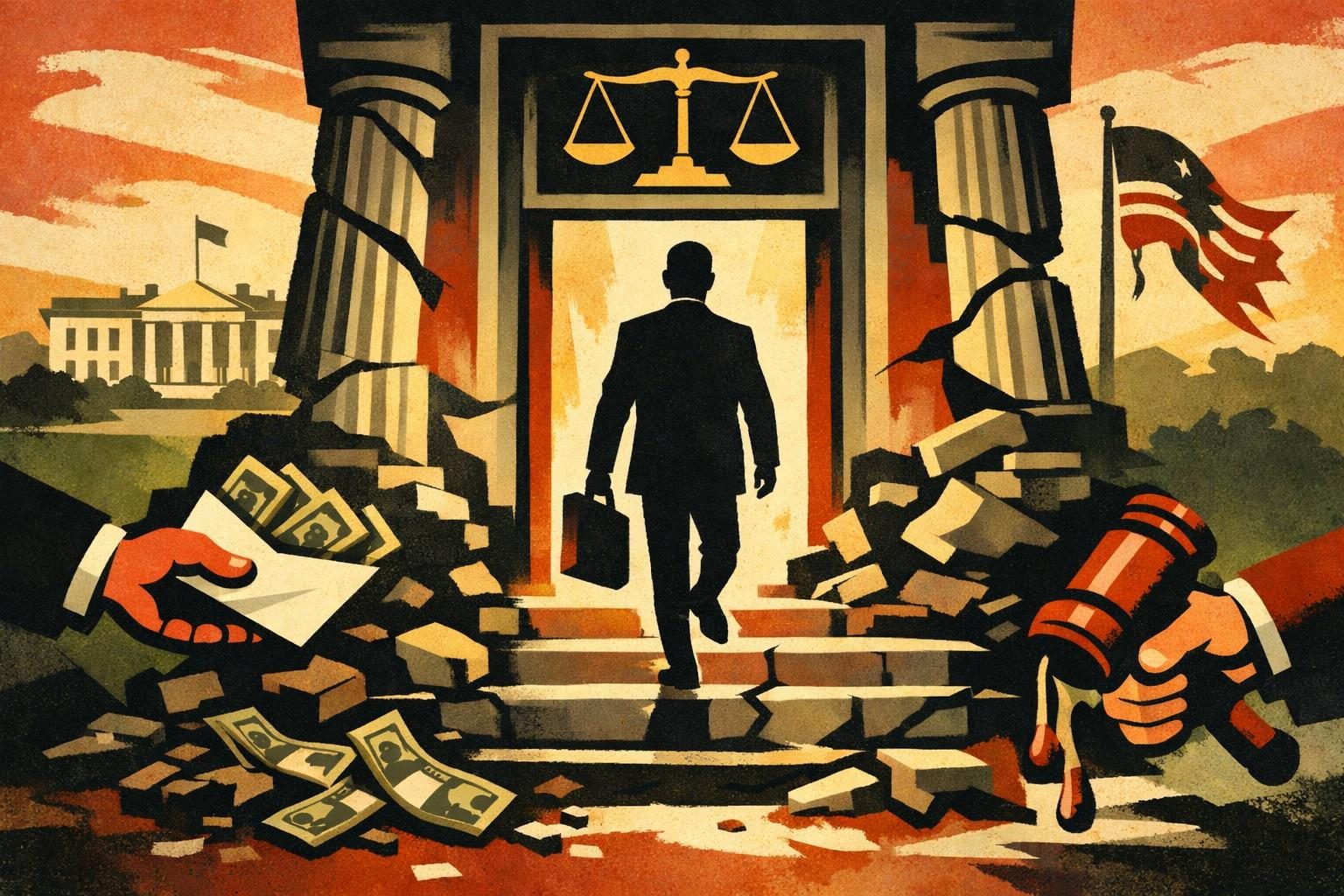
Todd Blanche was sworn in Monday as attorney general, stepping into the Justice Department after a confirmation fight that did not simply test his nomination but exposed how much strain the institution is under. The White House ceremony came just after the Senate’s narrow Saturday vote, and Blanche then moved on to a reception at Justice headquarters that was meant to signal continuity and confidence. Instead, the sequence read as a reminder that the department is now being asked to function inside a political environment where the line between public duty and personal loyalty has become increasingly hard to see. The confirmation process also forced the administration to abandon a plan for a $1.8 billion compensation fund aimed at Trump allies who said they had been wronged by the department, a retreat that underscored how politically toxic the idea had become. Even before Blanche put on the badge of office, the episode had already raised the question of whether the department is being stabilized or simply reorganized around the same center of gravity.
That question matters because the attorney general is not just another Cabinet secretary. The office sits at the top of the federal law-enforcement system, where every decision about charges, investigations, settlements, and internal discipline carries consequences far beyond the building in Washington. When the person occupying that office has spent years inside the president’s personal legal orbit, the appearance of independence becomes harder to sustain, even if the law itself has not been openly bent. Blanche’s background as one of Trump’s former personal lawyers made his ascent predictable in one sense and jarring in another, because it fused the nation’s top law-enforcement post with the president’s private defense team in a way that critics say is impossible to ignore. Supporters may argue that familiarity with the president’s worldview makes for stronger coordination, but that argument itself highlights the problem: the department is supposed to serve the law first, not the political needs of the executive branch. When those roles blur, career prosecutors and investigators are left to wonder whether their judgments still carry the same weight.
The collapsed compensation proposal only sharpened that concern. The administration’s retreat from the $1.8 billion fund for Trump allies was not presented as a victory lap, but as damage control after the plan drew obvious scrutiny and became difficult to defend on political grounds. Whatever the original intent, the idea looked to many observers like a payback structure dressed up as administration policy, and the fact that it had to be pulled back before Blanche’s tenure even got fully underway says a great deal about the pressure surrounding the department. It also suggests the White House understands, at least in moments of exposure, that some moves are too blatant to survive contact with public scrutiny. But a reversal after the fact does not erase what the episode revealed about how decisions are being made. It showed an administration willing to test just how far it can push the Justice Department before the political cost becomes too high, and that is exactly the kind of improvisational loyalty politics that corrodes institutional trust. For employees inside the department, the message is unlikely to feel reassuring simply because the most controversial piece was shelved.
Blanche’s supporters are likely to frame his arrival as an opportunity to restore professionalism and reset a department battered by partisan conflict. That argument may carry some appeal in the abstract, because every attorney general arrives promising order, discipline, and respect for the institution’s traditions. Yet the circumstances of this confirmation fight make the promise harder to take at face value. A bruising Senate battle, a late-stage retreat from a politically radioactive compensation scheme, and the visible interweaving of presidential loyalty with law-enforcement authority do not add up to a clean restoration project. They add up to an institution under pressure to prove it can still operate on neutral principles while being led by someone whose own political and legal history is inseparable from the president he now serves. That does not automatically mean every future decision will be compromised, but it does mean each one will be judged through a heavier lens than usual. In a department that depends on public confidence as much as internal expertise, that loss of trust is not a side issue. It is the main event. The immediate consequence is uncertainty, but the longer-term consequence may be more serious: once guardrails are treated as negotiable, they become harder to rebuild than to break.
There is also a broader institutional lesson in the speed with which this confirmation fight turned into a story about the administration’s governing style. The episode showed a reliance on pressure, last-minute reversals, and personal allegiance as tools of management, all of which may be effective in the short term and destructive in the long run. It is one thing for a White House to defend its choices against political opposition. It is another for the country’s top law-enforcement department to look like a mechanism for settling scores or rewarding loyalty. Blanche may insist that he can separate the job from the politics surrounding it, and perhaps he will try to do exactly that. But the damage from the confirmation battle is already baked in, because it has made the department’s fragility visible to the public and, more importantly, to the people who work there. Career lawyers and agents do not need a memo to understand that their independence is under a microscope. They can see it in the appointment itself, in the abandoned payout scheme, and in the fact that even a ceremonial swearing-in could not escape the sense that the Justice Department is being asked to serve two masters at once. That is not a healthy position for any institution, and it is certainly not how a nation is supposed to advertise the rule of law.
Comments
Threaded replies, voting, and reports are live. New users still go through screening on their first approved comments.
Log in to comment
No comments yet. Be the first reasonably on-topic person here.