
The courts keep turning immigration maximalism into a liability
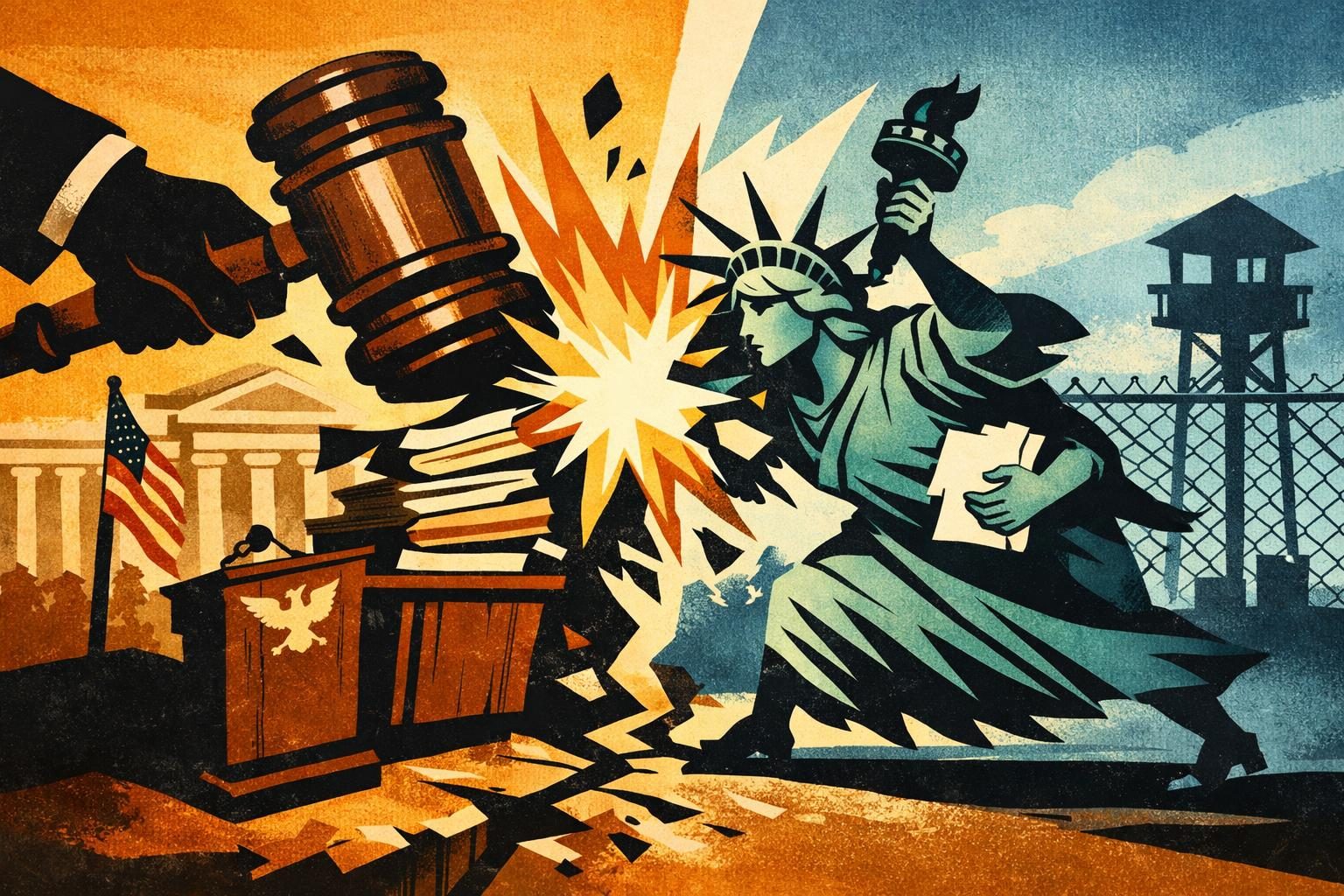
The administration’s immigration agenda is starting to look less like a show of strength than a steady accumulation of legal traps. In court after court, judges are forcing the government to defend broad, categorical moves that were designed to look decisive in public and durable in practice. On Aug. 10, one federal ruling knocked down a sweeping country-based restriction affecting immigration benefits and entry. Around the same stretch of time, another appellate decision widened the split over whether certain immigrants arrested inside the United States can be held in mandatory detention. Taken together, the cases point to a familiar pattern: the government is choosing the most aggressive available interpretation of its authority, and the courts keep responding by narrowing it.
That pattern matters because immigration enforcement is not an abstract policy debate. It shapes whether people can reunite with family members, keep their jobs, renew status, or remain free while their cases move through the system. When the government takes a broad approach and a court later trims it back, the immediate effect is not just a legal setback. It creates confusion for agencies trying to apply shifting rules, for employers trying to plan around workforce disruptions, and for families trying to understand whether they can travel, stay, or apply for benefits. The administration has made immigration enforcement a central promise, and it has often leaned on blunt, high-visibility actions to signal toughness. But those moves are increasingly colliding with statutory limits, procedural requirements, and judges who are unwilling to treat expansive executive claims as self-validating.
The country-based restriction is a useful example because it reflects the basic problem at the center of the administration’s immigration strategy. Broad nationality-based rules can be politically attractive because they are easy to explain and easy to defend in campaign terms. They can also appear to offer swift control over a complex system. Yet they are vulnerable in court when they run into the text of immigration law, the limits Congress placed on executive discretion, or constitutional concerns about treating people differently based on origin without sufficient justification. A ruling striking down such a restriction does more than erase one policy; it signals that the government cannot simply redraw the legal map with a sweeping order and expect it to hold. Even when the administration may still have room to regulate in narrower ways, the loss forces it to confront how much of its preferred approach was built on assuming courts would defer. So far, at least in these cases, that assumption has not paid off.
The detention dispute points to a similar problem, only in a different corner of the system. Mandatory detention is one of the most consequential tools in immigration enforcement because it determines whether people can be held without individualized review while their cases proceed. The appellate ruling that deepened the split over its use for immigrants arrested inside the United States suggests the courts are not settling into a clean, government-friendly consensus. Instead, the law is fragmenting, with judges and circuits wrestling over how far detention authority really goes and when it can be applied automatically. That uncertainty is costly for everyone involved. It affects how long people remain in custody, whether they can prepare defenses while detained, and how much pressure the government can exert through confinement. It also invites more litigation, because once appellate courts diverge, the issue becomes harder to resolve through simple enforcement practice alone.
The administration’s defenders are likely to argue that these are isolated setbacks, the normal friction that accompanies any ambitious enforcement program. They may say that courts are only testing the boundaries case by case, and that the government will ultimately prevail in enough places to preserve the larger architecture of the policy. There is some truth to the idea that not every loss is fatal. The executive branch still has significant authority over immigration, and legal fights over detention, entry, and benefits often move slowly enough that policy can continue in modified form even while challenges are pending. But that is not the same as control. A strategy that depends on expansive rules surviving long enough to shape behavior is weaker when judges keep cutting those rules back. The more the government reaches for maximal versions of its authority, the more likely it is to generate injunctions, appeals, conflicting standards, and administrative whiplash. The result is a system that looks forceful in rhetoric but increasingly brittle in execution. In that sense, the courts are not just responding to the policy; they are exposing its central vulnerability: the idea that immigration maximalism can substitute for legal durability.
Comments
Threaded replies, voting, and reports are live. New users still go through screening on their first approved comments.
Log in to comment
No comments yet. Be the first reasonably on-topic person here.