
Judge lets border wall work proceed along Tohono O’odham land
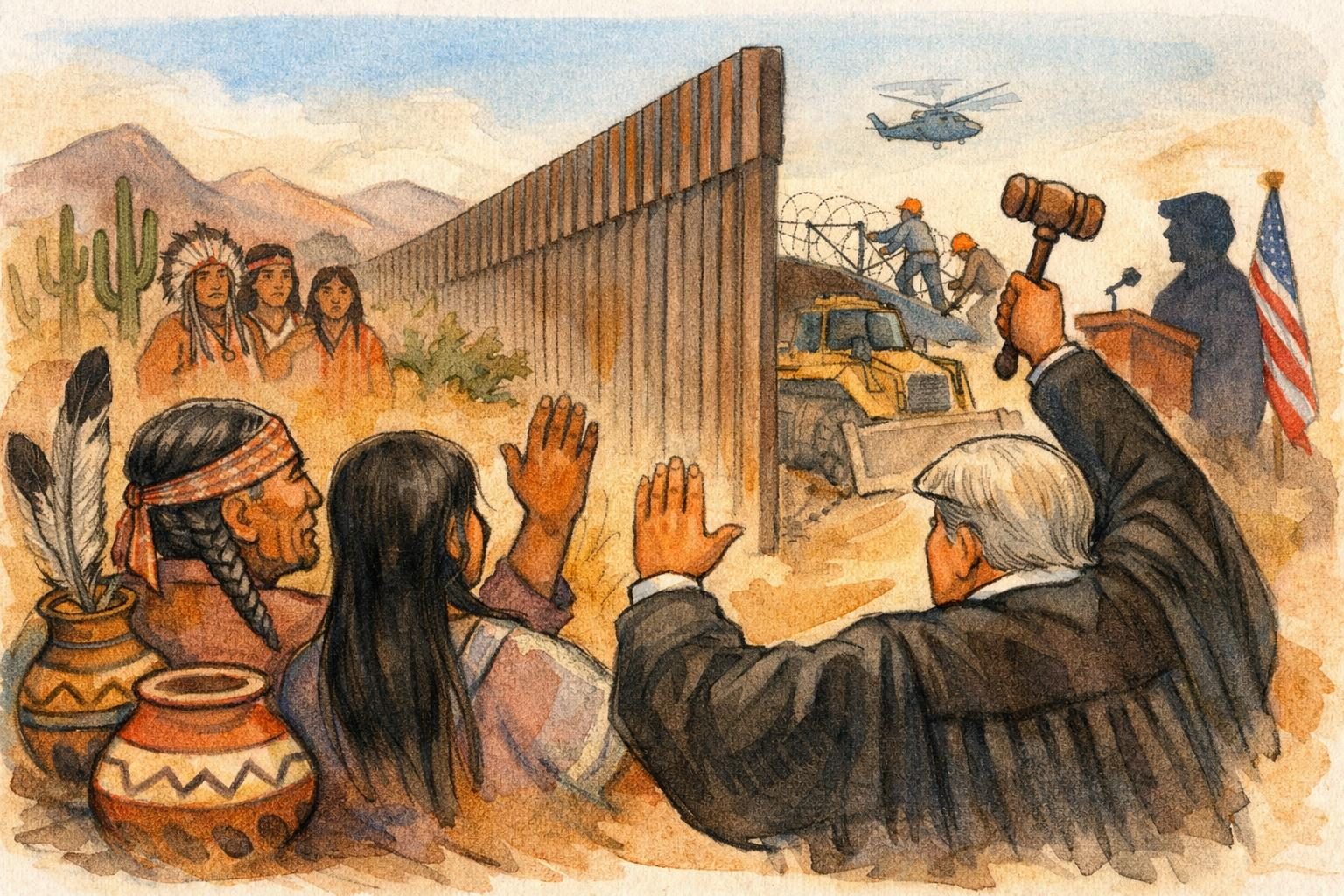
A federal judge in Washington on Friday declined to block the Trump administration from taking steps toward building additional border wall segments along a stretch of land tied to the Tohono O’odham Nation, leaving the project free to move ahead for now. The ruling does not settle the underlying dispute over tribal sovereignty, but it does remove an immediate legal obstacle that could have paused work on the ground. For the tribe, the decision is another reminder that its objections are being tested against a government determined to press forward with a border-security agenda. For the administration, it is a practical victory in a fight that has repeatedly turned on whether the border can be fortified first and litigated later. At this stage, the judge found the government’s interests strong enough to avoid an injunction. That means the case stays alive, but the balance of momentum has shifted toward construction.
The dispute centers on the administration’s plan to proceed with roughly 62 miles of wall along part of the reservation, a project the tribe says would amount to an unlawful intrusion on land it has not consented to surrender. The Tohono O’odham Nation has argued that wall building in the area would effectively redraw or disturb the reservation’s boundaries without the approval normally required for such a consequential federal action. The tribe’s position is not just about a physical barrier, but about who gets to decide what happens on sovereign land and under what legal authority. Federal border projects have long been justified as national security measures, yet here that justification runs directly into a longstanding tribal claim that its territory is being treated as a convenience rather than a protected homeland. The judge’s decision does not erase those arguments, but it signals that, for now, they are not enough to stop the administration in court. That leaves the tribe in the difficult position of fighting a project that may keep advancing while the legal system works at its usual glacial pace.
The ruling also highlights how the administration has framed border wall construction as a test of executive resolve, even when the project collides with land rights, environmental concerns, and tribal jurisdiction. Supporters of the wall have argued that border enforcement requires physical barriers and that the government must be able to act quickly in areas it considers strategically important. Opponents say that logic repeatedly turns legal objections into procedural inconveniences, flattening questions of sovereignty into a fight over temporary access and construction schedules. In the Tohono O’odham case, that tension is especially sharp because the reservation sits along a border that has already brought surveillance, patrols, and repeated federal interventions into tribal life. The tribe has spent years warning that more wall construction would not simply affect migration patterns, but would also disrupt cultural sites, access routes, and a way of life rooted in the land itself. None of that was resolved by Friday’s order. What the decision did was preserve the government’s ability to keep moving while those concerns remain unresolved in court.
Even with the injunction request denied, the case is far from over, and the legal fight is likely to continue over the scope of federal authority and the limits of construction on or near tribal land. The practical effect of the ruling is that contractors and officials may now have more room to prepare for or continue work, unless future filings change the court’s posture. For the tribe, that means another round of litigation with the same imbalance that has defined so many border disputes: government machinery advances first, while affected communities are left trying to slow it down after the fact. The bigger message reaches beyond one reservation and one wall segment. It suggests that when the administration treats border fortification as an urgent national imperative, Native sovereignty is still expected to yield in the name of security. That is the part that should alarm anyone paying attention, because it turns a constitutional conflict into a mere scheduling issue. The judge’s order may be temporary, but the underlying principle it exposes is not: once the bulldozers are waiting, the burden is on the tribe to prove why its land should not be cut up, fenced off, and treated as expendable.
Comments
Threaded replies, voting, and reports are live. New users still go through screening on their first approved comments.
Log in to comment
No comments yet. Be the first reasonably on-topic person here.