
Seattle’s court-picked U.S. attorney sues after Trump fires him
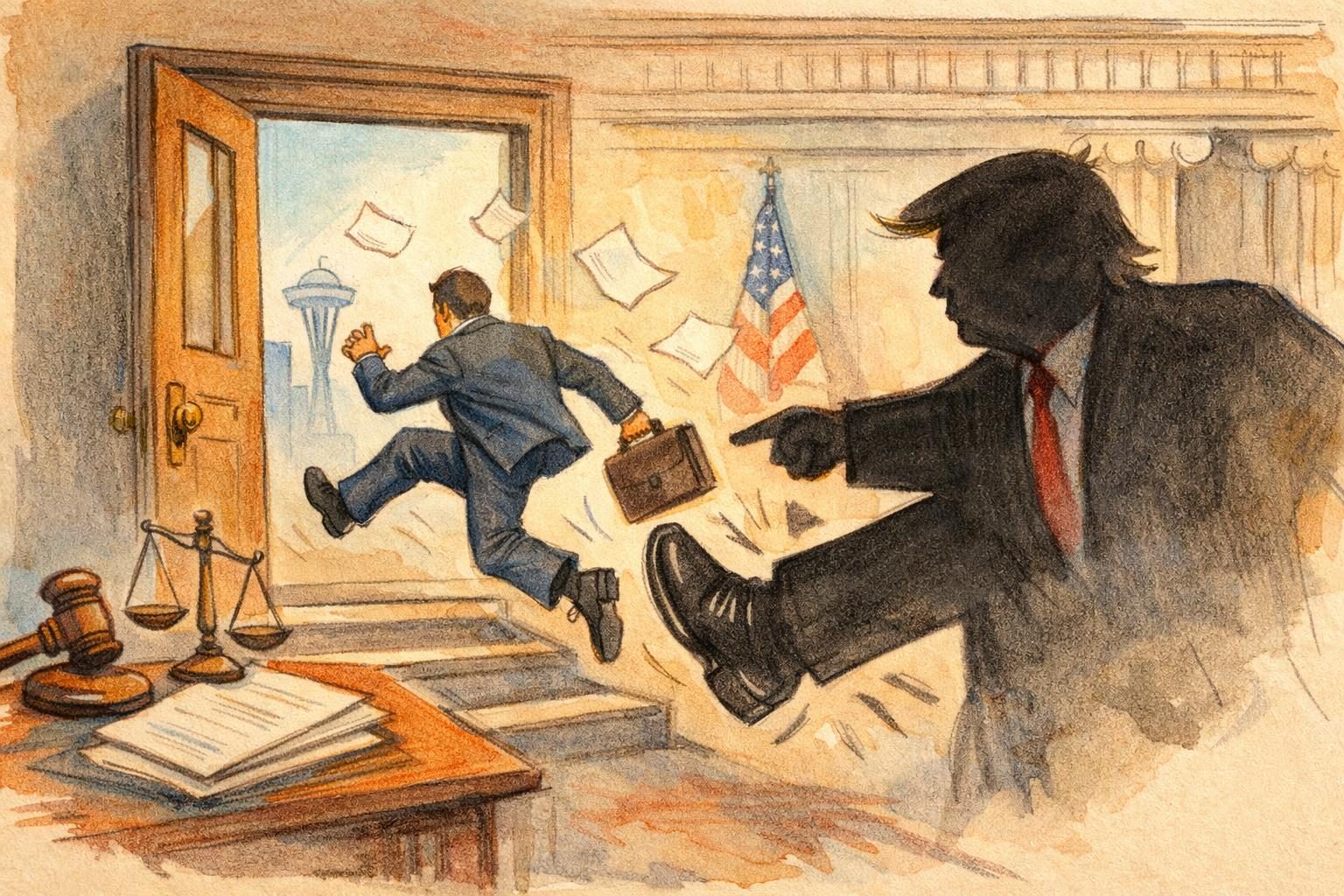
Roger Rogoff, the judge-appointed U.S. attorney for Seattle, has sued after Donald Trump removed him from the job only days after he took over the Western District of Washington. The complaint, filed in federal court, challenges what Rogoff says was an unlawful ouster of a court-picked prosecutor who was brought in to fill a vacancy. According to the draft account, Rogoff began serving on July 15 and was fired almost immediately afterward, turning what might have looked like an ordinary staffing move into a sharp institutional clash. The dispute lands in one of the most important corners of the federal justice system, where the U.S. attorney’s office directs investigations, sets enforcement priorities, and helps decide what kinds of misconduct are pursued and how aggressively. That makes the case bigger than a single personnel fight, because it asks whether a president can simply erase a judiciary-backed appointment once the officeholder is in place.
The basic legal question is straightforward, but the consequences are anything but. U.S. attorneys are among the most consequential political appointees in the federal government, yet they are also expected to operate with a degree of independence from day-to-day political pressure. When a district court steps in to appoint someone to bridge a vacancy, it is doing so to preserve continuity and prevent a leadership gap from disrupting the work of the office. Rogoff’s lawsuit appears to argue that the administration cannot simply treat that arrangement as disposable just because the White House wants a different outcome. If Trump can remove a court-appointed U.S. attorney immediately after the appointment takes effect, the court’s role in filling the vacancy becomes far less meaningful, and the balance between the branches gets noticeably thinner. In practical terms, the case is about who gets to control the levers of federal law enforcement when normal succession has broken down.
The administration may present the firing as a routine personnel matter or as an exercise of presidential authority over executive branch officials, but the timing gives the move a more pointed appearance. A removal that comes almost instantly after a judge-appointed prosecutor takes office does not read like a slow policy disagreement or a measured transition. It reads like a rejection of the appointment itself, and possibly of the institution that made it. That is why critics are likely to see the episode as part of a broader pattern in which Trump treats legal institutions less as independent constraints than as staffing pools to be managed for loyalty. The strength of that criticism depends on the underlying facts, and the draft account suggests those facts are unusually clean: the officeholder was not dismissed after months of conflict, but after only a few days on the job. That brevity matters, because it gives the lawsuit a crisp test case quality. Courts are being asked not to wade through a murky personnel dispute, but to decide whether the executive branch can sweep aside a vacancy-filling judicial appointment whenever it wishes. In plain terms, the case is a referendum on whether federal law enforcement answers to law or to presidential preference.
There is also a broader institutional cost here that goes beyond the legal arguments on paper. The Western District of Washington covers a major region of the Pacific Northwest, and stability in the U.S. attorney’s office matters to everyone who works inside the system. Prosecutors need leadership that can set priorities without constant upheaval. Defense lawyers need to know whom they are dealing with, and judges need a functioning office that can handle cases predictably and competently. When a court-appointed U.S. attorney is removed almost immediately, the message sent through the system is one of uncertainty, and uncertainty is corrosive in a place where deadlines, charging decisions, and ongoing investigations all depend on continuity. Even if the administration insists the move was lawful, the optics are hard to separate from the structure of the system itself. A president with a strong appetite for control can turn a vacancy fill into a flashpoint just by acting fast enough.
The lawsuit may also matter well beyond Seattle if it forces a court to draw a line around executive power over judiciary-backed appointments. That makes it the kind of case that other districts and future vacancy fights will watch closely, especially if the administration continues trying to replace or override officials appointed through the court process. The stakes are not abstract. If one branch can effectively nullify another branch’s appointment to a federal prosecutorial post without meaningful restraint, then the independence built into the vacancy-filling process starts to look fragile. For now, the immediate effect is a leadership scramble inside a major federal office, but the larger effect could be a precedent about whether the White House can unmake a court’s temporary staffing solution at will. That is a dangerous proposition in any justice system, and it becomes more troubling when the dispute centers on an official whose job is to supervise criminal and civil enforcement without fear or favor.
For Rogoff, the case is obviously personal, but the complaint reads as a challenge to the structure of the office as much as to his own removal. For the administration, it is one more confrontation with the idea that some parts of government are supposed to function with insulation from presidential whims. For the courts, it is another opportunity to decide how much authority a judge-appointed prosecutor really has once the executive branch decides it wants someone else. However the litigation unfolds, the episode already underscores how quickly a personnel decision can become a constitutional argument when the people involved sit at the intersection of law, politics, and federal power. And because the dismissal happened so soon after Rogoff took office, the case is likely to remain a compact but significant test of whether independence in the justice system is a real safeguard or just a label that survives only until someone in the White House gets impatient.
Comments
Threaded replies, voting, and reports are live. New users still go through screening on their first approved comments.
Log in to comment
No comments yet. Be the first reasonably on-topic person here.