
West Virginia is sending more Guard troops into Washington, because the federal policing experiment apparently needed a sequel
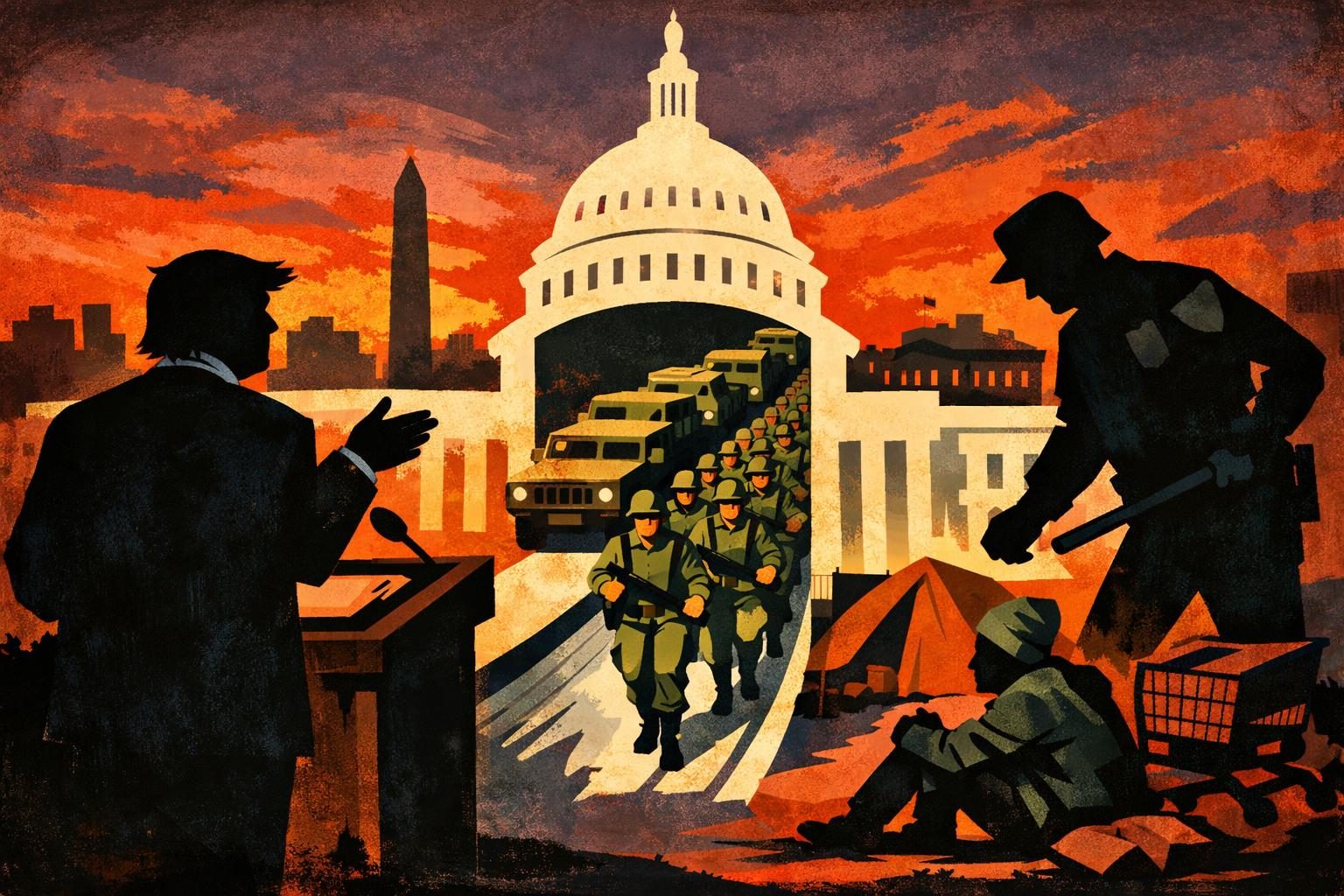
West Virginia said on August 16 that it is sending hundreds of National Guard members to Washington at the Trump team’s request, widening an already aggressive federal intervention in the city’s policing and homelessness response. The announcement marks another step in a rollout that has moved quickly from extraordinary to almost routine, even as local officials and civil-liberties advocates continue to question what problem the operation is actually solving. The deployment is part of a broader federal crackdown that has already placed troops and agents in visible public-facing roles across the capital. Supporters cast the effort as a necessary response to disorder, while critics see something closer to a staged show of force that blurs the line between public safety and political spectacle. However it is described, the decision to bring in more Guard personnel makes clear that the operation is not winding down; it is scaling up.
The latest reinforcement comes on top of an intervention that has already drawn sharp objections from District leaders, residents, and advocacy groups. For many in Washington, the presence of uniformed personnel tied to a federal initiative has been less reassuring than alienating, especially when it has been linked in public debate to the city’s approach to homelessness as much as to crime. Opponents argue that the city has been subjected to an outsized response that treats a complex social and policing challenge as though it could be fixed with more uniforms and louder declarations of control. The federal presence has also prompted discomfort because it appears to sidestep the normal balance between local authority and outside intervention. In that sense, the Guard expansion is not just about numbers; it is about who gets to decide what kind of emergency Washington is living through. The answer, at least for now, seems to be the federal government.
There is also a practical question hanging over the deployment: what exactly will these additional troops be asked to do. Federal officials have not presented the intervention as a narrowly defined, short-term mission with a clean endpoint, and that vagueness is part of what has fueled the backlash. When troops are assigned to a city already under intense political scrutiny, every patrol, checkpoint, and visible show of presence becomes a symbol, whether intended or not. That is especially true in Washington, where federal power is never far from the surface and where the optics of law enforcement carry a different weight than they might elsewhere. The administration’s approach appears to assume that more manpower will produce more order, but it has not fully answered why the existing tools were not enough or why expanding the military-style footprint should make the city safer in a lasting way. Without that explanation, the operation risks looking less like a public-safety strategy and more like a permanent improvisation.
The escalation also underscores how quickly a declared emergency can harden into a standing arrangement once the political incentives point in that direction. What began as a dramatic federal response is now being reinforced by a state contribution that signals the intervention has legs, even if the case for it remains disputed. The Trump team’s request for additional Guard members suggests that the original surge did not close the issue; it created momentum for another round. That may reassure supporters who want visible action and a message of control, but it is unlikely to calm those who see the deployment as excessive, humiliating, and poorly bounded. In practical terms, the city now faces the prospect of an expanded Guard presence layered onto the federal crackdown already in place, with no clear indication of how long it will last or what measurable result will justify it. The longer the arrangement continues, the more it resembles a political habit rather than a temporary emergency measure. And once that happens, ending it can become harder than starting it, especially when nobody in power seems eager to be the one to shut it down.
Comments
Threaded replies, voting, and reports are live. New users still go through screening on their first approved comments.
Log in to comment
No comments yet. Be the first reasonably on-topic person here.