
A judge says the administration blew through a voting injunction anyway
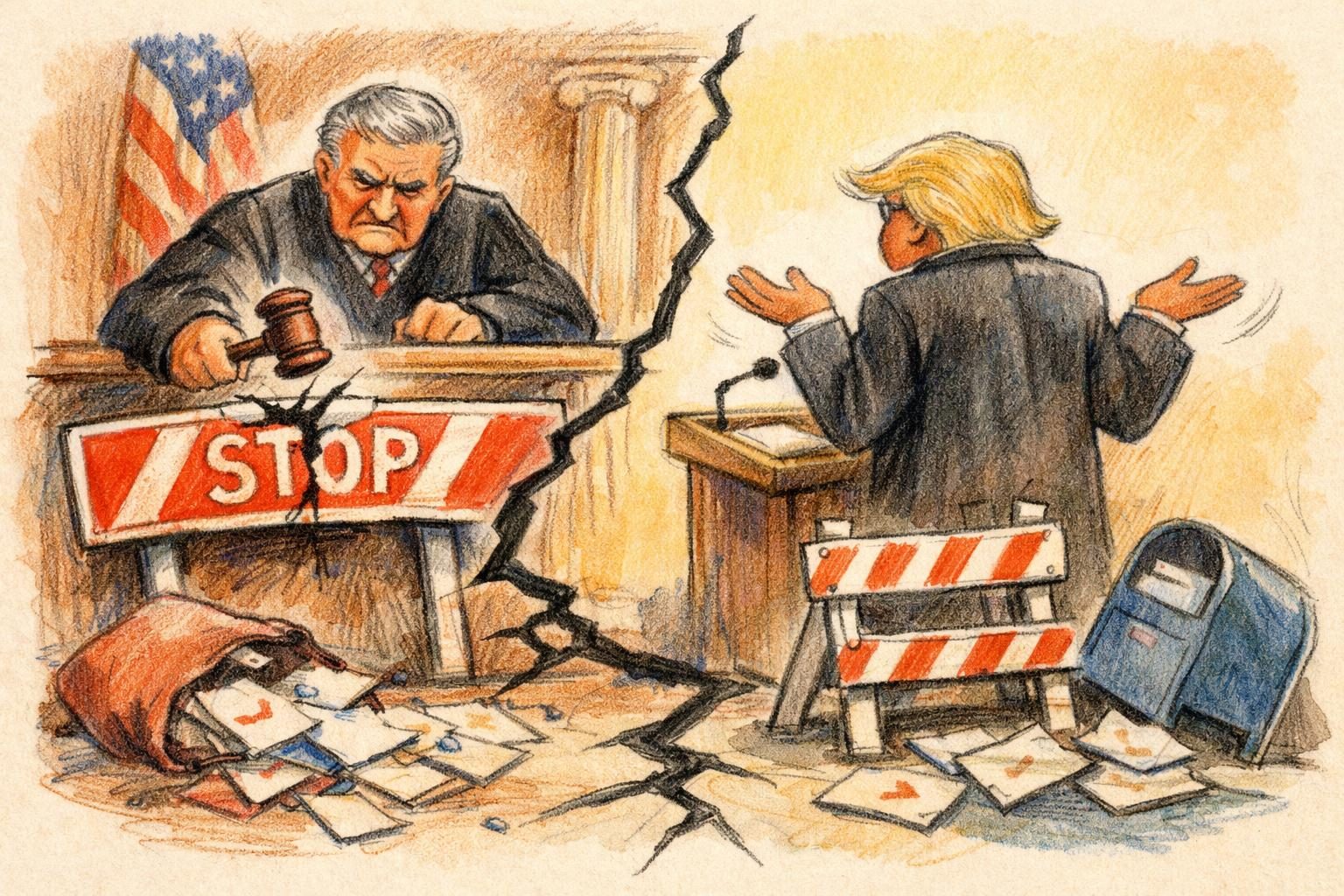
A federal judge on August 25 said the Trump administration violated an injunction tied to a Postal Service rule affecting mail voting, adding a sharper legal edge to a fight that had already been simmering over how far the executive branch can push election administration before a court steps in again. The ruling matters not just because it finds noncompliance, but because it turns a dispute over bureaucracy into a question of obedience. When a court has already told the government what it cannot do, and the government is then found to have done something that crosses that line anyway, the issue stops being abstract. It becomes a direct test of whether judicial orders still constrain federal power in practice. For voting-rights advocates and election administrators, that makes the case feel less like a technical fight over a postal rule and more like a warning about how fragile election safeguards can become when an administration is willing to press ahead while litigation is still unfolding.
The administration’s position, based on its filings and arguments so far, is that the rule was not supposed to take effect while the legal challenge continued. That kind of defense may sound tidy in a courtroom memo, but it can look awfully thin when set against a judge’s conclusion that the conduct nonetheless violated an injunction already in place. The distinction between “we said it wouldn’t go into effect yet” and “we did not actually comply with the court order” is the entire case. If a government can publicize, advance, or operationalize a rule and then point to a future effective date as a shield, then the practical force of injunctions starts to erode. Courts rely on the basic assumption that the parties before them will treat an injunction as a hard limit rather than as an inconvenience to be managed. When that assumption breaks down, the legal system has to decide whether to respond with stronger enforcement or accept that federal agencies can test the edges of compliance and shrug at the consequences.
That is why the ruling is drawing attention well beyond the immediate Postal Service dispute. Mail voting is not just another regulatory issue; it sits at the center of how millions of people cast ballots, especially in states where absentee and mailed ballots are central to participation. Any move that complicates that process can have effects far beyond the text of a rule, because election systems run on planning, deadlines, and trust. Once state officials and local election workers begin operating under uncertainty, they are forced to build contingency plans around federal chaos rather than stable guidance. That is exactly the sort of operational mess that voting-rights advocates have been warning about, particularly when national politics turns ordinary election machinery into a battlefield. The broader concern is not merely whether one rule survives review, but whether the administration is willing to keep pushing until it finds the point at which a court finally says the line has been crossed too many times.
The political significance is also obvious. A finding that the administration violated an injunction gives its opponents something more concrete than generalized complaints about bad faith or overreach. It provides a judicial rebuke that can be used in new litigation, in state-level resistance, and in public arguments about the legitimacy of the administration’s approach to voting rules. New York’s attorney general has already moved to challenge the rule in a separate action, arguing that it would shut millions of people out of the ballot process, which underscores how quickly one federal policy decision can trigger a cascade of legal fights. That does not mean every claim against the rule is already proven or that every downstream consequence is settled. It does mean the administration is now operating under the cloud of a court finding that its conduct did not stay within the boundaries the judiciary had set. And when the subject is ballot access, even a partially successful defense can still leave behind serious damage to confidence in the rules that are supposed to govern the next election.
What happens next will depend on how the judge frames the violation, what remedies are available, and whether the administration keeps arguing that its actions stayed within the letter of the injunction even if they offended its purpose. Those are not minor distinctions, because the remedy in a case like this can shape how aggressively future courts police federal agencies that try to move ahead before their legal authority is settled. The immediate lesson, though, is already clear enough. Injunctions are supposed to restrain conduct, not merely register a disagreement with it. If the executive branch can keep moving and then insist the paperwork will sort itself out later, the result is not just a legal nuisance. It is a slow conversion of court orders into suggestions, and that is a dangerous way to run election policy. For now, the judge’s ruling suggests the administration did not get the benefit of that doubt, and the fight over mail voting is likely to get even more combustible from here.
Comments
Threaded replies, voting, and reports are live. New users still go through screening on their first approved comments.
Log in to comment
No comments yet. Be the first reasonably on-topic person here.