
HHS finalizes a rule gutting disparate-impact enforcement under Title VI
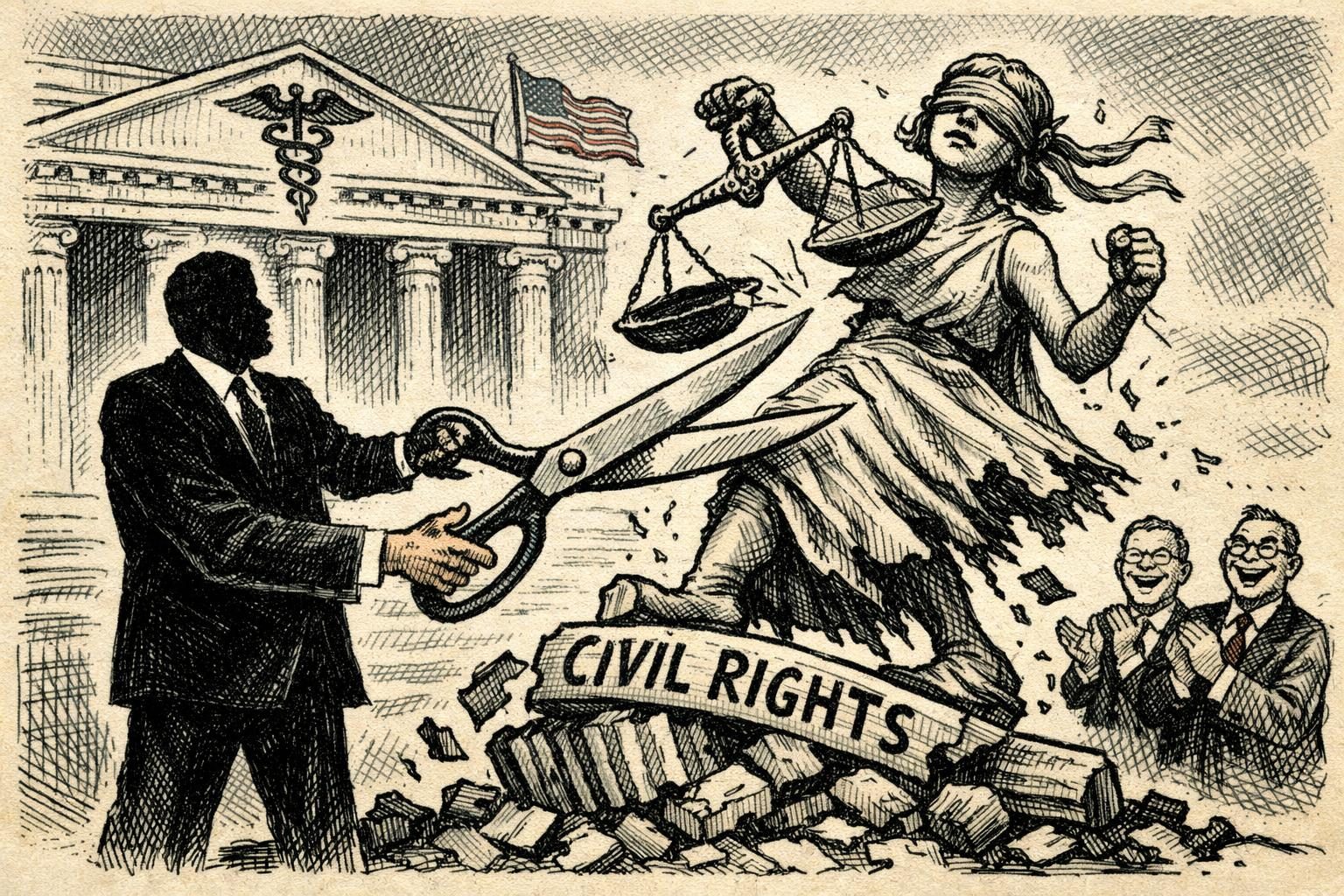
The Department of Health and Human Services has finalized a civil-rights rule that strips disparate-impact liability out of its Title VI regulations, marking one of the clearest enforcement retreats in the federal government’s antidiscrimination playbook. HHS said on July 23 that it had completed the rule, and by August 25 it was already shaping the current policy landscape. The practical effect is straightforward even if the legal language is not: it makes it harder for the government to challenge policies that do not explicitly mention race or another protected trait but still produce discriminatory outcomes in practice. That matters because many modern civil-rights disputes are not about written slurs or openly exclusionary rules. They are about systems that claim neutrality while consistently delivering unequal results. Under the new approach, proving discrimination becomes more difficult unless the plaintiff can point to something closer to overt intent, and that shift is exactly why opponents of the rule see it as a meaningful rollback. HHS framed the change as restoring the promise of equal protection under Title VI, but the rewrite also narrows one of the main tools regulators have used to spot and stop bias before it hardens into policy.
The move reaches far beyond a single department because Title VI sits near the center of federal civil-rights enforcement. Any organization receiving federal funds can end up inside its orbit, from hospitals and clinics to schools, local agencies, and contractors tied to public programs. That means the rule is not just a technical adjustment to legal standards; it changes the incentives for institutions that need to think carefully about how a facially neutral policy might land on different communities. Critics are likely to argue that the new framework invites decision-makers to hide behind process language while producing results that consistently burden vulnerable groups. Supporters, by contrast, will describe the change as a long-overdue correction to what they view as regulatory overreach. Both sides are already talking past each other in familiar ways, but the core dispute is easy to see: whether civil-rights law should focus mainly on obvious discriminatory intent or also on the real-world impact of systems that sort people unevenly even when no one says the quiet part out loud. HHS’s final rule answers that question in a much narrower way than earlier federal interpretations did, and that narrowing will likely shape enforcement for a long time.
For civil-rights advocates, the danger is that the government is making discrimination harder to prove precisely in the kinds of programs where structural bias often does the most damage. Health care, public benefits, and other federally funded services can all produce unequal outcomes without any single decision-maker ever writing down discriminatory intent. A rule that weakens disparate-impact enforcement could leave agencies with fewer ways to intervene when problems show up as patterns instead of admissions. That is not a hypothetical concern. If a policy predictably disadvantages a particular racial group, language community, or other protected population, the old enforcement model gave regulators more room to ask whether the policy itself was the problem. Under the new regime, that kind of challenge becomes more constrained, which may delay corrective action until the harm is more visible, more entrenched, and more expensive to fix. The administration can argue that it is simplifying civil-rights enforcement and avoiding speculative claims, but the tradeoff is obvious to anyone watching closely: less leverage for investigators, fewer paths to relief for plaintiffs, and more room for systemic inequities to persist under the cover of bureaucratic neutrality.
The immediate consequence is that HHS, the institutions it oversees, and the people who challenge them now operate under a narrower enforcement baseline. That may sound like a lawyer’s footnote, but it is actually a shift in how power gets allocated when discrimination claims are tested. Plaintiffs may have to do more work to show intent, recipients of federal funds may feel more insulated from challenges tied to outcomes, and agencies may become more hesitant to press cases that once relied on disparate-impact theories. The result could be more litigation over where the boundaries now lie, more uncertainty for administrators trying to comply, and more frustration for communities that depend on federal civil-rights rules to catch harm early. The rule also sends a broader signal about the federal government’s posture toward antidiscrimination enforcement: less willingness to treat unequal outcomes as a problem in themselves, and more willingness to accept those outcomes unless they can be tied to something more explicit. That is why this final rule is more than a regulatory housekeeping item. It is an ideological reset that changes how discrimination is defined, how it is pursued, and how much evidence the government will require before it is willing to call a policy unjust. For people who rely on Title VI as a guardrail against hidden bias, that is a serious step backward, even if the damage will unfold quietly, one complaint and one program at a time.
Comments
Threaded replies, voting, and reports are live. New users still go through screening on their first approved comments.
Log in to comment
No comments yet. Be the first reasonably on-topic person here.