
Newsom uses Farmworker Day to blast federal immigration raids
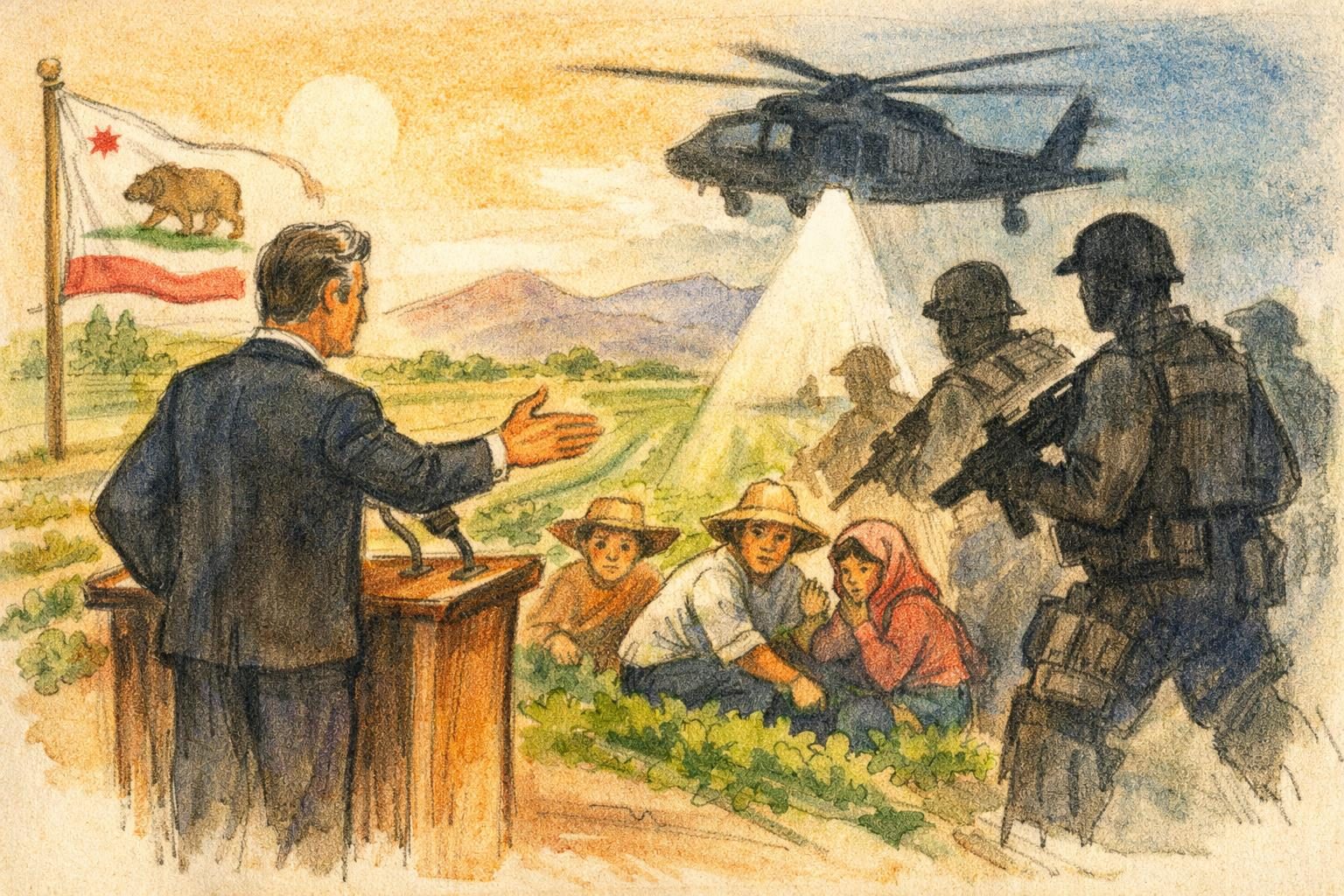
Governor Gavin Newsom used California’s Farmworker Day on Aug. 26 to deliver a pointed political message about federal immigration enforcement, turning what is usually a ceremonial recognition into a direct rebuke of the Trump administration’s raids and the fear they are said to be spreading through agricultural communities. In his proclamation, Newsom presented farmworkers as essential to the state’s food system and argued that immigration crackdowns are not abstract policy debates but real disruptions that land in workplaces, fields, and family lives. The timing mattered. Rather than treating Farmworker Day as a simple celebration, he used it to frame immigration enforcement as a threat to labor stability, worker dignity, and the ability of California agriculture to function without constant upheaval. That is a familiar Newsom move, but the sharpness of the statement suggests he wanted the contrast to be unmistakable. California, in his telling, is standing with the people who harvest the state’s crops; Washington, by implication, is treating them as collateral damage.
The governor’s message builds on a longstanding and uncomfortable reality in California agriculture: farm labor depends heavily on immigrant workers, and any aggressive enforcement effort can ripple through the system quickly. When workers fear being stopped, detained, or swept up in raids, attendance patterns change, crews shrink, and employers start worrying about whether they can get crops out of the ground on time. That is not some theoretical inconvenience. It is the sort of labor disruption that can affect harvest schedules, processing, transport, and eventually consumer prices. Newsom’s statement leaned into that practical argument by tying federal raids to economic instability, not just humanitarian concern. He was effectively saying that immigration enforcement is being carried out in a way that damages the very communities that keep the state’s agricultural engine running. The point is political, but it is also operational. If workers are afraid, the system does not perform the way it is supposed to, and everybody downstream feels the impact.
The proclamation also sharpens the broader state-versus-federal clash that has defined immigration politics for years and remains especially intense in California. State leaders have repeatedly cast themselves as defenders of immigrant communities, labor protections, and local stability, while federal officials have argued that enforcement is necessary to restore order and deter unlawful entry or unauthorized work. Those two narratives are not just different; they are fundamentally incompatible. Newsom’s language suggests that he sees federal raids as not merely lawful enforcement actions but as a kind of disruptive force imposed on communities that already live with economic and legal vulnerability. That framing matters because it invites sympathy for workers who may not have formal legal status but are still central to the functioning of the state’s economy. It also reflects a broader strategy in which California tries to place itself on the side of continuity, productivity, and basic fairness. The federal government, by contrast, is cast as choosing fear as a policy instrument. The state’s argument is that such a tactic may satisfy political demands for toughness, but it also makes daily life harder for the people who can least absorb the shock.
Newsom’s statement arrives at a moment when employers, labor advocates, and state officials are increasingly warning that heavy-handed immigration operations can produce consequences far beyond the target list that enforcement agencies advertise. Raids can destabilize workforces, make it harder for workers to seek legal help, and deepen distrust in institutions that are supposed to provide guidance or protection. In agriculture, where timing is everything and margins are often thin, even a temporary labor shortage can become a major logistical problem. Supporters of aggressive enforcement may argue that these disruptions are the price of bringing order to a broken system, and they would likely say that economic discomfort should not override the rule of law. But Newsom’s counterargument is equally direct: if a policy repeatedly generates panic, shortages, and legal fights, then it is not just enforcing the law, it is imposing broad collateral damage on communities that are already carrying a huge share of the state’s burden. That is why the governor’s Farmworker Day proclamation reads less like a polite observance and more like an accusation. It treats the federal crackdown as something with concrete consequences, not a sterile set of administrative actions. In that sense, the statement is as much about political accountability as it is about immigration.
Because the proclamation was issued on Aug. 26, it is best understood as an immediate response to the current enforcement climate rather than a generic seasonal message. Newsom chose a symbolic day that celebrates farmworkers and converted it into a platform for an argument about who pays the price when immigration politics turn punitive. The result is a message that is both strategic and blunt: California’s agricultural communities are not side effects of the economy, they are the economy, and policies that unsettle them carry real consequences. Whether that argument moves federal officials is another matter, but it clearly speaks to a state audience that has grown accustomed to seeing immigrant workers pulled into the center of national political fights. Newsom is also betting that the public will notice the contrast between the daily reality of farm labor and the language of enforcement from Washington. If the federal government insists that the raids are restoring order, the governor is asking why the visible result is so much anxiety, so much uncertainty, and so much disruption. In a year crowded with symbolic gestures and political theater, this one came with a sharper edge: a holiday for farmworkers turned into a warning that immigration policy is doing real harm to the people who keep California fed.
Comments
Threaded replies, voting, and reports are live. New users still go through screening on their first approved comments.
Log in to comment
No comments yet. Be the first reasonably on-topic person here.