
Immigration Crackdown Keeps Blowing Through Legal Pathways
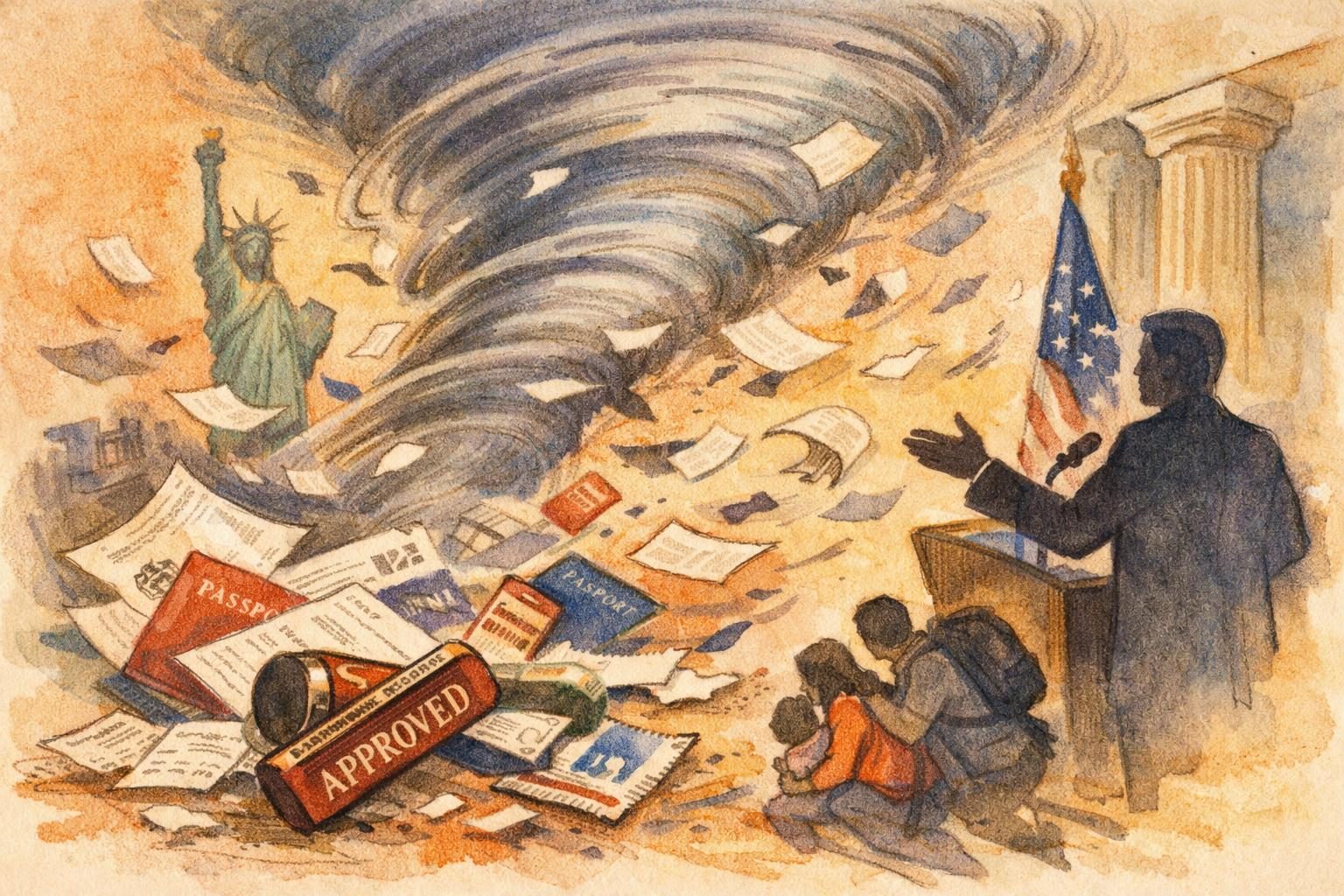
The Trump administration’s immigration push widened again on Tuesday, August 26, and once more the pressure is falling not just on people crossing the border without authorization, but on people trying to use the legal system the government says it still supports. New developments around visa processing and lawful entry added another layer of confusion to an already strained apparatus, following a federal judge’s recent decision to block an earlier visa restriction. That ruling matters because it showed the administration’s immigration strategy is not only running into political resistance, but also into the hard limits of executive authority and ordinary administrative capacity. In practice, the latest turn means more uncertainty for applicants, more scrambling for consular staff, and more families, students, and employers left to guess whether their plans will survive the next policy swing. The administration has spent months projecting toughness on immigration, but this episode suggests that toughness is increasingly coming at the expense of predictability. And when the government turns lawful channels into moving targets, it does not just enforce the rules; it risks damaging the very systems that make legal immigration possible.
That pattern is what makes the current moment more than a single-policy dispute. The latest moves fit a broader approach in which the White House keeps reaching for broad immigration restrictions and then acts as if the legal, operational, and human consequences are somebody else’s problem. Immigration lawyers and civil liberties advocates have repeatedly argued that the administration is blurring the line between targeted screening and blanket hostility to migration, particularly when it uses administrative obstacles to slow or deter entry rather than to make individualized decisions. The visa fight underscores that concern because it suggests the government is willing to impose friction across the system even when the underlying law does not clearly support that level of disruption. In theory, the administration can still defend broad authority over immigration enforcement and visa policy. In reality, it is increasingly colliding with judges, bureaucrats, and a visa infrastructure that cannot absorb constant shocks without consequences. That is not the behavior of a careful government making narrow adjustments. It is the behavior of an operation that keeps overreaching and then discovering the machinery underneath it is not built for improvisation.
The practical damage is easy to see even if the legal arguments remain in motion. Legal immigration is not an abstraction and it is not confined to a political talking point. It means international students trying to arrive before the start of a term, workers waiting to take jobs they have already been offered, spouses and children hoping to reunite, and employers trying to plan around staffing needs that depend on visa approval. When policy changes arrive faster than the processing system can handle, the burden shifts onto ordinary people who followed the rules and now have to live with delays they did not create. Consular officers and immigration staff are left to interpret shifting guidance, manage backlogs, and explain why a case that seemed on track may suddenly be paused or complicated. For applicants, every delay can mean missed classes, lost wages, cancelled travel, or a family separation that stretches far longer than anyone expected. The administration may frame these moves as orderly enforcement, but the visible effect is confusion. If the point is to show control, the result keeps looking more like bureaucratic whiplash.
The court ruling blocking an earlier visa restriction is also a warning that the fight is far from over. Every time the administration stretches a policy too far, it invites more litigation and more judicial scrutiny, which in turn can halt processing or force agencies to rewrite guidance on the fly. That cycle does not just create legal headaches; it makes the entire system more brittle. It also raises the odds of more public blowback, because people who are trying to immigrate lawfully tend to have little patience for being caught in a political stunt disguised as administration. The deeper problem is that the White House appears to be treating administrative friction as if it were a legitimate substitute for policy design. But delay is not the same thing as law, and confusion is not the same thing as enforcement. If the government keeps using procedural choke points as a de facto veto on entry, it will keep running into the same limits: courts that are willing to intervene, agencies that can only bend so far, and applicants whose lives cannot be put on hold indefinitely. The real screwup here is not merely that the administration is pursuing a hard line. It is that it keeps making the legal immigration system itself pay the price for political theater.
Comments
Threaded replies, voting, and reports are live. New users still go through screening on their first approved comments.
Log in to comment
No comments yet. Be the first reasonably on-topic person here.