
States hit USPS again over Trump’s mail-voting scheme
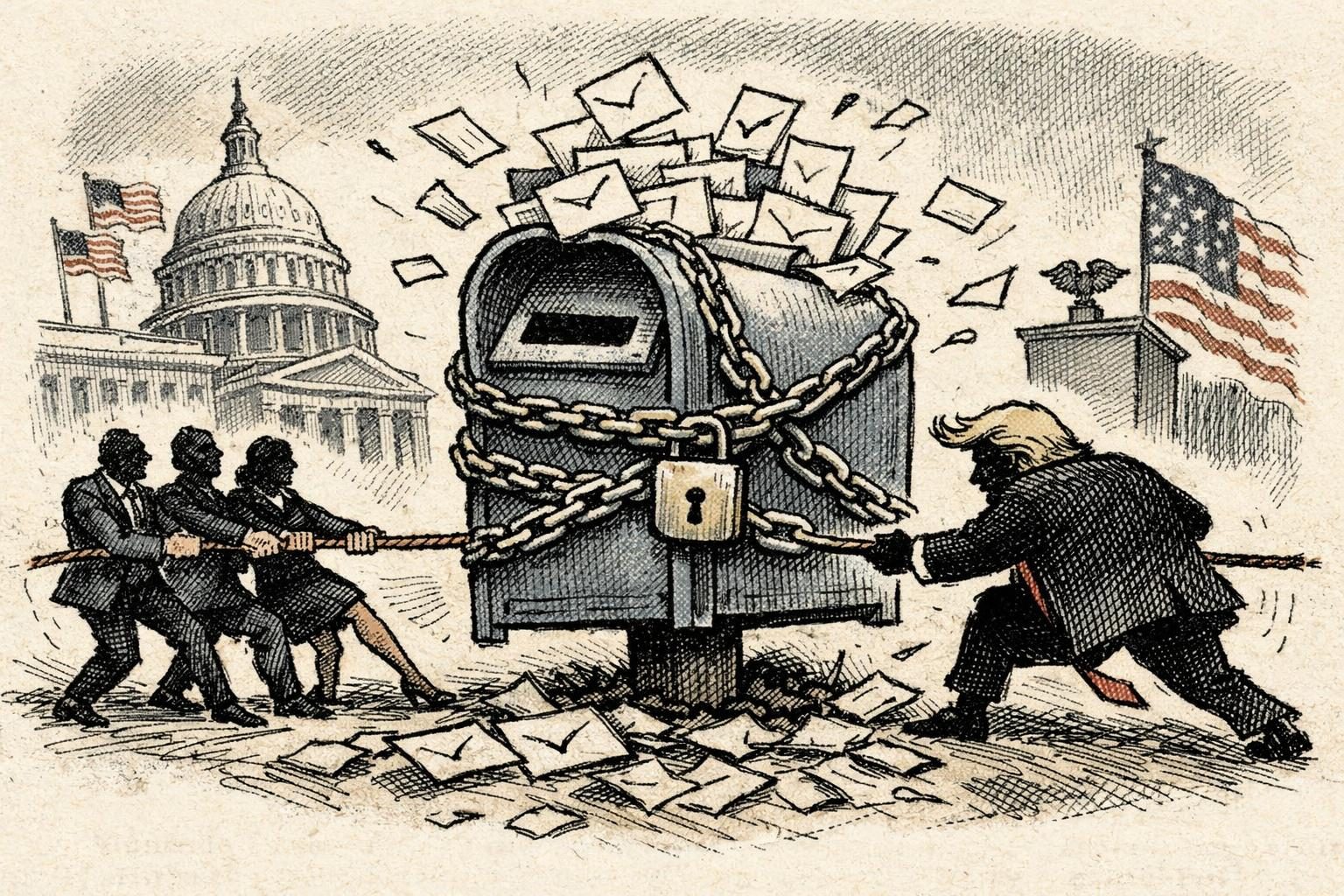
A coalition of Democratic-led states went back to court on Aug. 26, accusing the U.S. Postal Service of overstepping its authority after the agency finalized a new rule that could reshape how mail ballots are handled in future elections. The challenge landed just as the administration notched a separate procedural win in Massachusetts, where a federal judge removed one obstacle to the broader Trump voting order while leaving the larger constitutional and statutory fight unresolved. Together, the developments sharpened an already high-stakes conflict over how much power the executive branch can exert over election rules that have traditionally been set by states. They also ensured that, instead of settling into the late summer lull, the fight over mail voting is heading into another round of emergency litigation. For state officials, the timing was especially alarming because any implementation window for election changes is getting narrower, not wider, as 2026 approaches.
The new complaint says the Postal Service is trying to do much more than manage the mail. According to the states, the finalized rule would allow USPS to impose new limits on ballot procedures, force states to redesign ballot envelopes, require the sharing of state-specific voter information, and compel election officials to revise guidance on an aggressive timeline. In practical terms, that means states that rely heavily on vote by mail would be asked to rebuild portions of their election systems around a federal mandate they say has no clear statutory basis. The plaintiffs argue that the Postal Service does not possess independent power to dictate which elections practices states must adopt, especially when those rules reach deep into the mechanics of ballot return and verification. The states’ view is that the agency has taken a postal function and stretched it into something that looks a lot more like election administration. That, they say, is not a close call about bureaucratic housekeeping; it is a direct clash over federal overreach. And in the background of all of it is the same political reality that has driven the broader voting fight from the start: mail voting remains central to how millions of Americans cast ballots, so any change that makes it more cumbersome can have real-world consequences.
State officials have framed the rule as both legally indefensible and operationally chaotic. Washington state, one of the plaintiffs, said the new requirements would force impossible redesign and compliance work, a point that resonates with election administrators who already operate under tight deadlines and limited room for error. Other state plaintiffs are treating the rule as a direct attack on vote by mail itself, not just a technical adjustment to postal rules. Their argument is not simply that the Postal Service got the law wrong, but that the agency is attempting to create leverage over the voting process at the behest of the White House. That allegation matters because the legal battle is not unfolding in a vacuum; it is happening alongside the Trump administration’s broader effort to tighten control over election-related procedures through executive action. The states are making clear that, in their view, the order is not about improving election integrity or streamlining delivery. It is about introducing friction into the system and hoping the friction is enough to change behavior. Even if the administration ultimately loses in court, the process itself can still create confusion, delay, and costs for election offices that have to prepare for multiple possible outcomes at once. That is exactly the kind of burden the plaintiffs say the Postal Service is now imposing.
The Massachusetts ruling on Tuesday gave the administration a partial procedural win, but it did not close the door on the underlying dispute. Instead, it removed one barrier while leaving the broader legal questions intact, which is why the states immediately headed back into court rather than waiting for the issue to settle on its own. The Postal Service’s decision to finalize the rule despite that earlier injunction fight only intensified the states’ sense that the administration was trying to push through an election policy before the courts could fully weigh in. The result is a familiar but increasingly urgent pattern: an administration issues a directive, states challenge it, a court intervenes, and then another filing arrives before anyone has had a chance to breathe. That sequence is especially sensitive here because the rule could affect local election planning far in advance of the next federal cycle. For administrators, uncertainty is not a minor inconvenience; it can mean printing deadlines, staff training, public instructions, ballot design, and voter outreach all have to be reconsidered before the law is even settled. And for voters, the practical effect is that the rules of the road may keep shifting just as election offices are trying to lock them in. For now, the only certainty is that the legal fight over mail voting is not receding. It is expanding, and the states are betting that the courts will again have to decide whether the Postal Service has turned a mail rule into a voting rule without the power to do so.
Comments
Threaded replies, voting, and reports are live. New users still go through screening on their first approved comments.
Log in to comment
No comments yet. Be the first reasonably on-topic person here.