
DOJ broadened its anti-smuggling push with fresh El Paso arrests and child-smuggling charges
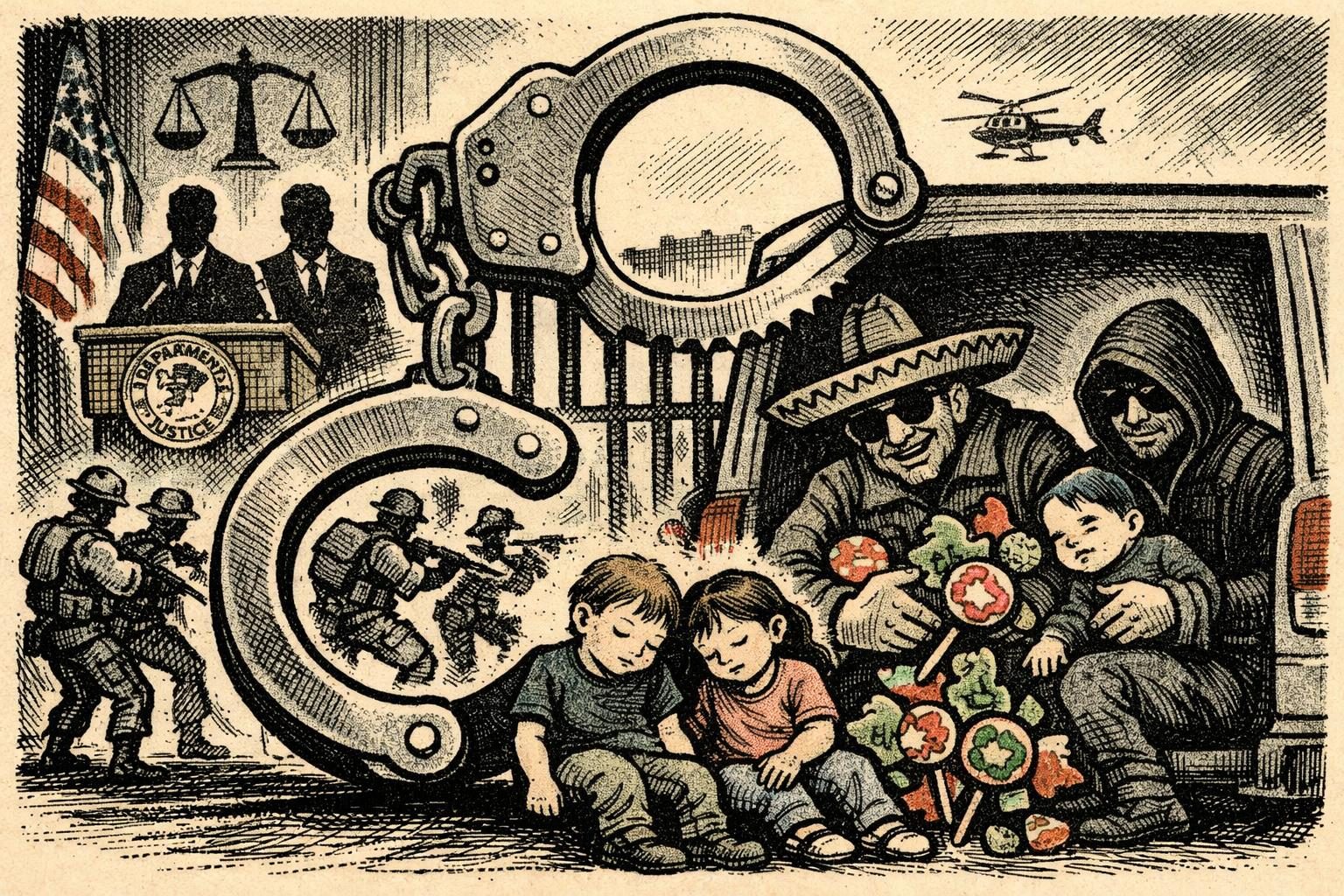
The Justice Department said Sunday that federal agents arrested two people in El Paso and brought child-smuggling charges against two Mexican nationals in a case that prosecutors say involved candy laced with THC used to sedate children during smuggling runs. The announcement was not presented as an isolated prosecution. Instead, it was folded into a broader federal push that officials say is aimed at dismantling transnational human smuggling and trafficking networks that move people for profit and, in the process, expose children to serious harm. The allegations are still allegations, and the case will rise or fall on evidence in court, but the outline the government described is disturbing enough on its own. Prosecutors say the scheme turned children into cargo and treated sedation as just another operational tool.
That framing matters because it shows how the federal government wants to talk about the border right now. This is not merely an enforcement update about arrests and charges; it is also an attempt to connect criminal prosecutions with a larger political argument about migration, public safety, and the limits of border control as a slogan. The case offers the kind of concrete, hard-to-ignore example that officials often reach for when trying to explain why smuggling cases are not theoretical. Human smuggling networks do not simply ferry people from one place to another. They exploit vulnerability, family separation, and desperation for money, and the allegation that children were allegedly drugged in the process only sharpens the brutality of that business model. Even for a Justice Department that has spent years describing transnational criminal organizations as sophisticated and adaptable, the use of THC-laced candy as part of a smuggling operation adds an especially ugly detail.
The broader enforcement context is just as important as the charges themselves. Federal officials are clearly trying to present these arrests as part of a wider escalation rather than a one-off success story, suggesting a campaign meant to hit not only couriers and low-level facilitators but the larger infrastructure behind them. That matters because smuggling cases are often built from a chain of small, interlocking actions: organizers recruit, transporters move people, and coordinators keep the operation running across borders and jurisdictions. When prosecutors can document tactics that involve drugging children, the government gets a stronger foundation for arguing that these are not ad hoc violations but pieces of a durable criminal enterprise. It also gives investigators more room to pursue related suspects, communications, and financial trails that may lead higher up the network. In that sense, the El Paso arrests and the child-smuggling charges are less the end of the story than the beginning of a larger federal effort to map and disrupt how these networks function.
Politically, the case gives the administration a fresh chance to recast border enforcement in terms that are harder to dismiss. Officials can point to allegations of child endangerment and say the issue is not abstract migration politics but organized abuse with victims who are too young to protect themselves. That message may resonate with voters who are tired of border debate that floats between abstractions and partisan theater, because it provides a real-world example of the harms law enforcement says it is trying to stop. At the same time, the administration is taking on a higher burden of proof by using rescue language to justify a hardline enforcement posture. If the government wants the public to accept its broader crackdown, the cases have to hold together legally and factually, not just rhetorically. That means careful prosecution, reliable evidence, and restraint in how the facts are presented.
There is also a deeper tension embedded in the story. The government is right to emphasize the criminal exploitation at the center of these allegations, because networks that smuggle children and allegedly sedate them are not engaged in ordinary border-crossing behavior. But the politics of enforcement can quickly outgrow the facts of any single case, and that is where the danger lies. A vivid prosecution can become a shorthand for an entire policy agenda, even when the legal record is still being developed. The public can be left with the impression that one shocking case proves everything, when in reality it proves only what investigators can establish in that specific matter. The Justice Department appears to understand the value of using this kind of case as a symbol of a broader crackdown. Whether it can do that without overreaching will depend on how solid the evidence is, how the court proceedings unfold, and whether the government can keep its claims tied to what it can actually prove. For now, the message from Washington is unmistakable: this is being treated as part of a larger campaign against smuggling networks, and the child-smuggling allegations are meant to show just how far those networks will go in pursuit of profit.
Comments
Threaded replies, voting, and reports are live. New users still go through screening on their first approved comments.
Log in to comment
No comments yet. Be the first reasonably on-topic person here.