
Pentagon tries to calm election-interference fears with a letter it probably should not have needed
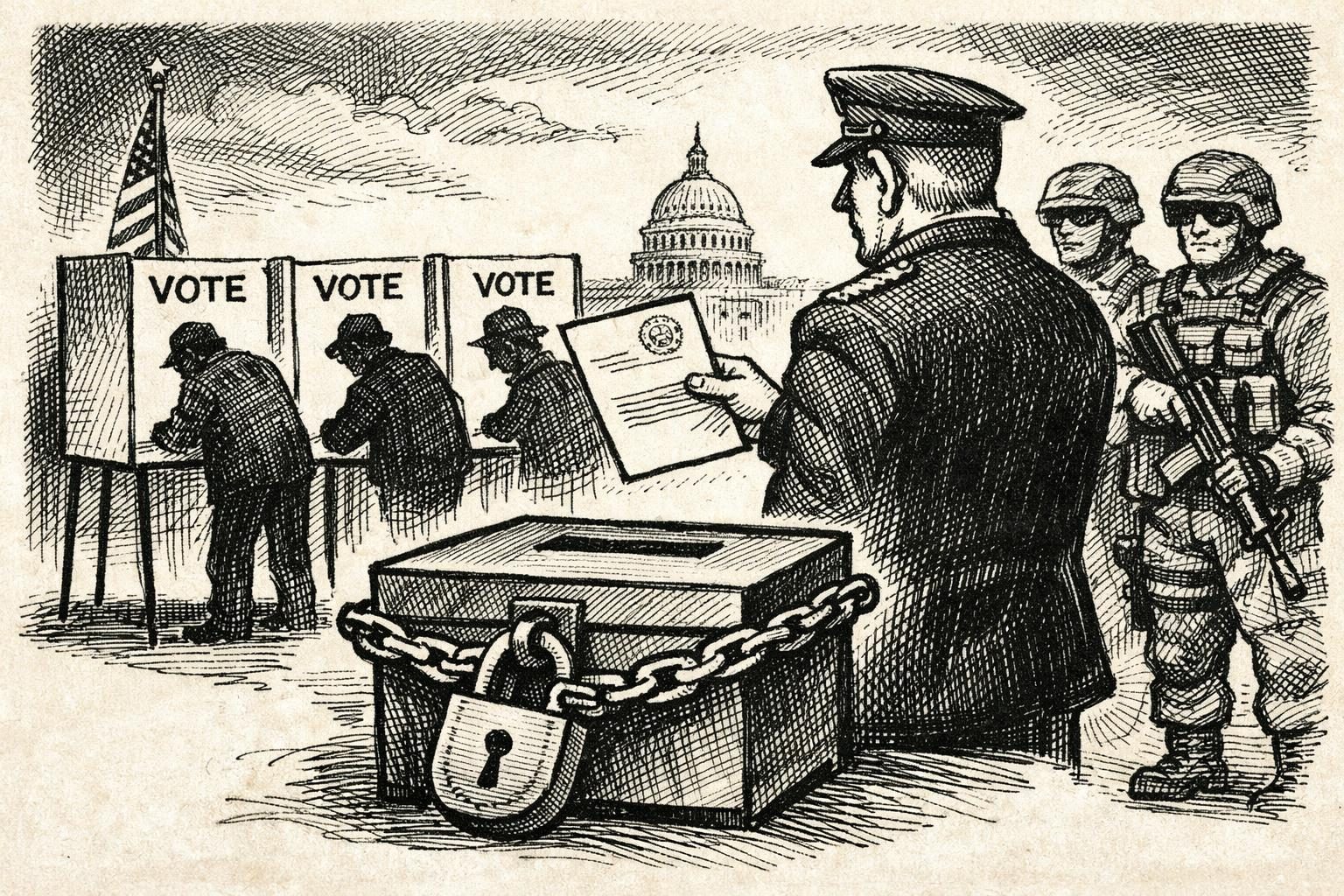
The chairman of the Joint Chiefs of Staff has now put in writing what, in a functioning democracy, should not have needed spelling out: the military does not have plans to send federal troops or federalized National Guard members to polling places during the 2026 elections. The letter was an answer to growing questions from lawmakers who wanted a clear statement about whether the administration might try to place uniformed personnel anywhere near voting lines. For now, the answer is no. But the fact that the answer had to be formalized at all says plenty about how far election fears have traveled from the fringe into the center of Washington debate. Reassurance is useful. The need for reassurance is the real warning sign.
The concern did not emerge in a vacuum. Democrats have pressed for clarity because the broader political environment has become thick with suspicion over election administration, federal power, and the possibility of rules being used as leverage rather than safeguards. Election officials and civil liberties advocates have already spent months warning about moves that could affect mail voting, ballot access, and the basic independence of local election systems. That backdrop has made even hypothetical talk about military involvement feel less like paranoia and more like contingency planning. A visible military presence at polling places would be an extreme step, one that would risk turning ordinary voting into a security theater exercise and would almost certainly deepen public mistrust. Even the explicit denial of that idea lands as evidence of how tense the moment has become.
The administration’s posture on election issues has helped feed that anxiety. It has already pushed hard on election rules, prompting repeated court fights and a steady stream of claims from critics that federal power is being tested against the boundaries of acceptable conduct. When a top military officer feels compelled to reassure Congress that troops will not be deployed to polling places, it suggests that the possibility, however remote it may still be, is now plausible enough to ask about in public. That is not a trivial shift. A decade ago, the prospect of military personnel near voting booths would have sounded so implausible that it might have been dismissed out of hand. Now it has become a question worth putting on paper, which tells you how much normal political trust has eroded. The military is trying to remain above partisan conflict. The political system around it is giving the impression that it might not stay there by accident.
There is also a deeper institutional problem lurking behind the immediate reassurance. Election administration depends on the public believing that voting is conducted by neutral local officials under stable legal rules, not by whichever faction happens to control federal agencies at the moment. That confidence is fragile even in calm times, and it becomes much more vulnerable when national leaders treat election procedures as a battlefield. The chairman’s letter may calm some fears for now, but it does not resolve the larger question of whether federal institutions are being pulled into political fights that should never reach the polling place. Lawmakers now have a written statement they can cite if the issue resurfaces. Campaigns have another example to use when warning voters that the stakes go beyond ordinary partisan competition. And election workers, who are already carrying the burden of operating under intense scrutiny, are left to read yet another reminder that the rules of the game are not universally assumed to be fixed. In that sense, the letter is less a conclusion than a symptom. It shows that the country has reached a point where a promise not to station troops at polling places counts as a needed act of damage control, and that alone says more about the political climate than any single denial could undo.
Comments
Threaded replies, voting, and reports are live. New users still go through screening on their first approved comments.
Log in to comment
No comments yet. Be the first reasonably on-topic person here.