
The administration’s own court filing says clean-energy grants were canceled for political reasons
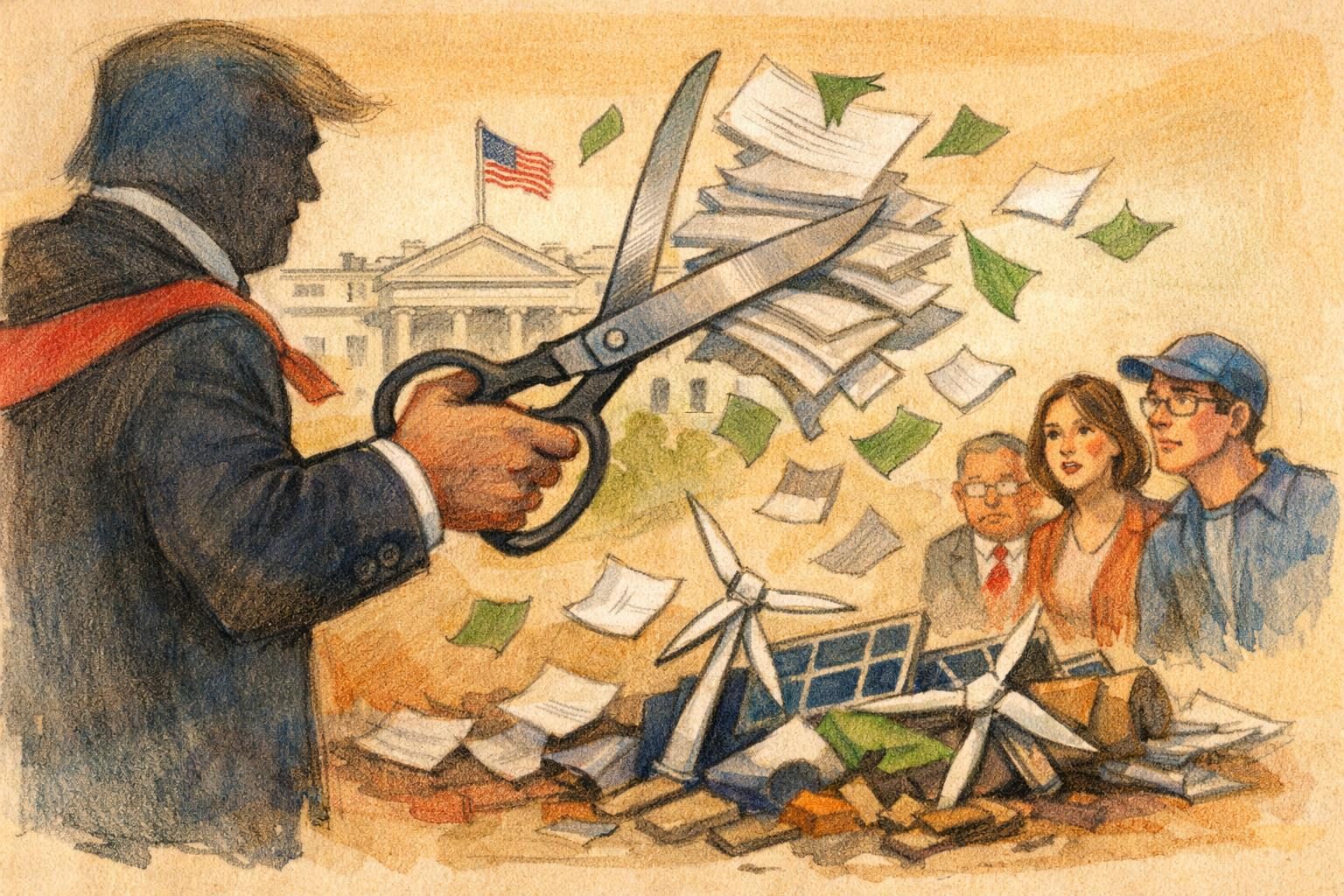
The Trump administration has now put in writing what its critics have been arguing for months: the cancellation of $7.6 billion in clean-energy grants was driven by politics, not by neutral program management. In a court filing, the government tied the termination of the grants to the fact that the affected states had voted for Kamala Harris in 2024. That is an extraordinary statement to see in a legal document because it moves the dispute from the realm of inference and allegation into the far more damaging territory of formal admission. Even if the administration continues to argue that the grants were improper for other reasons, the filing gives opponents a line they can repeat with confidence: the money was taken away because the states were Democratic. The practical effect is to change the posture of the case, and perhaps the public debate around it, in a way the White House would almost certainly prefer to avoid.
The new filing also deepens the sense that the administration’s earlier explanations do not sit comfortably with the record now before the court. For months, the government had publicly framed the grant cancellations as a matter of policy review, program integrity, or fiscal discipline, the kind of language administrations often use when they want to justify cutting politically sensitive spending. But a court filing that points to the voting behavior of the recipient states does not sound like a technical evaluation of grant performance. It sounds like a political test, one that turns federal spending into a reward-and-punishment system based on which side of the presidential race a state happened to support. That is why the filing matters so much beyond the immediate litigation. It suggests that what was described as administration housekeeping may have been something closer to partisan retaliation, and that distinction could become central in court as well as in Congress. If the government’s own lawyers are now documenting that the states were targeted for supporting Harris, the legal and political vulnerabilities widen at the same time.
For the states and organizations challenging the cancellations, the filing is the kind of evidence that can reshape a case. Claims of retaliation, viewpoint discrimination, or arbitrary executive action are much easier to press when the government’s own document appears to connect funding decisions to partisan outcomes. Judges do not have to accept that the admission resolves everything, and the filing does not by itself decide whether the cancellations were lawful under the relevant statutes and grant conditions. But it does make the administration’s defense harder to present as a straight policy dispute. The question is no longer only whether the grants should have been canceled, but whether federal power was used to penalize places because of how they voted. That is a more serious allegation, and it reaches into basic norms about how the executive branch is supposed to treat states, especially when the money at issue is meant for clean-energy projects that were already approved and underway. If the government’s explanation is now effectively that Democratic states were singled out, opponents will argue that the real injury is not just financial but institutional.
The political fallout is obvious because this is the kind of material that can be quoted in one line and understood instantly. Democrats can now say the administration admitted what it had denied: the grants were canceled because the wrong states won the wrong election. Environmental groups can use the filing to argue that clean-energy investment is being weaponized for partisan ends. Republican allies may still try to frame the dispute as a fight over overreach, waste, or ideological favoritism in prior grantmaking, but that is a tougher sell once a legal record points to the recipients’ voting patterns as the reason for the cuts. The episode also feeds a broader concern that federal agencies are increasingly being used as instruments of political retribution rather than neutral administration. That concern is not limited to any one program, and it is one reason this filing could resonate well beyond the specific grants at issue. Even if the administration tries to narrow the meaning of the document, the phraseology is now out there, and once a party’s voting behavior is linked to federal funding decisions, the accusation sticks.
There is still a legal process ahead, and the filing does not by itself settle the underlying lawsuits. The government may try to argue that the cancellations were lawful for reasons embedded elsewhere in the record, or that the court should read the filing in a more limited way than critics will. But the damage is already done in terms of public credibility. Courts, lawmakers, and voters are now likely to examine the administration’s broader use of executive discretion with more suspicion, particularly when decisions appear to track partisan geography. This is also the sort of case that can linger because it is easy to explain and hard to forget. The administration can argue about policy details all it wants, but a court paper saying the grants were killed because the states backed Harris is the kind of fact that does not fade. It becomes a shorthand for the whole fight, and shorthand is usually what wins the attention war. For a White House already accused of turning government into a political cudgel, the filing hands opponents a cleaner and more damaging narrative than they could have hoped for on their own.
Comments
Threaded replies, voting, and reports are live. New users still go through screening on their first approved comments.
Log in to comment
No comments yet. Be the first reasonably on-topic person here.