
Federal court blocks Trump election order in California suit
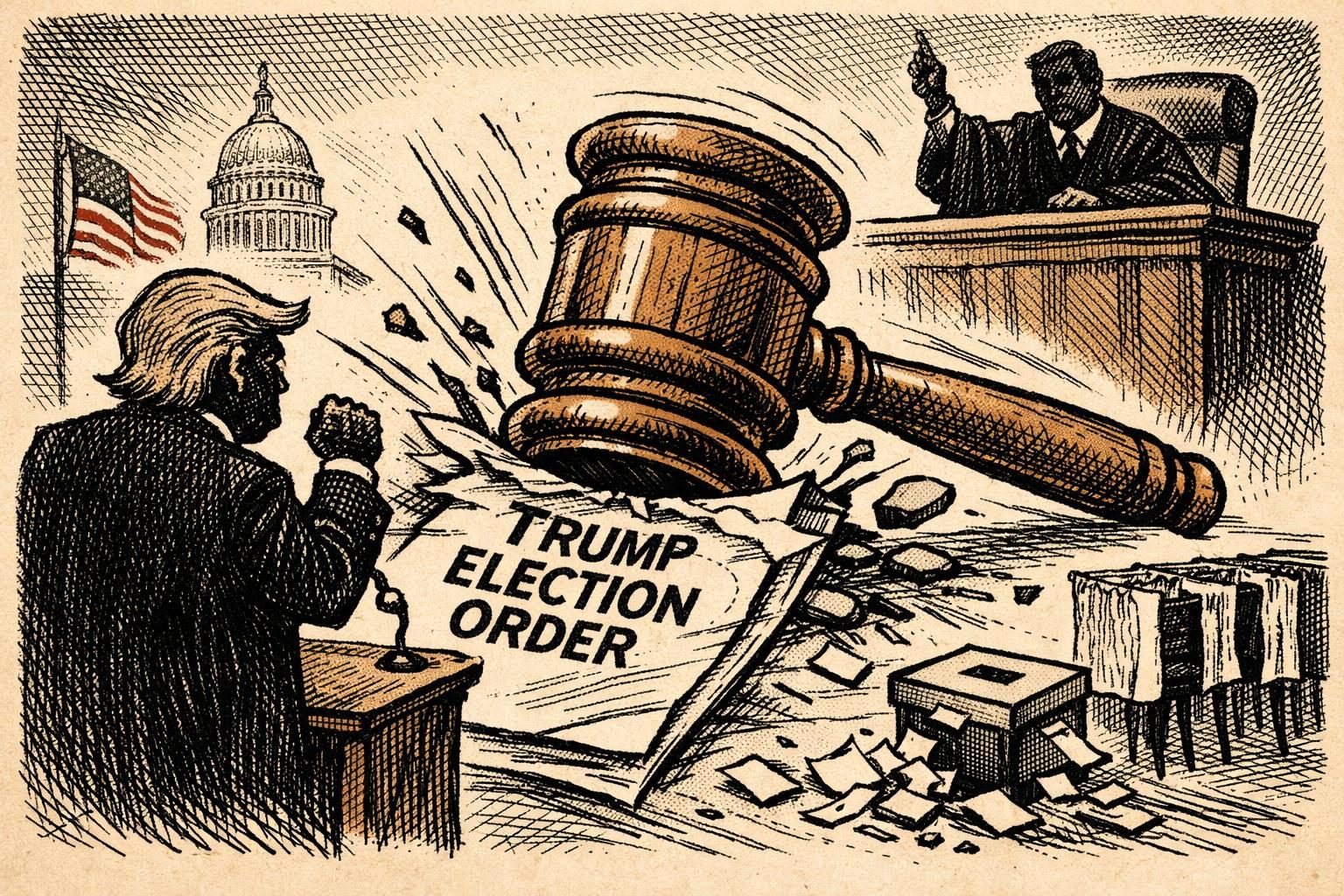
A federal judge has put a hard stop on key parts of a White House election order, ordering the administration to halt implementation in the plaintiff states and to unwind any steps already taken under the challenged provisions for the coming federal election. In the California-led case, the court concluded that the disputed parts of the directive could not be carried out as written for federal election purposes, at least against the states that brought the lawsuit. The ruling does not end the broader fight over the order, but it does remove immediate force from the provisions the court found unlawful. It also means federal officials now have to treat those sections as off-limits while the case continues. For an administration that had been pressing ahead with the directive, the result is a significant legal setback.
The order matters because election directives are not just political messaging. When the White House tells federal agencies how to operate around voter registration, citizenship verification, election administration, or other election-adjacent issues, even temporary steps can ripple through state systems and confuse local officials. The judge’s intervention signals that federal power has limits when it comes to managing elections, especially where the Constitution and federal statutes set the boundaries. The court’s action also suggests that, at least on the record before it, the challenged provisions were not merely controversial but legally defective enough to justify immediate restraint. That is a strong message to the executive branch, which often relies on urgency and administrative momentum to push disputed policies into practice before courts can catch up. Here, the court essentially refused to let that strategy work.
The practical effect is twofold. First, the plaintiff states get relief from having to live under provisions they argue should never have been imposed in the first place, which spares them further administrative disruption while the case moves ahead. Second, federal agencies are now under notice that they must stop implementation and report back on compliance, which turns the dispute into a live supervision problem rather than a purely abstract legal fight. The judge also required the government to notify agencies and provide a status update, a step that indicates the court expects prompt and concrete action rather than vague assurances. That kind of compliance order often matters as much as the underlying legal ruling, because it forces the executive branch to account for what has already happened and what still needs to be undone. In that sense, the decision is not just a rebuke; it is also an administrative cleanup order aimed at limiting spillover from the blocked provisions.
The broader political significance is harder to miss. Election orders can become flashpoints because they sit at the intersection of presidential authority, state control over elections, and the rights of voters who depend on clear rules. When a court tells the administration to stand down in significant part, it weakens the image of executive control and strengthens the argument that election administration cannot be changed by forceful decree alone. Civil-rights and voting-rights advocates are likely to see the ruling as evidence that courts remain a backstop against overreach in election policy. The administration, by contrast, now has to defend a directive that at least one federal court has treated as unlawful in important respects. That is not an easy position, especially when the calendar is moving toward a major federal election and uncertainty is the last thing election officials want. What happens next will depend on further litigation and any appeal or emergency relief the government seeks, but for now the court has made one point unmistakable: the White House cannot simply will disputed election rules into existence and expect the states to follow along.
Comments
Threaded replies, voting, and reports are live. New users still go through screening on their first approved comments.
Log in to comment
No comments yet. Be the first reasonably on-topic person here.