
White House slaps a $100,000 price tag on H-1B entry
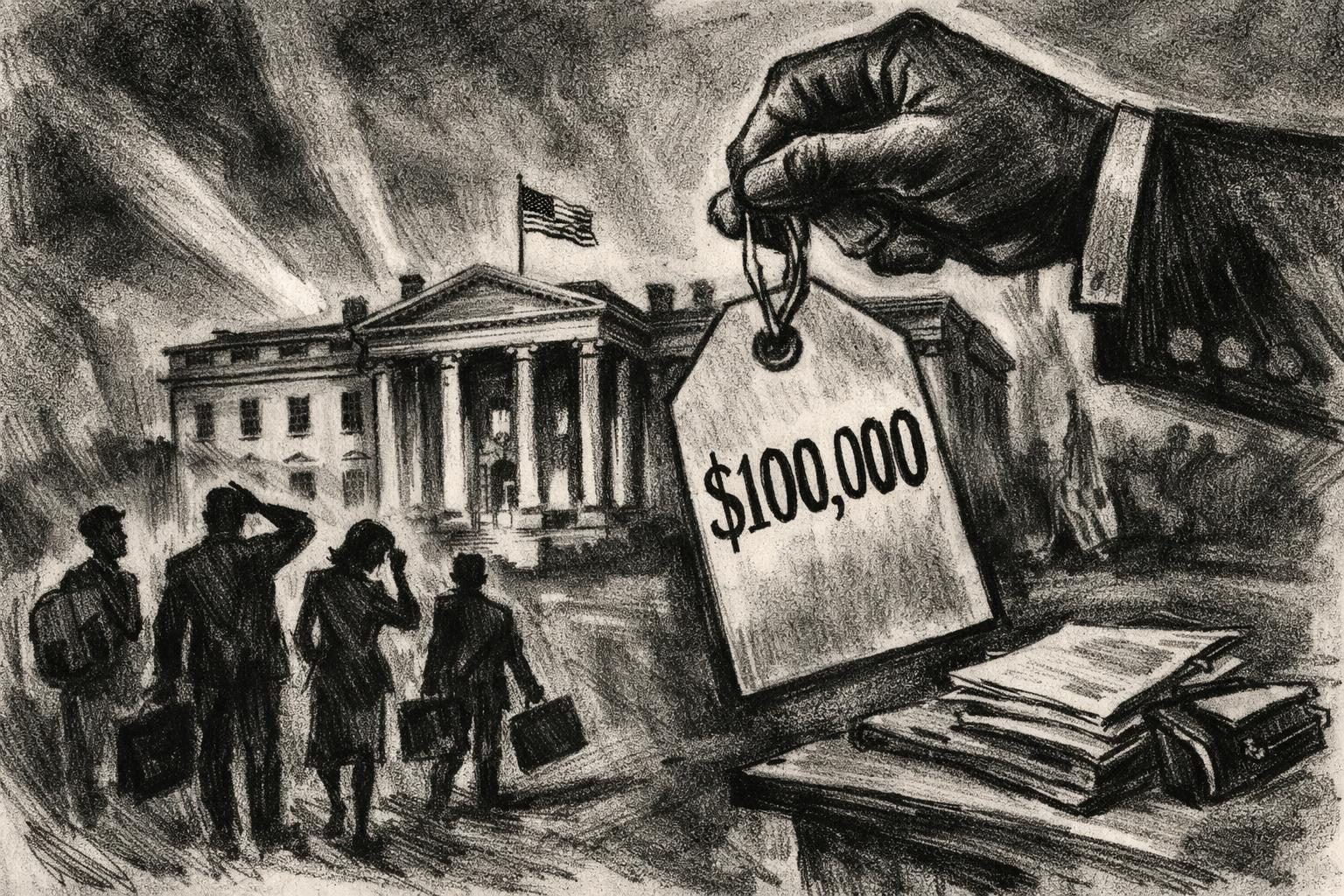
The White House has put an abrupt, expensive new barrier in front of H-1B workers, announcing that specialty-occupation employees will be blocked from entering the United States unless the petition is paired with a $100,000 payment, with limited national-interest exceptions. The move lands as one of the administration’s most aggressive steps yet against the visa category that has long helped U.S. companies hire engineers, programmers, researchers, doctors, and other specialized talent from abroad. It also directs federal agencies to tighten scrutiny around petitions and visas for workers outside the country, signaling that the administration wants to slow the pipeline well beyond the airport checkpoint. In practical terms, the proclamation turns a familiar employment visa into a far more costly and uncertain proposition almost overnight. Employers, foreign workers, and immigration lawyers now have to sort through a policy that appears designed as much to deter as to regulate.
That matters because H-1B has never been just an immigration program; it is a pressure valve for industries that say they cannot always find enough workers with the right skills in the domestic labor market. Large technology companies rely on it, but so do hospitals, universities, engineering firms, manufacturers, financial firms, and smaller businesses that compete for highly trained employees. By attaching such a steep price to entry, the administration is not merely adding paperwork or raising compliance costs. It is changing the basic economics of sponsorship in a way that could make the visa function less like a channel and more like a wall. Even if the White House frames the change as a measure to protect American workers and restore integrity to the system, the immediate effect is to inject doubt into hiring plans, recruitment timelines, and staffing budgets across a wide range of sectors. Companies that assumed the existing rules would hold are now being forced to rethink their options in real time.
The administration is casting the move as part of a broader effort to crack down on fraud, abuse, and what it says are distortions in the program, and that rhetoric is doing a lot of work. By invoking labor protection and program integrity, the White House is placing the H-1B fight squarely inside the same political frame that has shaped its wider immigration agenda: suspicion of foreign labor, a promise to prioritize domestic workers, and a willingness to use blunt executive power to make the point. But a policy that is meant to deter abuse can also sweep in lawful applicants and legitimate employers who had nothing to do with misconduct. That is where the concern gets sharper, because the proclamation appears to lean heavily on deterrence rather than on targeted enforcement. If the result is a mess of exceptions, delays, inconsistent treatment, or legal ambiguity, then the burden may fall on compliant companies and workers while the deeper problems remain unresolved. That is the central contradiction built into the new rule: it presents itself as a clean-up effort, but it may create a new layer of chaos before it solves anything.
The real-world fallout is likely to unfold quickly, even if parts of the policy face immediate challenge or practical uncertainty. Agencies will have to interpret what qualifies for the national-interest exception, how the payment requirement will be applied, and what happens to petitions already in the pipeline. Employers will have to decide whether to absorb a staggering new cost, delay hiring, move work elsewhere, or abandon planned recruitment altogether. Foreign workers, especially those outside the United States, are left in a holding pattern while the government works out how much of the rule can be implemented, how aggressively it will be enforced, and whether the courts or the agencies will narrow its scope. For now, the proclamation is less a finished system than a shock to the system, and that may be the point. The White House has made clear that it wants to turn H-1B into a much tougher gate to pass through, and it has done so in a way that leaves the people who depend on it with the least certainty and the most to lose.
Comments
Threaded replies, voting, and reports are live. New users still go through screening on their first approved comments.
Log in to comment
No comments yet. Be the first reasonably on-topic person here.