
Supreme Court pauses Missouri redistricting rulings in a late-night election mess
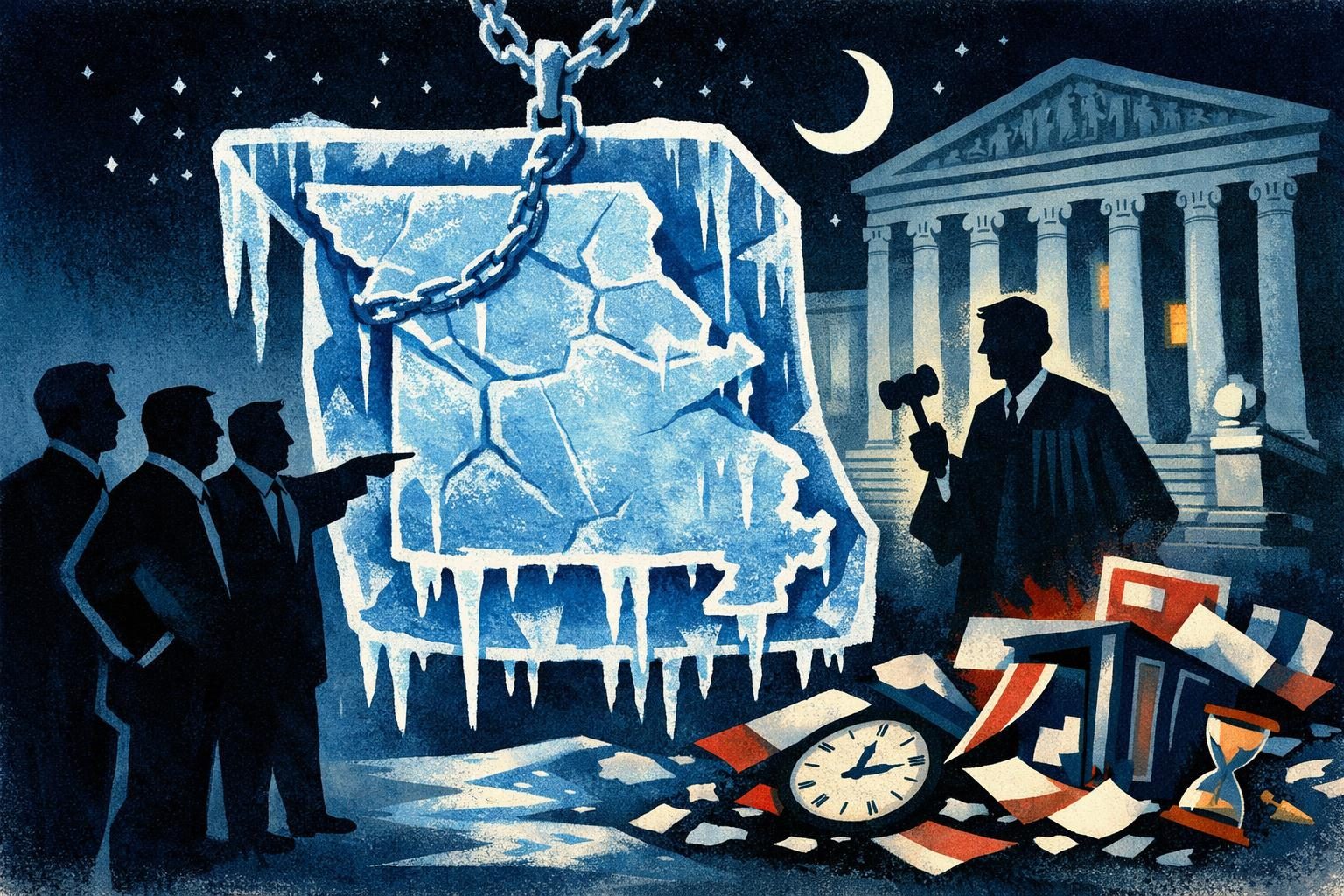
The Supreme Court on September 26 stepped into Missouri’s congressional map fight with the kind of late-night procedural move that can scramble an election calendar before anyone has time to catch up. In a brief order, the justices stayed lower-court rulings that had kept the dispute alive and had blocked the state from moving ahead under the map in its current form. The order reaches both an Eighth Circuit mandate and district-court injunctions, freezing their immediate effect while the case continues to move through the courts. For now, that leaves the map’s defenders in the stronger position and its opponents scrambling to read what the stay means for the next phase of the litigation. It is not a final ruling on the merits, but it is a powerful signal that the Court is willing to alter the rules of the road while the vehicle is already moving.
The practical effect of the stay is easy to see even if the legal logic remains tangled. Missouri’s congressional boundaries are not just a technical dispute over district lines; they determine who can run, where they can run, and under what political geography the next election will be fought. When a court order changes that framework this close to candidate filing deadlines and ballot preparation, it can ripple through campaigns, election administrators, and voters all at once. State officials are left trying to make plans around a case that may shift again with another emergency filing or another judicial directive. Candidates have to decide whether to organize around the map as it exists, the map as a lower court wanted it to exist, or the map that might emerge if the litigation returns in another form. That kind of uncertainty is not a side effect anymore. In election law, it has become part of the governing structure.
The stay also fits a broader pattern in which the Court’s emergency docket has become a regular venue for high-stakes election disputes that should, at least in theory, have been resolved well before they reached this stage. Instead of a slow and orderly process that gives states and campaigns time to adapt, the legal system is increasingly delivering last-minute intervention that can reorder the battlefield with minimal explanation. That is especially disruptive in redistricting cases, where timing matters as much as doctrine and where every delay can change the practical balance of power. The Missouri dispute has been moving through the lower courts, but the Supreme Court’s intervention turns it into a sprint between judicial process and the administrative calendar. In that race, delay often favors whichever side is already benefiting from the status quo. Critics of emergency rulings say the Court is not merely responding to instability but helping create it, then using that instability as the reason to keep acting quickly. Whatever one thinks of that critique, this order gives it fresh fuel.
Politically, the immediate fallout is less about the paper trail than about the message. Missouri’s map battle now stands as another reminder that congressional redistricting can become a proxy war over who gets to shape the electorate before a single vote is cast. The justices have not resolved the underlying questions, and the merits of the case still matter. But the stay changes the leverage in the meantime, and leverage is often what decides election disputes long before a final opinion arrives. For local officials and campaign operatives, the order effectively tells them to keep waiting while the court decides whether the case should continue on the fast track. For everyone else, it is another demonstration that the machinery of election law can be stopped, restarted, and redirected in a single unsigned order. The result is not clarity. It is another round of managed confusion, with the Court holding the steering wheel and everyone else trying to keep their footing on the road behind it.
Comments
Threaded replies, voting, and reports are live. New users still go through screening on their first approved comments.
Log in to comment
No comments yet. Be the first reasonably on-topic person here.