
White House doubles down on immigration restriction for certain foreign workers
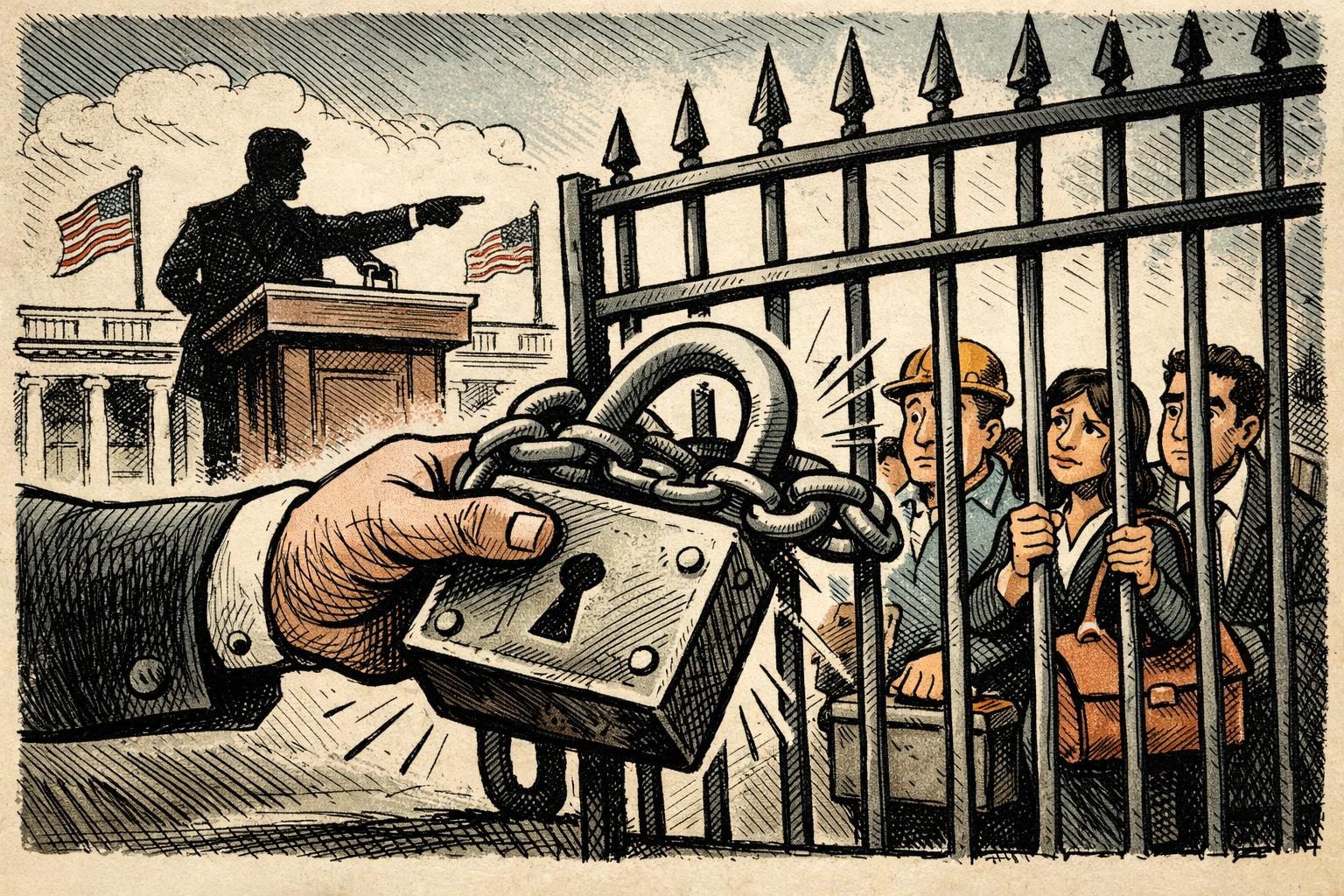
The White House has put a new immigration restriction into effect that targets the entry of certain nonimmigrant workers, turning a campaign-style posture into an immediate governing action with consequences that are already being felt by employers, visa holders, and immigration lawyers. The proclamation took effect on September 21 and is now part of the day-to-day reality for companies that rely on foreign talent to fill specialized jobs. This is not a symbolic statement or a vague warning about future enforcement. It is a formal executive move that changes the ground rules while the broader immigration fight continues to rage around it. For businesses, that means hiring plans, onboarding timelines, and visa strategies may now have to be rewritten with little notice. For workers, it means entry and mobility decisions can be altered by a presidential signature rather than a lengthy legislative process.
What makes the move so consequential is not only the substance of the restriction but the mechanism behind it. The administration is using presidential authority to narrow access for a subset of foreign workers, framing the policy as a matter of domestic protection and federal control. That approach is politically potent because it allows the White House to act quickly and present the decision as a response to current conditions rather than a promise deferred to Congress. It also sidesteps the messier work of building durable legislation, where lawmakers would have to spell out the rules in public and take ownership of the tradeoffs. Supporters of tighter immigration controls will likely see this as a straightforward use of executive power to protect domestic labor interests. Critics will see something else: a fast-moving restriction that may affect lawful entrants without the kind of transparent debate that usually accompanies major changes to immigration law.
Business groups are almost certain to object, if only because uncertainty is poison to hiring. Employers that depend on foreign professionals typically plan months in advance, often navigating a maze of filings, travel schedules, and compliance deadlines. A sudden restriction on entry for certain nonimmigrant workers does not just alter one border crossing; it can disrupt entire labor pipelines, delay projects, and complicate staffing in sectors already struggling to recruit. Immigration attorneys are likely to spend the coming days and weeks parsing the proclamation’s language to determine who is affected, which categories are covered, whether any exemptions apply, and how aggressively the administration intends to enforce the new policy. That kind of uncertainty can be costly even when the final scope turns out to be narrower than feared. In practice, the fear of disruption can be almost as damaging as the disruption itself, because companies begin making defensive decisions before the details are fully clear.
Immigration advocates, meanwhile, are likely to argue that the proclamation fits a familiar pattern: the use of executive authority to shrink lawful entry without the accountability that comes from a broader legislative fight. They will probably say the administration is treating immigration less like a system to administer fairly and more like an emergency lever to be pulled when politically convenient. That critique is not just rhetorical. When policy can be tightened through proclamation, the rules governing work, travel, and family planning become more volatile, especially for people who are technically authorized to come to the United States but now face new barriers at the border or in consular processing. The result is a system that can feel less predictable for people who follow the law than for those who try to exploit loopholes. Even when the government insists the policy is limited or justified, the practical effect is to remind visa holders that their status can be narrowed by executive action with very little warning.
The broader political significance of the move is that it reinforces a governing style in which immigration is treated as something to be controlled through emergency-like measures rather than stable administration. That may be satisfying to restrictionists who want stronger barriers and fewer admissions, but it leaves employers, workers, and lawyers operating in a climate of churn. It also keeps the larger debate unresolved. The White House can claim it is acting decisively, but the underlying tension remains: how much power should the executive branch have to reshape lawful immigration flows on its own, and how much of that decision should be forced through Congress? For now, the answer is being written in real time through a proclamation that has already taken effect and may face legal, political, and practical pushback as its consequences become clearer. The immediate takeaway is simple enough: immigration policy is once again being turned on and off by presidential decree, and the people most likely to pay the first price are the ones who were trying to follow the rules.
Comments
Threaded replies, voting, and reports are live. New users still go through screening on their first approved comments.
Log in to comment
No comments yet. Be the first reasonably on-topic person here.