
Postal Service halts work on mail-voting system after court defeat
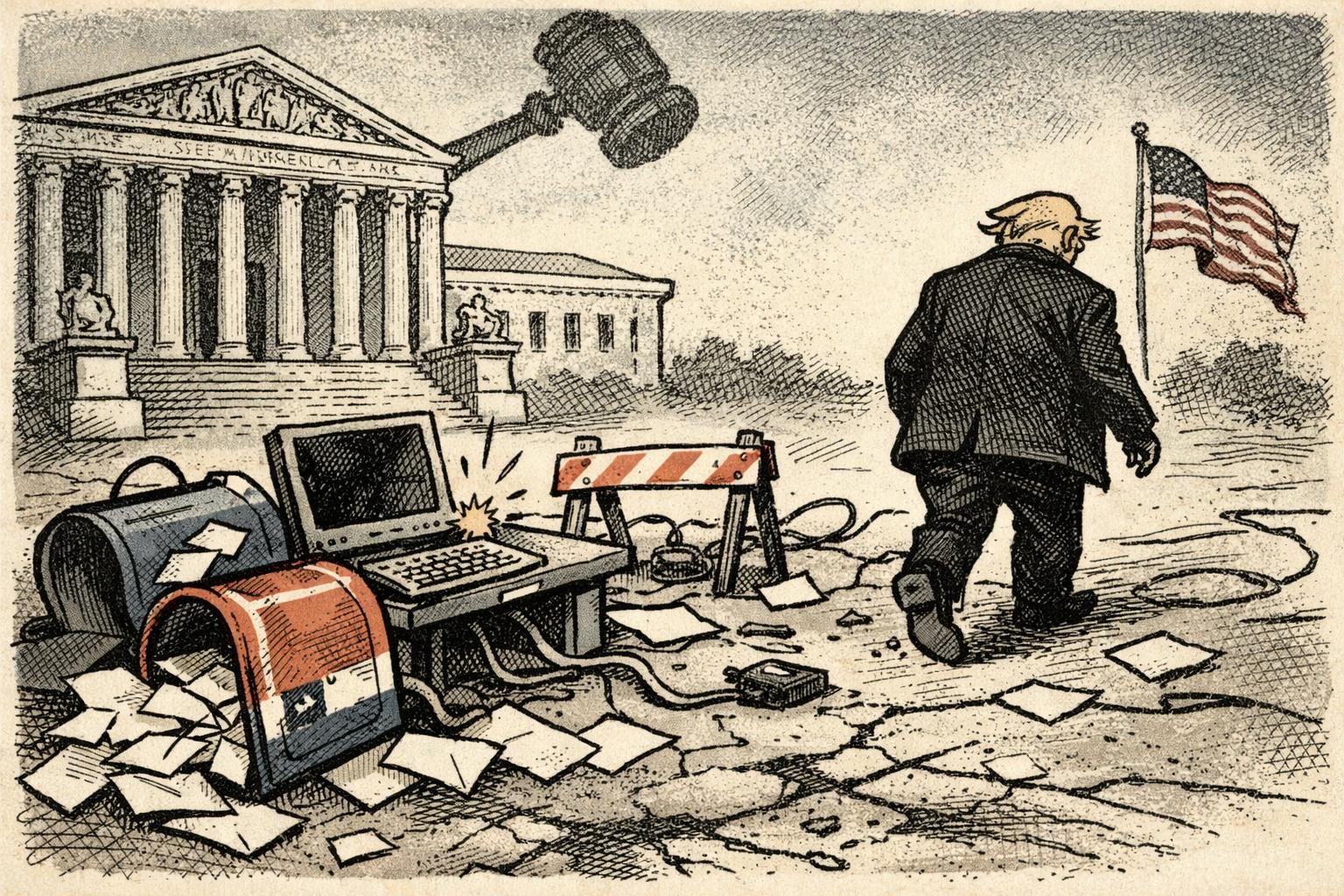
The Postal Service has stopped work on the computer system tied to President Donald Trump’s effort to clamp down on mail voting, a sharp sign that the administration’s push has run into a wall of law and logistics. Postmaster General David Steiner said the agency is not moving forward because an injunction is in place, effectively acknowledging that the project cannot advance while the courts are blocking the underlying policy. The decision comes after the Supreme Court rejected the administration’s attempt to enforce the mail-ballot restrictions for the midterms, depriving the White House of the legal cover it needed to keep pressing ahead. What had been cast as a major step in reshaping election administration has now been reduced, at least for the moment, to a halted internal project. That makes the Postal Service’s retreat more than a procedural footnote; it is a concrete setback for a drive that was supposed to change how elections are administered on a national scale.
The significance of the move goes beyond one computer system or one agency memo. Mail voting is not a marginal feature of American elections, especially in a country where millions of voters rely on it for convenience, accessibility, or necessity. In many states, election officials are already deep into the work of printing, preparing, and mailing ballots for upcoming contests, which means any sudden federal attempt to alter the machinery of mail voting would have introduced exactly the kind of disruption that election administrators spend months trying to avoid. The Postal Service was being asked to play a central operational role in a politically charged effort that would have touched nearly every part of the vote-by-mail process. Halting the system now suggests that the administration’s plan was not just legally vulnerable but operationally unrealistic once the courts stepped in. It also underscores how difficult it can be to transform election rules on the fly, even when the White House wants the federal bureaucracy to help do the work.
The broader fight has exposed a familiar argument about executive power and elections. Voting rights advocates have warned for months that the administration was trying to rewrite election rules through unilateral action instead of legislation, a strategy they said threatened to sidestep the usual democratic process. The Postal Service’s decision to stop work lends weight to that criticism because it shows how deeply the agency was drawn into a policy fight it did not control. When a federal service built to deliver mail is suddenly implicated in a campaign to narrow access to mail ballots, it raises obvious questions about institutional independence and political pressure. Steiner’s explanation, centered on the injunction, also reflects the simple reality that agencies do not get to ignore court orders while waiting for politics to catch up. With the Supreme Court refusing to bless the underlying restrictions, the administration is left with a weaker hand and a rapidly closing window before the midterms.
For states and voters, the immediate effect may be less dramatic than the rhetoric surrounding the fight, but it still matters. Election officials can continue using the systems already in place, which lowers the risk of a last-minute administrative scramble that could have confused voters and strained local offices. That does not mean the dispute is over, or that it cannot reappear in some other form, but it does mean the most ambitious version of the Postal Service role has been shelved for now. The episode is a reminder that election administration is built on a lot of practical machinery, and those systems are not easy to repurpose at the speed of political combat. For Trump, the outcome is another example of raw executive ambition colliding with institutions that still have limits. For everyone else, it is a sign that the courts have, at least temporarily, stopped a push that could have turned a mail ballot fight into an election-year logistical mess.
Comments
Threaded replies, voting, and reports are live. New users still go through screening on their first approved comments.
Log in to comment
No comments yet. Be the first reasonably on-topic person here.