
Supreme Court lets Florida keep stripping rainbow crosswalks
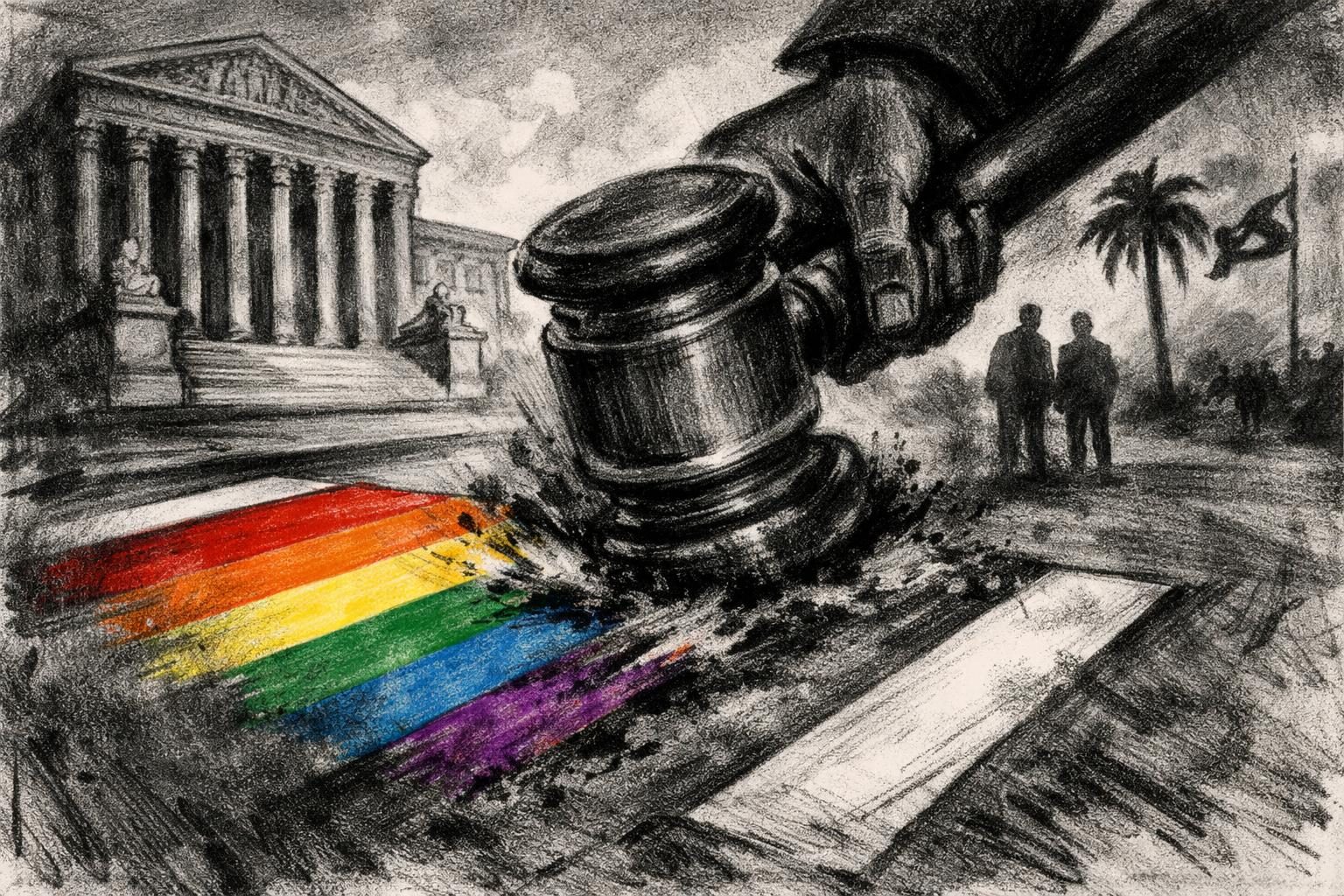
The Supreme Court has left Florida’s anti-rainbow-crosswalk policy in place for now, declining to revive an injunction that would have temporarily shielded the painted street designs from removal. The decision does not resolve the underlying legal fight, and it does not amount to a final ruling on the constitutionality of the state’s policy. But it does mean the immediate protection challengers were seeking is off the table, at least for the moment, and Florida officials retain the upper hand while the case continues to move through the courts. For LGBTQ advocates and local governments, that is not a small procedural detail. It means the state can keep treating a visible symbol of LGBTQ inclusion as something it may erase from public streets unless a lower court, a full appeals panel, or the justices themselves eventually say otherwise.
The dispute is about much more than paint on pavement. Rainbow crosswalks have become one of the most public, ordinary, and durable markers of LGBTQ visibility in many cities, precisely because they occupy shared civic space rather than private property or a protest stage. Supporters of the designs see them as a simple acknowledgment that queer people exist, contribute to communities, and deserve to be visible in the places where everyone else is visible too. Florida’s policy, by contrast, treats those symbols as a problem to be managed, whether on grounds of roadway standards, municipal authority, or some broader theory of keeping state-controlled spaces free of expressive markings. That framing is why the case matters beyond the immediate street-level dispute. When a government starts stripping away one kind of identity expression from public infrastructure, it is not just making an aesthetic choice. It is deciding whose presence can be made legible in everyday life.
The Court’s action here is narrow, but the effect is real. By refusing emergency relief, the justices have preserved the status quo and allowed the state’s approach to keep operating while the litigation proceeds on a slower track. That matters because the longer a policy like this remains in place, the easier it is for officials to normalize it as routine governance rather than the deliberate political statement it is. Florida can now point to the fact that the challenge did not win immediate intervention, and that may encourage other conservative lawmakers and administrators to see similar measures as low-risk. For LGBTQ residents, the practical message is that visibility can be made contingent on the pace of litigation, which is often the same as saying it can be delayed into irrelevance. That is one of the quiet ways anti-LGBTQ policy advances: not always through dramatic pronouncements, but through enough procedural success to keep exclusion intact in the meantime.
There is room for the state to argue that the issue is about neutral roadway rules and the power of local officials, not hostility toward LGBTQ people. That argument may matter in court, and it may persuade judges who prefer to see the case in technical terms rather than cultural ones. But technical language does not change who loses when a rainbow crosswalk disappears from public view. The practical target is a symbol that has come to stand for inclusion, safety, and recognition in spaces that are supposed to belong to everyone. Critics are likely to read the state’s position as petty, cruel, and performative, and that reaction is easy to understand. Supporters will insist the controversy is being overstated. Yet the stakes are visible in the most literal sense possible: whether an LGBTQ marker remains on the street or gets erased from it. The Court did not decide that question forever, but it did decline to stop Florida from answering it for now in its own favor. That is a small ruling in formal terms, but a meaningful one in political terms, because sometimes the loudest statement is made by refusing to intervene when visibility is on the line.
Comments
Threaded replies, voting, and reports are live. New users still go through screening on their first approved comments.
Log in to comment
No comments yet. Be the first reasonably on-topic person here.