
Trump’s mail-voting crusade is now a Postal Service headache
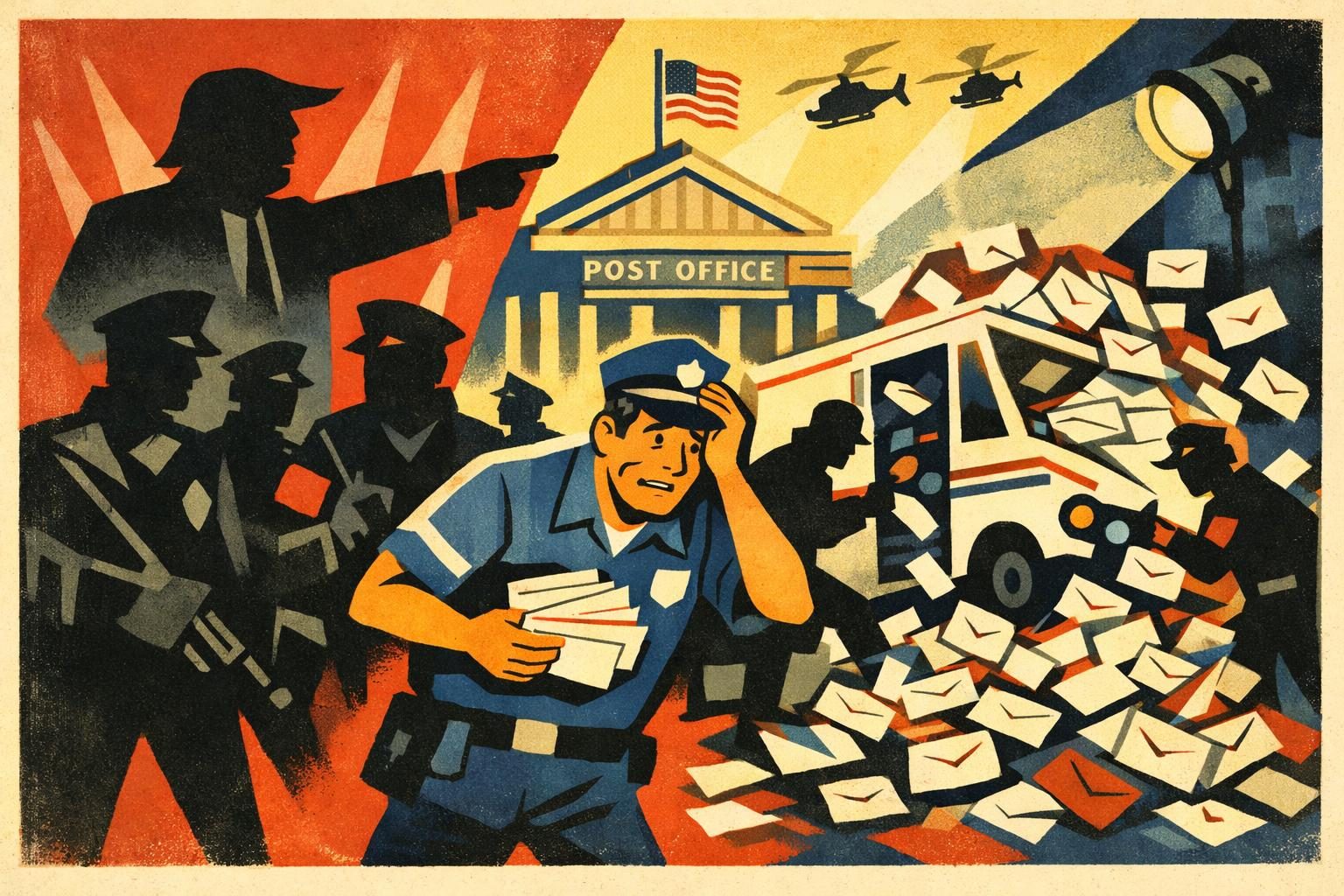
The Trump administration’s effort to tighten the screws on mail voting has landed the Postal Service in a familiar but uncomfortable spot: right in the middle of a political fight it keeps insisting it does not want. What started as a campaign-style attack on voting by mail has increasingly taken on the shape of a governmentwide policy push, with the White House leaning on the postal system in ways that make neutrality harder to perform than proclaim. The result is a strange kind of bureaucratic collision, one in which election administration, partisan messaging, and federal logistics are all being mashed together into a single argument. The Postal Service, which is built to move ballots and packages without taking sides, now has to explain how it can keep its distance while serving as part of a broader crackdown on a lawful voting method. That is not an easy case to make when the administration itself is treating mail voting less like a practical election tool and more like a target.
The tension matters because the Postal Service occupies a uniquely sensitive place in civic life. It is one of the few federal institutions that millions of people encounter as a matter of routine, and its credibility depends on the public believing that it delivers mail impartially, regardless of who is in power. Once the agency is dragged into disputes over whether voters should be able to use the mail to cast ballots, the damage is not just reputational in the abstract. It can shape whether voters trust deadlines, whether election officials trust delivery times, and whether local administrators can confidently tell people that their ballots will arrive and be counted as intended. The administration’s posture appears to rest on the idea that mail voting is something to be controlled, narrowed, or politically discredited, rather than simply managed as one of several lawful ways Americans participate in elections. That may play well with loyal supporters who view mail ballots with suspicion, but it also creates the risk of unnecessary confusion for voters who rely on them, especially in places where voting by mail is common and deeply embedded in election practice. In a system already strained by distrust, even a modest federal push to police the process can ripple outward in ways that are difficult to contain.
That is why the criticism from election experts, postal workers, and democracy advocates has been so pointed. Their central concern is not that election rules should never be reviewed or that postal operations should never be scrutinized. It is that politicizing the delivery system itself can generate more uncertainty than it solves, particularly when the underlying claims of widespread fraud have not been shown with enough force to justify broad disruption. If the administration’s response to electoral frustration is to turn the Postal Service into a pressure point, the practical effect may be to invite doubt into a process that depends on routine, predictability, and public confidence. The more the postal system is discussed as an instrument in a partisan struggle, the more voters may begin to wonder whether their ballots are being handled as neutral mail or as evidence in a political case. That kind of suspicion can become self-perpetuating, because once people start worrying about whether mail voting is being targeted, every late delivery, every vague instruction, and every administrative hiccup takes on outsized significance. And in a midterm cycle, when control of Congress and local power can turn on small changes in turnout, procedural noise becomes a campaign issue almost instantly. The administration may see this as an assertion of order, but to critics it looks more like the government manufacturing doubt where it should be building reassurance.
For the Postal Service, the immediate fallout is mostly administrative, but that does not make it trivial. Leadership has to balance legal obligations, internal norms of neutrality, and pressure that is clearly political even when it is dressed up in the language of election integrity. That is a bad place for a service whose core mission is to move mail efficiently and reliably, not to referee a national argument over who gets to vote and how. The agency can repeat that it is not a political actor, but repeated exposure to a politically charged campaign makes that claim harder to sustain in the eyes of the public. Every new directive or public statement can look, fairly or not, like evidence that the postal system is being pulled deeper into the administration’s electoral strategy. The White House may think it is projecting strength by taking a hard line on mail ballots, but the broader effect is to make the country’s most essential delivery network explain why it keeps getting dragged into the campaign trench. That is a poor use of institutional energy, and it risks leaving behind exactly the kind of confusion and mistrust that election administrators spend years trying to prevent.
Comments
Threaded replies, voting, and reports are live. New users still go through screening on their first approved comments.
Log in to comment
No comments yet. Be the first reasonably on-topic person here.