
Federal election-law fight takes another hit after court dismissal
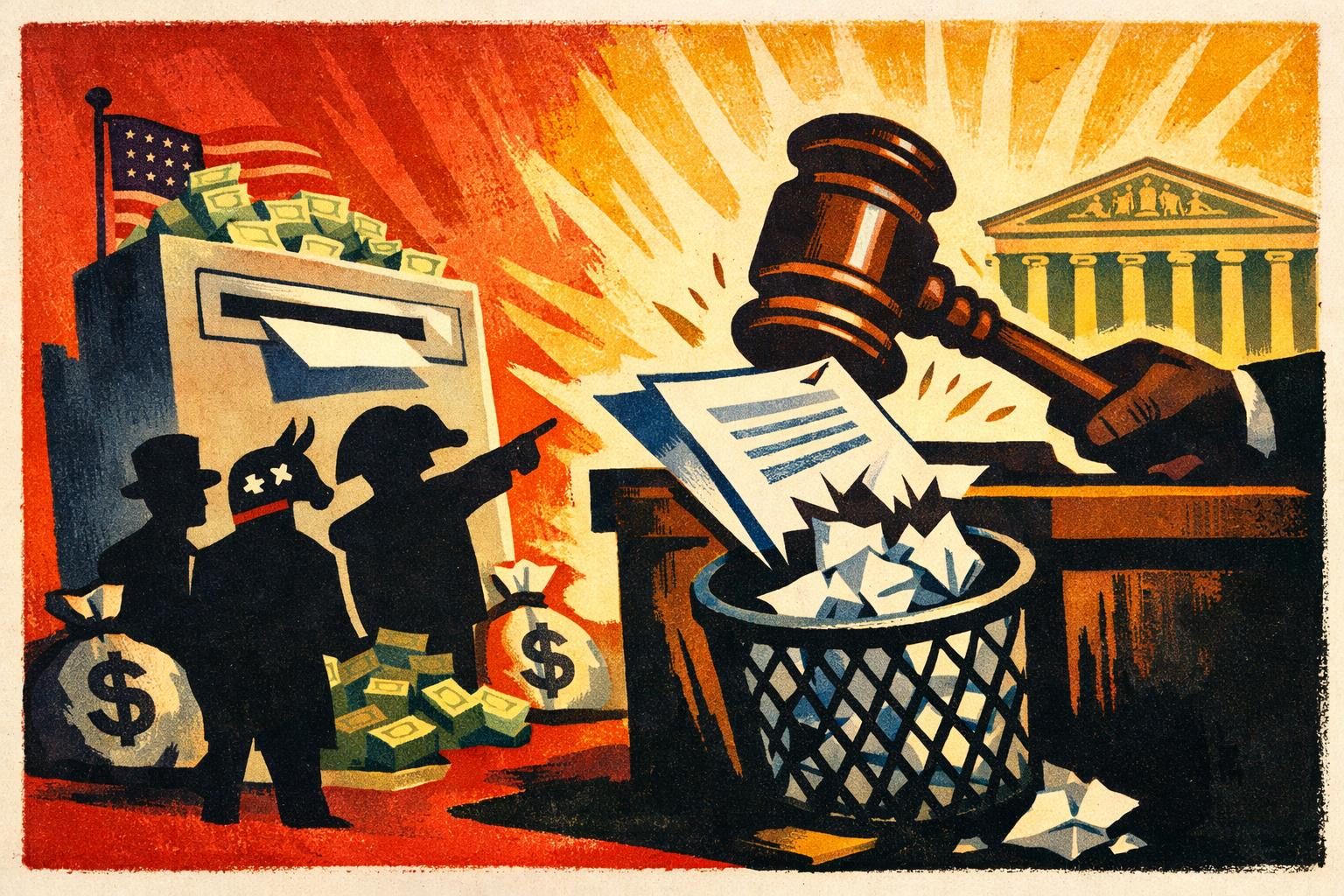
The Federal Election Commission’s case materials show that the Democratic Congressional Campaign Committee’s long-running election-law challenge has taken another hit, with the district court granting dismissal and treating the Supreme Court’s June decision as potentially mooting the dispute. On the face of it, that may sound like just another entry on a docket sheet, but in campaign-finance litigation, procedural losses often do the real work. A dismissal can end a case outright, narrow what a court is willing to consider, or signal that the legal theory supporting the challenge no longer has stable footing. Here, the court’s willingness to view the high court’s summer ruling as possibly mooting the issue suggests the ground beneath the case shifted enough to make the dispute harder to keep alive. That is a meaningful development in a field where every doctrinal change ripples through pending suits almost immediately.
The broader significance is that the political money system is becoming even more difficult to regulate through ordinary litigation. When the Supreme Court changes the operative baseline, lower-court cases built around the older framework can suddenly look outdated, weakened, or irrelevant before they are ever fully resolved. That does not only affect one party or one committee; it affects regulators, campaign lawyers, and reform organizations that rely on litigation to test the boundaries of what candidates, party committees, and outside groups can do. In practical terms, a court’s dismissal may matter less than the Supreme Court decision that created the problem in the first place, because the high court’s ruling can remove the assumptions on which an entire enforcement case depends. Once that happens, the case is no longer just about the parties in front of the judge. It becomes an example of how quickly the campaign-finance map can be redrawn.
That is especially important because election-law disputes are often built around overlapping theories, contested statutory interpretations, and questions about whether a challenge remains live after a higher court acts. The FEC’s case page indicates that the district court did not treat the DCCC’s claim as if it could proceed untouched after the June Supreme Court decision. Instead, the court appears to have accepted at least the possibility that the new precedent mooted the dispute, which is enough to undercut the case in a serious way. For litigants, that kind of ruling is more than a setback; it is a warning that related challenges may not survive if the legal foundation has already been altered at the top. For the broader campaign-finance world, it reinforces a familiar problem: cases that once seemed like promising opportunities to clarify or enforce the law can evaporate once the Supreme Court speaks. The result is a system in which the most consequential changes often happen not through Congress, but through a chain of judicial decisions that leaves little room for ordinary enforcement to catch up.
Critics of the current campaign-finance regime are likely to see this as one more sign that the system favors the biggest spenders and the most aggressive legal positions. If a Supreme Court ruling opens new space for political money while challenges to that shift are dismissed on mootness or jurisdictional grounds, then the path for reform narrows even further. That does not necessarily mean every dismissal reflects bias or even bad lawyering; sometimes a case truly does become impossible to maintain after a major precedential change. But it does mean the practical outcome is the same for anyone hoping courts will preserve stronger guardrails. The enforcement landscape gets thinner, the chances of a meaningful judicial reset drop, and reformers are left to argue for legislative fixes that are difficult to move in any Congress. In that sense, the dismissal is not merely an isolated litigation event. It is part of a larger pattern in which campaign-finance doctrine increasingly determines political power before voters ever see a ballot.
The immediate consequence is narrow but still important: one more route of challenge has closed, and other litigants now have a clearer signal that similar cases may face the same fate. The FEC’s docket entries indicate that the dispute involving the DCCC is not being treated as a live opportunity to revisit the underlying legal question in the way challengers may have hoped. If that reading holds, then the June Supreme Court ruling is doing more than deciding one controversy; it is shaping which election-law fights are even worth bringing. Campaigns and committees pay close attention to those signals, because they help define what is legally safe to do in the next election cycle. When courts dismiss these cases, they do not just end a lawsuit. They help set the boundaries of political behavior, one ruling at a time, and that can matter as much as any headline-grabbing decision on the merits.
Comments
Threaded replies, voting, and reports are live. New users still go through screening on their first approved comments.
Log in to comment
No comments yet. Be the first reasonably on-topic person here.