
Justice Department rolls out a fresh disruption week against West African scam networks
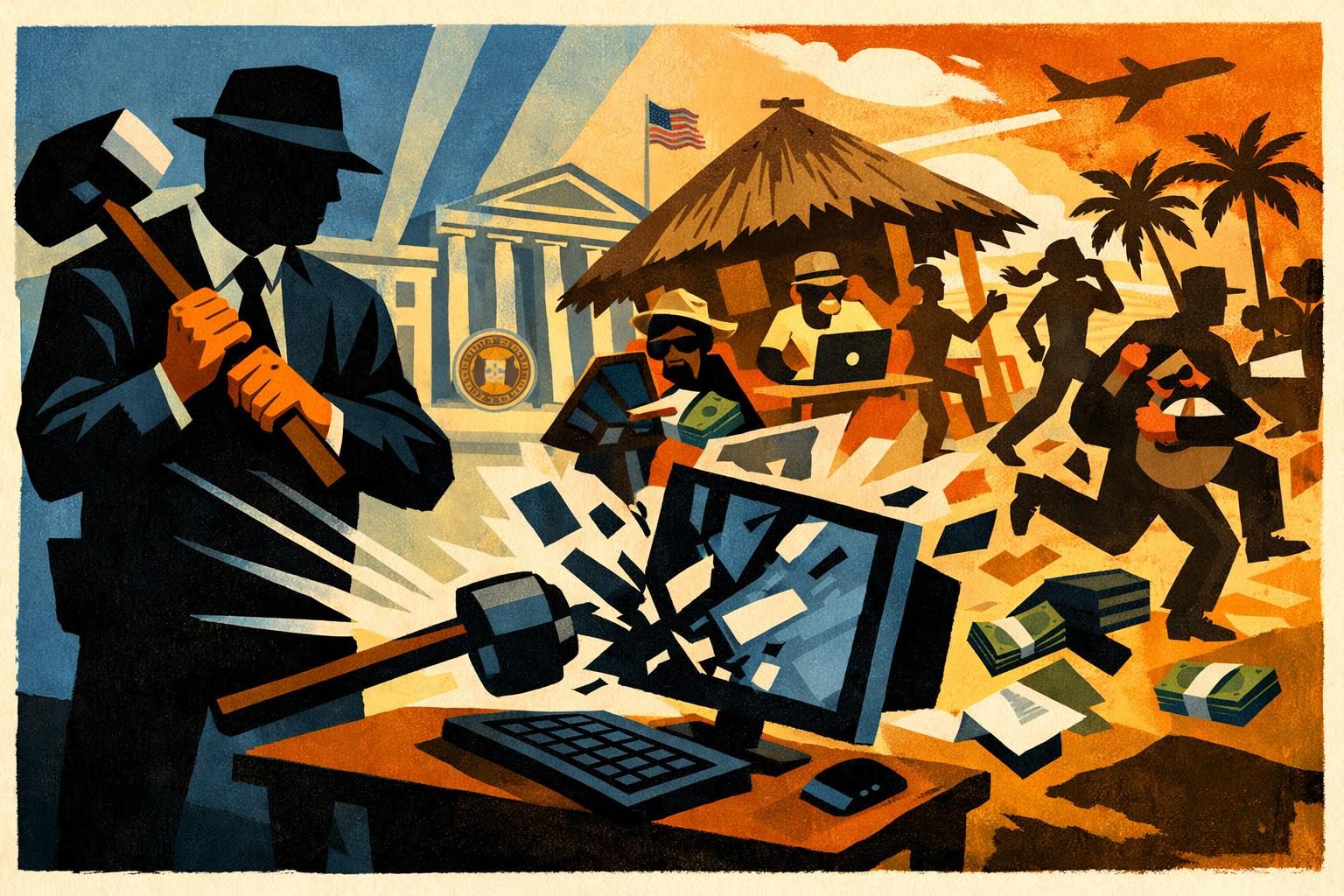
The Justice Department on October 13 announced a coordinated disruption effort aimed at online scam accounts and transnational criminal networks operating out of West Africa, putting fresh federal muscle behind a familiar problem that keeps draining money from American households and businesses. The move is best understood as a targeted attempt to interrupt the machinery of fraud rather than a claim that the problem has been solved, because the underlying ecosystem is still broad, adaptable, and stubbornly profitable. Officials framed the effort as a joint disruption week, which strongly suggests the work of multiple agencies acting together rather than a single case announcement designed mainly for the cameras. That distinction matters, because networks built around phishing, impersonation, romance scams, business email compromise, and other online schemes tend to survive ordinary enforcement in the same way mold survives a half-hearted cleaning. By going after the accounts, payment channels, and digital infrastructure that keep these schemes moving, investigators are signaling that they are trying to make the scams harder to run, not just harder to read about.
That approach reflects a more realistic federal understanding of how modern fraud works. The people running these operations are not necessarily sitting in one office using one platform or one bank, and they are not relying on a single criminal corridor that can be shut down with one arrest. Instead, they often depend on a whole stack of intermediaries that make the fraud appear ordinary enough to slip through: social media accounts, messaging services, payment apps, bank accounts, shell entities, stolen identities, and disposable domain registrations. When those pieces work together, the scam can scale quickly and reach victims far beyond the region where the operators sit. The Justice Department’s decision to announce a disruption week rather than only a narrow prosecution suggests it understands the target as an ecosystem, not just a handful of defendants. That is important because ecosystem cases can produce seizures, account takedowns, arrests, and financial friction that slow the business down even if the network is not erased outright. In plain English, federal authorities are trying to make the fraud more expensive and more annoying to run, which is often the closest thing to success available in this lane.
The political significance is larger than the law-enforcement theater around it. Cyber-enabled fraud has become a consumer-protection issue, a public-safety issue, and increasingly a structural trust issue for the financial system itself. When ordinary people lose savings to impersonation scams or get tricked into wiring money through manipulated online communications, the damage does not stay neatly inside the inbox. It spills into bank compliance, platform moderation, local police workloads, family finances, and the basic confidence that a digital transaction means what it appears to mean. A federal disruption campaign tells the public that the government is at least trying to treat the problem as a serious crime ecosystem rather than a personal failure by victims who should have known better. That shift is overdue, because scam networks thrive on speed, embarrassment, and the false assumption that every victim should have detected the scheme in time. The reality is uglier and more operational than that. These groups often rely on volume, psychological pressure, and cross-border complexity, which lets them exploit gaps between platforms, financial institutions, and law enforcement jurisdictions. Any enforcement action that narrows those gaps is worth noting, even if it does not deliver the clean, satisfying endings politicians prefer to advertise.
Still, there is no reason to mistake a disruption week for a final answer. Federal operations in this space can be meaningful without being miraculous, and they often produce mixed results that take time to measure. A takedown today can simply push operators toward a different platform, a different payment path, or a different set of front accounts tomorrow. That is why the real test is whether this action becomes part of a sustained pattern of pressure rather than a one-off press release that lets everyone declare victory and move on. Even so, the fact that the department is publicly prioritizing this kind of coordinated action on October 13 is newsworthy because it shows continued attention to transnational fraud infrastructure at a moment when too many victims are already getting hammered by phishing, impersonation, and cross-border scams. If the operation succeeds, it could create real friction for networks that depend on U.S. victims and U.S.-adjacent financial rails to keep the money moving. If it falls short, it will still have illustrated where the fight now lives: not just in courtrooms, but in the tedious, unglamorous work of choking off the systems that let online fraud scale. Either way, the announcement marks a concrete federal intervention, not a vague promise that inboxes will somehow clean themselves up."}
Comments
Threaded replies, voting, and reports are live. New users still go through screening on their first approved comments.
Log in to comment
No comments yet. Be the first reasonably on-topic person here.