
DOJ Claims a Major Scam-Network Takedown After International Disruption Week
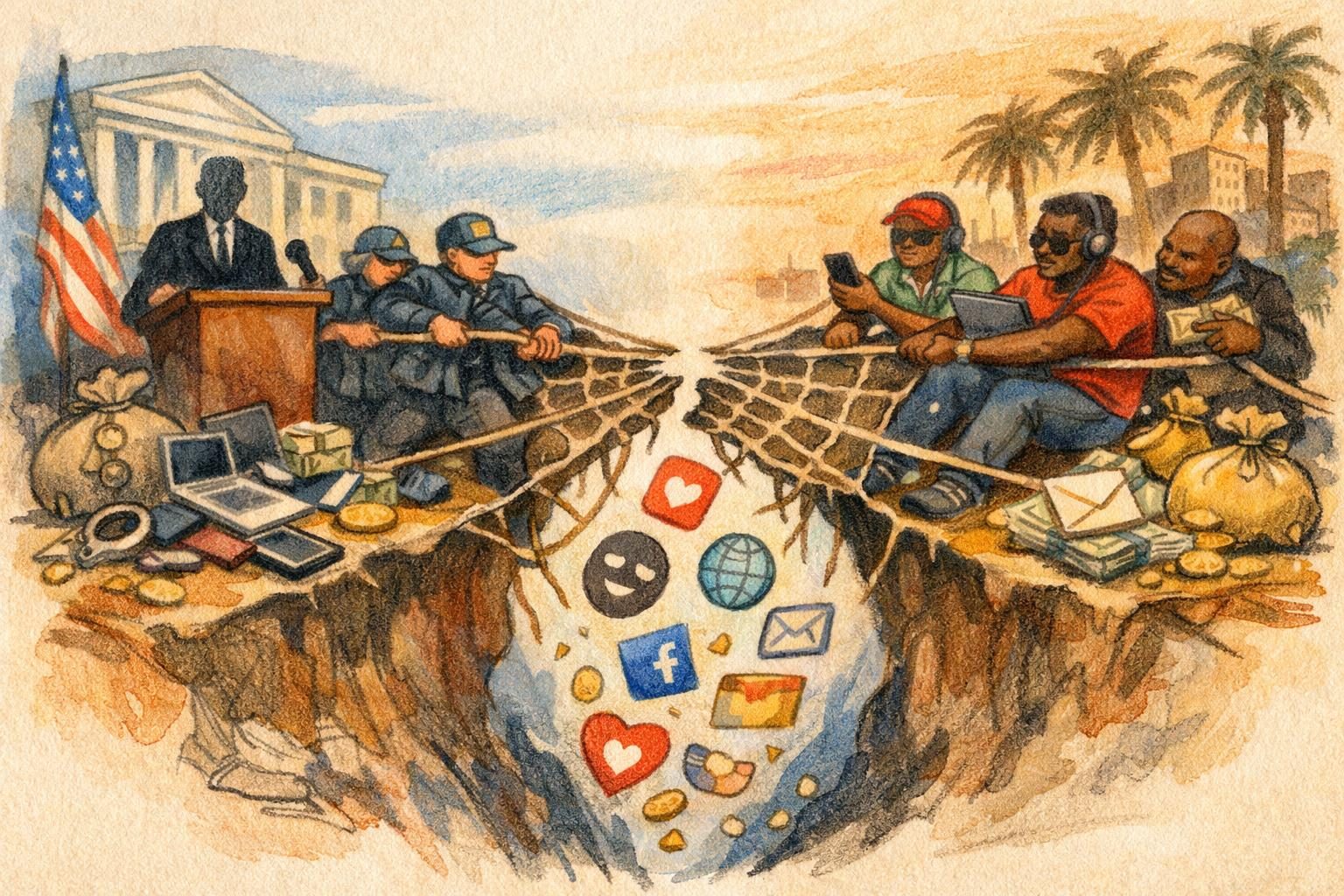
The Justice Department on Tuesday announced the results of a coordinated enforcement effort aimed at transnational scam networks operating out of West Africa, saying the operation produced arrests, seizures, and what it described as the largest-ever takedown of fraudulent social-media accounts tied to the scheme. Officials framed the action as a joint disruption week that brought together law enforcement and private-sector partners, with the stated goal of choking off the digital and financial infrastructure used to target victims in the United States and elsewhere. In the department’s telling, this was not a narrow criminal case but a broader strike at an industrialized fraud ecosystem that has been able to scale quickly across borders. The announcement made clear that prosecutors wanted the public to see the effort as more than a one-off bust. They presented it instead as a coordinated push against a sprawling network that has been difficult to pin down and even harder to keep down.
That framing matters because the underlying problem is not small, isolated, or especially static. Scam operations of this sort are often built to exploit emotion, urgency, trust, and technology all at once, which makes them unusually adaptable and frustratingly resilient. They can target vulnerable people directly, wash proceeds through layers of accounts and jurisdictions, and shift tactics whenever law enforcement closes one avenue. In other words, even a large takedown does not mean the underlying economy has been broken. It means investigators found a way to interrupt part of it, at least for now. That distinction is important, because the public often hears the word disruption and assumes something closer to defeat. In reality, these cases usually reveal how much fraud survives by moving faster than the institutions trying to catch it.
The Justice Department’s own emphasis suggests it understands that reality. The value of a coordinated international effort is not only in the immediate arrests or seizures, though those are obviously significant. It is also in the intelligence gathered, the accounts removed, and the pressure placed on the financial and digital channels that scam actors rely on to operate at scale. A large-volume fraud network is not just a collection of bad actors. It is an apparatus that depends on communication platforms, money movement, identity manipulation, and constant improvisation. When officials say they hit the largest set of fraudulent social-media accounts linked to the scheme, that is a sign they are trying to attack the operational plumbing as much as the people behind it. Still, there is an obvious limit to this approach. The more fragmented and international the fraud model becomes, the more law enforcement has to chase it in pieces. That makes each success meaningful, but also makes it hard to confuse success with control.
The broader political and institutional significance is that online fraud has become a frontline public-safety and consumer-protection issue, not merely a nuisance for platforms or a niche cybercrime concern. The victims are often ordinary people who are manipulated into sending money, sharing credentials, or trusting a criminal story that was engineered to feel personal and urgent. The damage can be financial, emotional, and in some cases devastatingly hard to reverse. That is why the administration is likely to treat this kind of announcement as evidence that it is taking coordinated fraud enforcement seriously. It should be treated that way, because coordination across borders and across sectors is genuinely difficult and genuinely necessary. But seriousness is not the same thing as victory. The grim truth is that the fraud economy keeps innovating, and every enforcement push has to contend with the possibility that the next version of the scam is already being assembled somewhere else. Tuesday’s announcement is a reminder that the government can land real blows. It is also a reminder that the larger contest remains lopsided, and that one major disruption week, however substantial, is still only a down payment on the scale of the problem."}]}
Comments
Threaded replies, voting, and reports are live. New users still go through screening on their first approved comments.
Log in to comment
No comments yet. Be the first reasonably on-topic person here.