
White House touts a science boom while the details scream spin
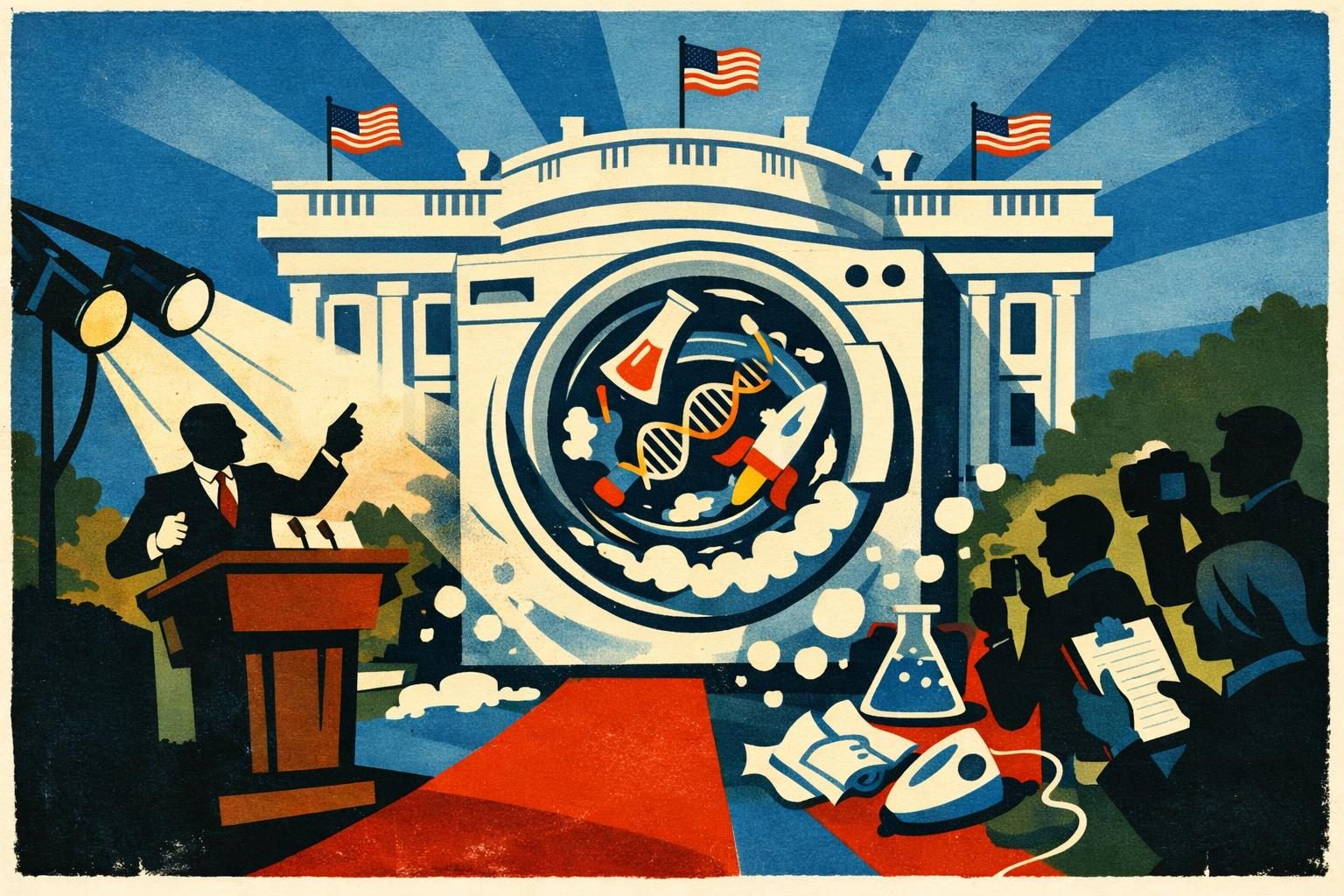
The White House spent October 13 trying to sell a scientific renaissance, wrapping the day in the kind of large, confident language that suggests history is being made whether or not anyone has yet seen the finished product. The administration’s latest messaging push leaned hard on superlatives and sweeping ambition, presenting a package of science initiatives as evidence that it is engineering a new era of American innovation. The central claim was not subtle: this is supposed to be the most ambitious science agenda of the century. The materials backing up that claim pointed to billions of dollars in investments spread across government, industry, academia, and philanthropy, all gathered into a narrative of momentum and national purpose. But the political purpose of the rollout was just as important as the policy content, because the whole exercise was built to translate announcement-day energy into proof of governing success.
That is where the familiar gap opens up between a polished federal pitch and the messier reality of how policy actually gets made and sustained. The White House is clearly trying to frame itself as the architect of a future-facing boom, one that can be measured in labs opened, projects funded, and discoveries accelerated. Yet the public-facing version of that story depends heavily on scale, symbolism, and the promise of what could happen later, rather than on what has already been delivered in a durable way. A big announcement can generate headlines, but headlines are not implementation. It is one thing to showcase commitments and partnerships, and another to demonstrate that those commitments will survive the usual constraints of bureaucracy, oversight, shifting priorities, and the slow grind of execution. That distinction matters because science policy is one of the few domains where ambitious rhetoric can sound almost identical to actual progress, especially when the numbers are large and the beneficiaries are broadly described.
The administration seems to understand that dynamic and to be leaning into it. Science, unlike many other corners of policymaking, offers a relatively friendly stage for optimism, collaboration, and long-term vision. A rollout about research, infrastructure, and innovation can project competence even when the deeper record remains mixed or incomplete. It can also blur the line between a real policy commitment and a reputational exercise designed to reassure supporters, attract allies, and make the government appear forward-looking. That is why the details matter so much, even when they are wrapped in inspiring language about investment and national renewal. Questions about implementation, oversight, timelines, and whether the promised money actually reaches the people and institutions it is supposed to help are not side issues. They are the substance that determines whether the announcement marks a genuine policy shift or just another turn of the messaging machine. In that sense, the White House’s science push looks less like a clean breakthrough than a reminder that modern governing often involves narrating success before the evidence has had time to catch up.
The broader political context only sharpens that impression. Critics of this style of governance argue that the administration has become highly skilled at generating the feeling of progress while leaving the harder questions unresolved. That critique lands harder when the White House is dealing with litigation, staffing churn, and the kind of procedural and legal friction that tends to complicate nearly every ambitious promise. A science summit or a major fact sheet can be real, and still function as political theater if the machinery underneath is not moving with comparable force. The administration wants the public to see a builder’s hand, a steady commitment to research and discovery, and a governing philosophy that prizes boldness. But the surrounding environment keeps dragging the story back to the present tense, where the test is not how grand the announcement sounds but how much of it can actually be carried out. For now, the White House can claim a victory lap in language, if not yet in results. The glossy version says the country is entering a golden age of science. The more grounded version says the administration is still trying to prove that its spotlight is more than just another hard hat photo-op.
Comments
Threaded replies, voting, and reports are live. New users still go through screening on their first approved comments.
Log in to comment
No comments yet. Be the first reasonably on-topic person here.