
Wisconsin starts preparing for federal officers showing up at polling places
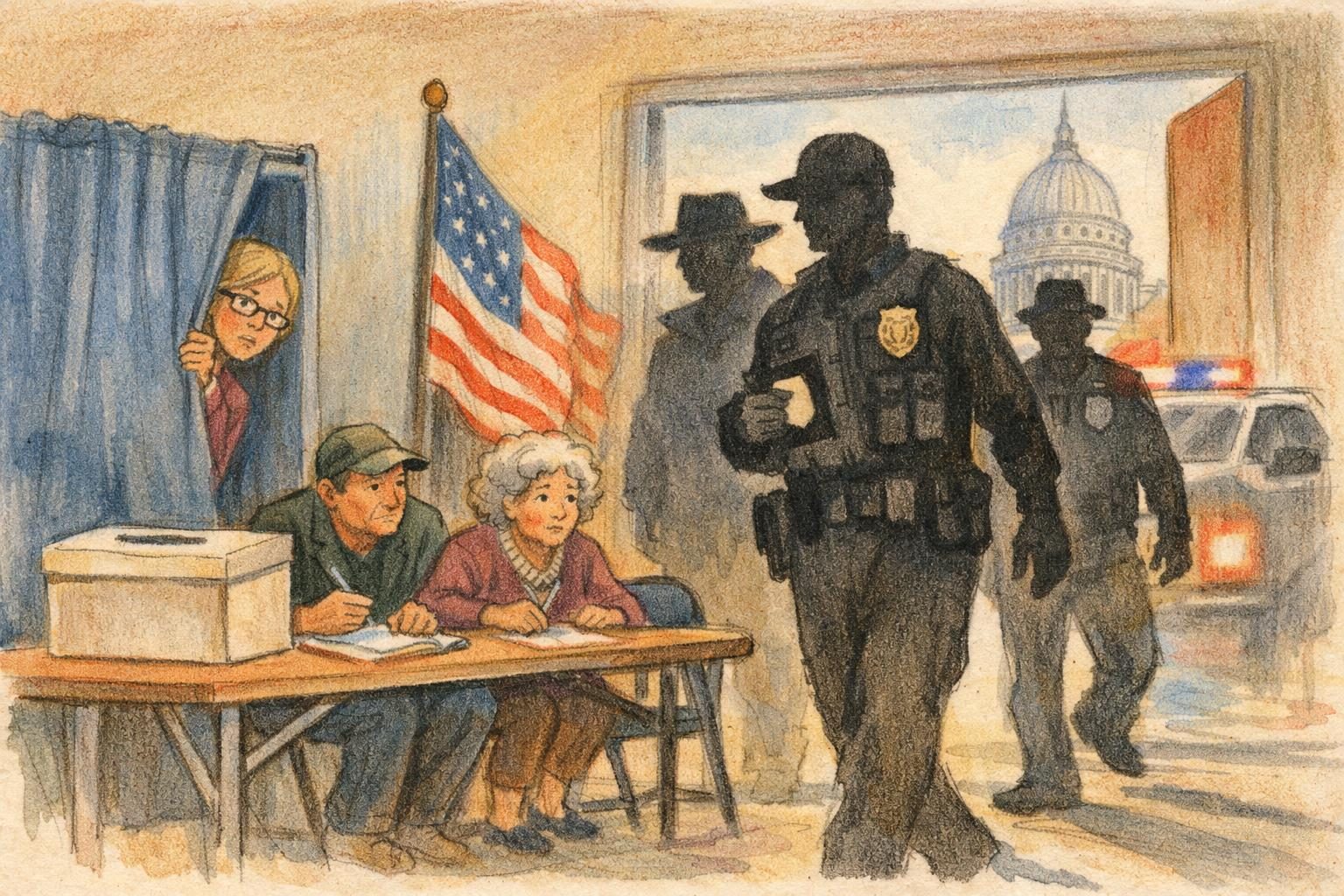
Wisconsin election officials are preparing for a kind of scene that used to sound unthinkable and now has to be treated as a live possibility: federal officers, and possibly local law enforcement, showing up at polling places on Election Day. On October 13, the Wisconsin Elections Commission circulated draft guidance for local clerks on how to respond if Immigration and Customs Enforcement agents, Department of Homeland Security personnel, FBI agents, or police appear at voting sites. The commission is expected to vote on the guidance later this week, but the release itself already says something important about the current state of election administration. Officials are no longer just planning for long lines, equipment failures, or bad weather. They are also planning for the possibility that armed or badge-bearing authorities may walk into a place meant to function as a neutral civic space. That shift is not routine, and it is not healthy, but it is increasingly the reality administrators are being forced to confront.
The draft guidance matters because the legitimacy of elections depends not only on ballots being cast and counted correctly, but also on people believing they can vote without intimidation. Polling places are supposed to be calm, ordinary sites where voters enter, cast a ballot, and leave with no reason to think anyone is watching them other than election workers carrying out their duties. Even a limited law enforcement presence can change the atmosphere in ways that are hard to measure but easy to feel. Voters who are already nervous may decide not to show up. Others may misread a routine encounter as a sign that something is wrong. In a state as closely watched and politically consequential as Wisconsin, those effects matter a great deal. The state has spent the last several election cycles at the center of national fights over turnout, recounts, fraud claims, and administrative procedure, which means officials there are acutely aware that confusion can travel faster than facts. Preparing for the possibility of officers at the polls is an attempt to keep a bad situation from becoming a bigger one.
The broader backdrop is an election environment in which claims about fraud, noncitizen voting, and the legitimacy of the process remain loud enough to shape how people think about voting itself. That matters because rhetoric does not stay rhetorical for long once it starts influencing behavior at polling places. When voters hear constant warnings that the system is rigged, or when they see government personnel near voting lines, the result can be suspicion, hesitation, or confrontation. Wisconsin is not saying that law enforcement interference is inevitable. It is saying that it would be irresponsible not to prepare for the possibility. That distinction is important. Officials are not announcing a crisis; they are trying to prevent one. The draft guidance is therefore less about predicting chaos than about reducing the odds that clerks will be caught improvising under pressure if officers appear and questions arise about what they may or may not do. That kind of planning sounds mundane, but in the current political climate it is a form of damage control.
There is also a larger institutional point buried inside the memo. Election administration works best when it is treated as a professional, nonpartisan function, not as an extension of law enforcement or partisan combat. The moment police or federal agents become part of the visual landscape at a polling location, the balance changes. Even if officers are simply present to ask questions, respond to a complaint, or carry out some unrelated duty, their presence can be interpreted as surveillance or pressure. That is why clerks need clear instructions now, before any such scenario unfolds in real time. They need to know who to call, what authority applies, what boundaries exist, and how to protect voters without escalating a confrontation. Wisconsin’s guidance is aimed at that exact gap between theory and practice. It reflects an effort to keep polling places functioning as voting sites rather than turning them into settings where official power overshadows the ordinary act of casting a ballot. In a better political moment, none of this would need to be spelled out in a memo. In this one, it does. And that fact says a great deal about how badly the atmosphere around elections has deteriorated, even before a single voter has stepped into a booth.
Comments
Threaded replies, voting, and reports are live. New users still go through screening on their first approved comments.
Log in to comment
No comments yet. Be the first reasonably on-topic person here.