
Operation Show Me Justice ends with a bruising St. Louis sweep
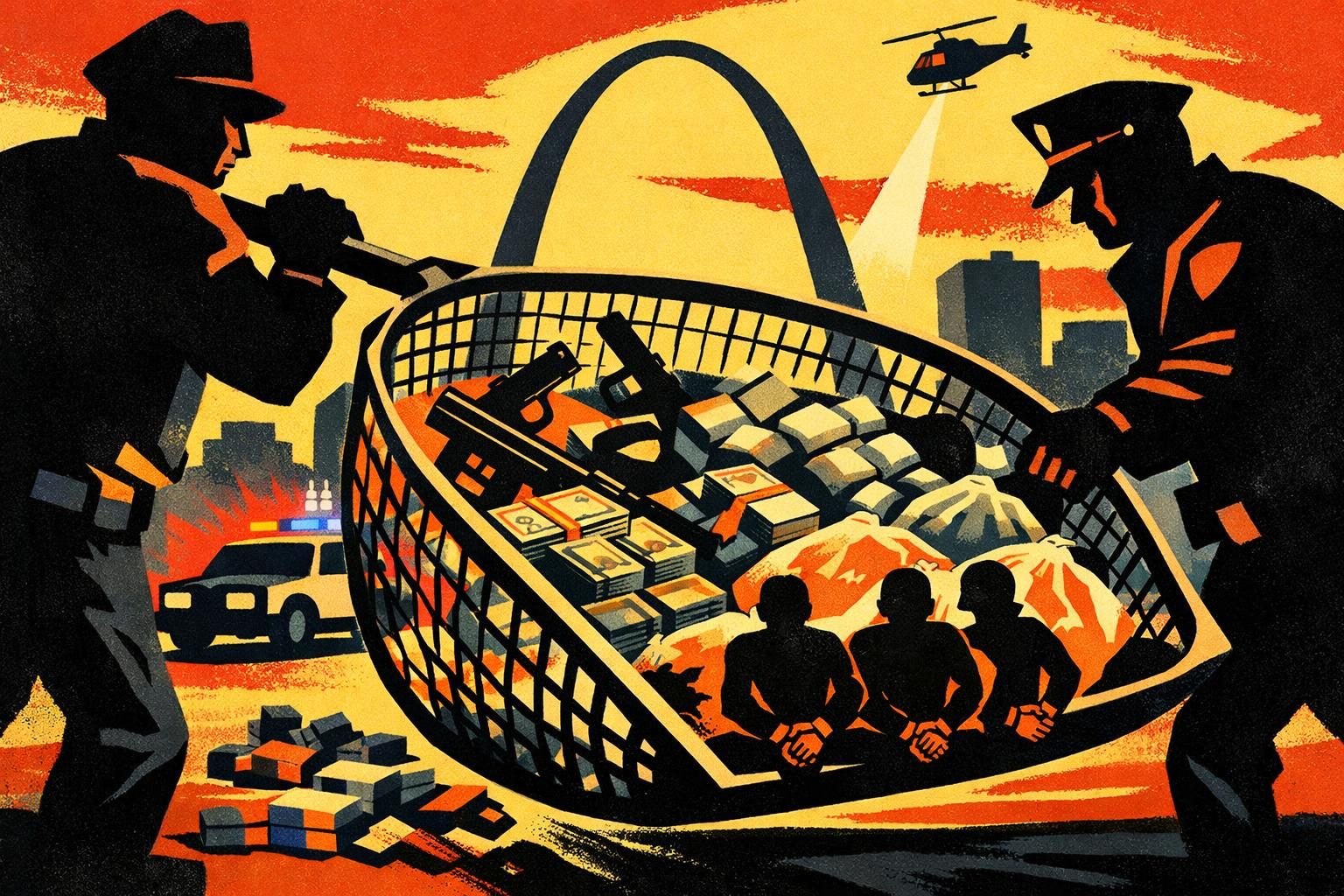
Federal, state and local law-enforcement agencies say a months-long violent-crime crackdown in St. Louis has ended with a haul that gives the operation its headline numbers: 435 arrests, 166 firearms seized, 81 kilograms of drugs taken off the street and more than $1.25 million in suspected crime cash recovered. The Justice Department said Thursday that Operation Show Me Justice has concluded after what it described as a high-impact surge focused on violent offenders, illegal guns and drug trafficking in and around the city. Officials said the effort brought together the ATF, U.S. Marshals Service, FBI, DEA, Homeland Security Investigations, the U.S. attorney’s office and local police, which is the sort of broad coalition that tends to be assembled when Washington wants to show it is taking a city’s violence problem personally. They also said the operation cleared 412 warrants and led to the recovery of machine-gun conversion devices, underscoring that the targets were not limited to low-level street offenses. The basic factual takeaway is straightforward: the sweep is over, the totals are in, and the federal government is presenting the operation as a significant disruption of violent-crime activity.
The scale of the numbers matters because they are meant to do more than document arrests. They are being used as evidence that a coordinated, heavily enforced public-safety campaign can make a visible dent in the most dangerous corners of a city long associated with gun violence. That is the pitch from the Justice Department and its partners: focus resources, hit repeat offenders, remove firearms and narcotics, and use the combined reach of federal and local agencies to pull people out of circulation before they can commit more serious crimes. In that framing, each warrant served and each weapon seized is not just a law-enforcement statistic but a proof point for a larger strategy. Still, the numbers alone do not settle the deeper question of whether these operations produce durable safety gains or only temporary relief. A sweep can interrupt criminal activity, but it does not automatically answer what happens once the arrests are processed and the streets adapt.
That uncertainty is why operations like this draw both praise and skepticism, even when the public presentation is all victory lap and no hesitation. Supporters are likely to point to the sheer volume of arrests and seizures as evidence that the campaign was aimed at people and weapons most likely to drive violence. They may also argue that taking 166 firearms out of circulation, along with drugs and cash, can reduce the immediate capacity for shootings, trafficking and retaliation. Critics, however, are likely to ask whether a law-enforcement surge simply pushes the same networks to regroup elsewhere, leaving the underlying market for guns and drugs intact. They may also note that broad, multi-agency operations often produce a large number of cases at once, but do not necessarily reveal how many of the arrests were tied to the most serious offenders versus lower-level enforcement actions. The official release does not answer every one of those questions, and it does not try to.
What is clear is that the Justice Department wants the public to see this as more than a routine roundup. The language used to describe the effort — a high-impact violent-crime enforcement surge — signals an effort to package enforcement as a direct answer to political pressure over urban violence. That is especially true in a city like St. Louis, where shootings and gun crimes have remained a persistent source of concern for residents, police and elected officials alike. The operation’s conclusion gives federal officials a concrete set of figures they can point to when arguing that an aggressive, coordinated model still works when applied at scale. At the same time, the release also reveals the limits of that argument, because the numbers say nothing yet about whether the city’s long-term violence trend has changed, how prosecutors will handle the cases that came out of the arrests, or whether the same pressure points will reappear after the surge ends. For now, the documented result is a large enforcement sweep, a big list of recovered contraband and a federal message that St. Louis was treated as a priority target in a broader fight over violent crime.
Comments
Threaded replies, voting, and reports are live. New users still go through screening on their first approved comments.
Log in to comment
No comments yet. Be the first reasonably on-topic person here.