
DOJ says UCLA Law discriminates in admissions
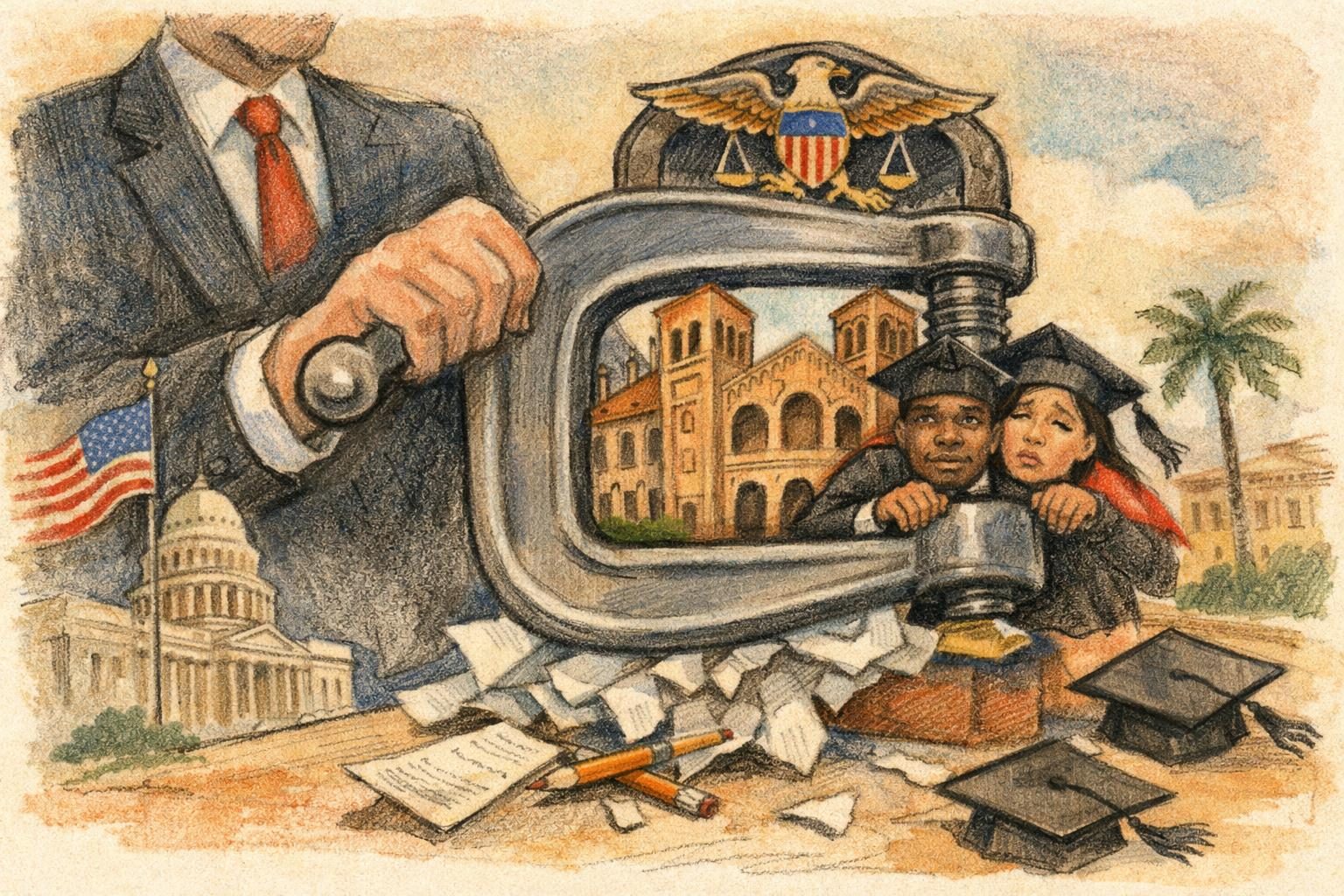
The Justice Department said on October 16 that UCLA Law School discriminates based on race in admissions, a finding that immediately turns what might have been another routine campus skirmish into a broader federal confrontation over who gets into elite public universities and on what terms. The Civil Rights Division’s conclusion lands in the middle of an already combustible national debate over diversity, merit, and the legal limits on race-conscious decision-making after the Supreme Court sharply constrained affirmative action. On its face, the announcement is a civil-rights enforcement action. In practice, it is also a political signal, one that fits neatly into an administration that has made anti-DEI enforcement a defining feature of its higher-education agenda. For UCLA, and for the University of California system more broadly, the message is plain enough: admissions policy is no longer just an internal governance issue or a matter of campus branding. It is now a federal problem with consequences that could reach into litigation, funding, and the public reputation of one of the country’s most visible law schools. The government’s conclusion does not end the matter, but it does raise the stakes in a way that university leaders cannot ignore.
The significance of the finding goes well beyond one campus and one admissions office. A formal civil-rights determination from the Justice Department gives the administration a powerful tool to argue that elite institutions have not simply been making difficult policy judgments, but have been skirting the law while presenting their practices as efforts to promote fairness. Supporters of the move will say that this is exactly how civil-rights enforcement is supposed to work: review the facts, apply the law, and hold public institutions accountable when they cross the line. Critics will see something else entirely, namely a concerted effort to use the machinery of the federal government to wage a political war against higher education and to discourage even lawful attempts to build more diverse student bodies. Those competing interpretations are not likely to be settled quickly, because they go to the heart of a broader argument about whether diversity initiatives in admissions are legitimate policy choices or disguised discrimination. What is clear is that the administration has chosen to make UCLA a high-profile example. That means the case will be read not only as a legal finding, but also as a warning to other universities that have spent months trying to adjust to a new post-Supreme Court landscape.
That broader warning may be the real point. Public universities across the country are likely to study the UCLA finding carefully, not because they think every school is identical, but because federal enforcement actions often become templates for what comes next. Admissions offices, general counsels, regents, and deans are all likely to ask the same questions: What exactly triggered the federal conclusion? How broad is the government’s theory of discrimination? How much room remains for considering race-neutral alternatives that still aim to widen access? And how aggressively might the administration apply this same approach elsewhere if it believes other institutions are violating civil-rights law? Those questions matter because university admissions are not managed in a vacuum. They are shaped by lawsuits, regulatory guidance, demographic pressures, donor expectations, and political scrutiny that has only intensified in the wake of the Supreme Court’s recent restrictions. A finding against UCLA gives the White House a concrete example to point to in that wider fight, whether the goal is deterrence, persuasion, or setting up a larger legal challenge to campus diversity programs. Even if the ultimate legal outcome changes, the immediate effect is to put every selective public university on notice that its admissions policies may be reviewed through a much harsher lens than before.
For UCLA, the practical fallout will depend on what happens next, and that is where the uncertainty matters. The Justice Department’s announcement creates pressure, but it does not by itself resolve every factual or legal question surrounding the school’s admissions process. The university may defend its policies, contest the government’s interpretation, or adjust practices in response to the scrutiny. It may also face outside pressure from students, alumni, faculty, and state officials who see the federal finding as either overdue enforcement or an overreach aimed at elite institutions. What is already obvious, though, is that the dispute has moved from abstract policy debate into a more serious phase where every response will be parsed for legal risk and political meaning. If the administration presses the issue further, UCLA could become a test case in a much larger campaign against diversity programs in higher education. If the government overreaches or fails to sustain its claim, the episode could become another expensive, highly visible fight that strengthens critics’ argument that the federal government is using civil-rights law as a bludgeon rather than a neutral standard. Either way, the center of gravity has shifted. Universities that once treated admissions debates as internal matters now have to reckon with the possibility that those debates have become the front line in a national legal and cultural struggle.
Comments
Threaded replies, voting, and reports are live. New users still go through screening on their first approved comments.
Log in to comment
No comments yet. Be the first reasonably on-topic person here.