
Supreme Court opens Friday session with orders pending
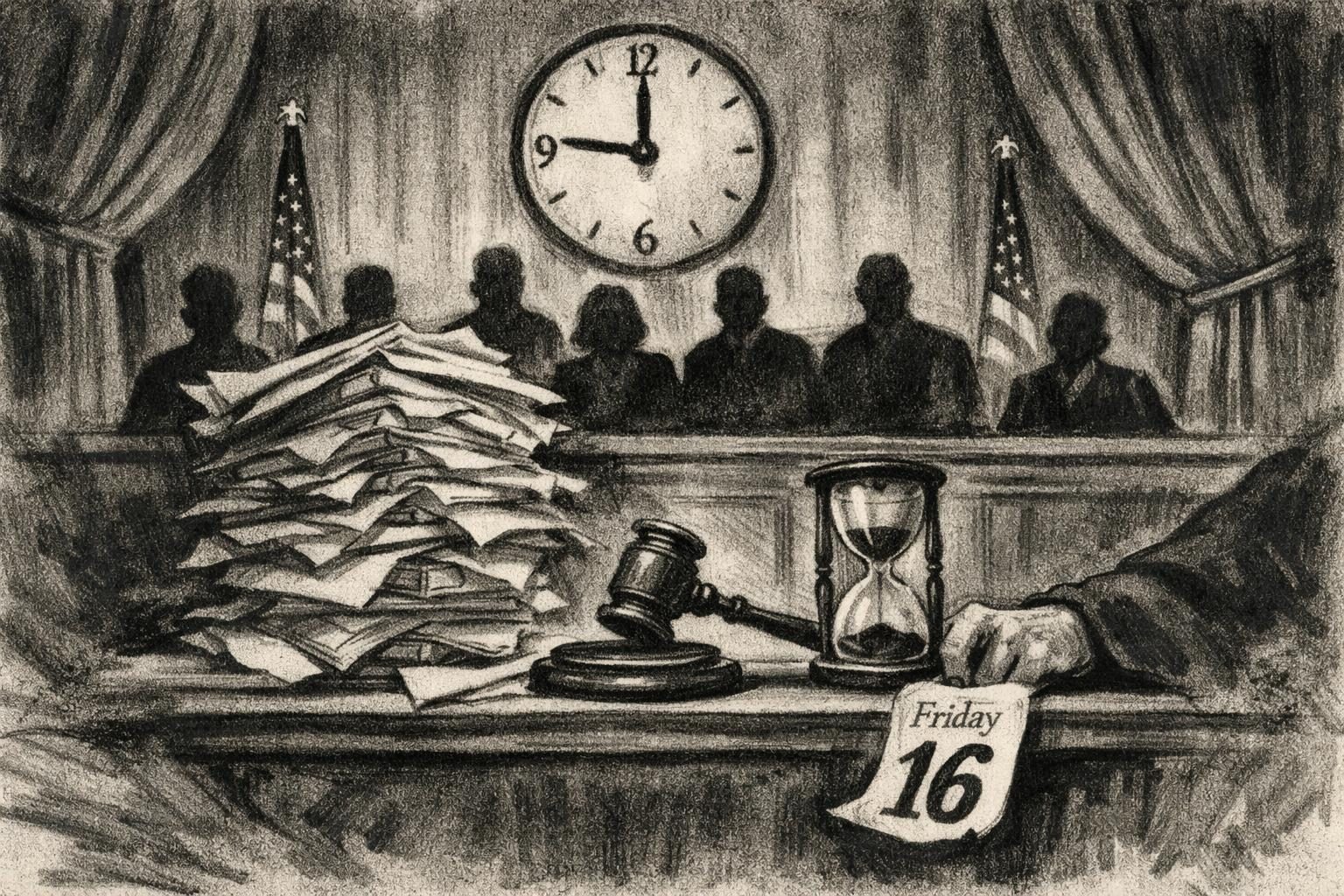
The Supreme Court’s public docket shows a Friday session on October 16, 2026, a routine-looking entry that still carries more weight than the calendar alone would suggest. On its face, this is the kind of day that usually passes without drama: the justices meet, the clerk’s office posts orders, and lawyers across the country refresh the page to see whether anything significant has shifted. But for a Court that has become central to the country’s biggest legal and political conflicts, even a plain order-list day can feel consequential. It signals that the institution is back in its regular fall rhythm and moving through a pipeline that is already crowded with high-stakes disputes. In a moment when political fights are increasingly routed into the federal courts, the fact of the Court opening business on schedule matters almost as much as any immediate ruling might.
That is especially true because the docket is rarely just a docket anymore. Every order session now functions as a pressure point in a broader struggle over how far the executive branch can go, how quickly lower courts can check it, and how much can happen before the Supreme Court chooses to intervene. Election disputes remain one obvious area of concern, but they are hardly the only ones. Press-freedom fights, federal power clashes, separation-of-powers challenges, and other constitutional disputes are all part of the legal traffic building toward the justices. Some of those matters may not reach the Court for weeks or months, and some may never draw emergency attention at all, but the accumulation itself is the story. A morning devoted to routine orders can therefore be read as a snapshot of a system already bracing for another round of accelerated political litigation.
The political significance of the session is also tied to how this Court often acts when it does decide to step in. Much of the criticism directed at the justices is not about a single sweeping opinion but about the pattern of emergency orders, shadow-docket action, and selective intervention that can change the terrain before a full hearing ever occurs. That criticism is subtler than the arguments aimed at elected officials, but it is no less pointed. When the Court moves quickly in some matters and slowly in others, it can shape the national debate without issuing the kind of blockbuster ruling that dominates a term. When it delays, it can leave lower courts, litigants, and political actors to fight over what is effectively open season until review arrives. In that sense, the Court’s silence can be as meaningful as its speech, and a Friday order session is one more reminder that the justices often influence events by deciding what not to decide yet.
For now, the immediate impact of October 16 appears limited, at least in public view. There is no reason to read the mere scheduling of an order session as evidence of a coming constitutional earthquake, and it would be a mistake to treat every routine calendar note as if it were a forecast of emergency action. Still, the institutional context is impossible to ignore. A Court whose public business draws attention simply because it is meeting on a Friday is a Court operating amid unusually intense legal pressure. The volume of cases working their way through the system suggests that the justices may continue to function less as a distant backstop than as a day-by-day weather report for democratic stress. If the federal government keeps generating these disputes at the current pace, then even the ordinary mechanics of the Court will remain politically charged, because they tell everyone watching that the next big decision may already be on the way.
Comments
Threaded replies, voting, and reports are live. New users still go through screening on their first approved comments.
Log in to comment
No comments yet. Be the first reasonably on-topic person here.