
Trump’s ‘Lawfare’ Talk Meets a Fresh DOJ Retaliatory-Lien Indictment
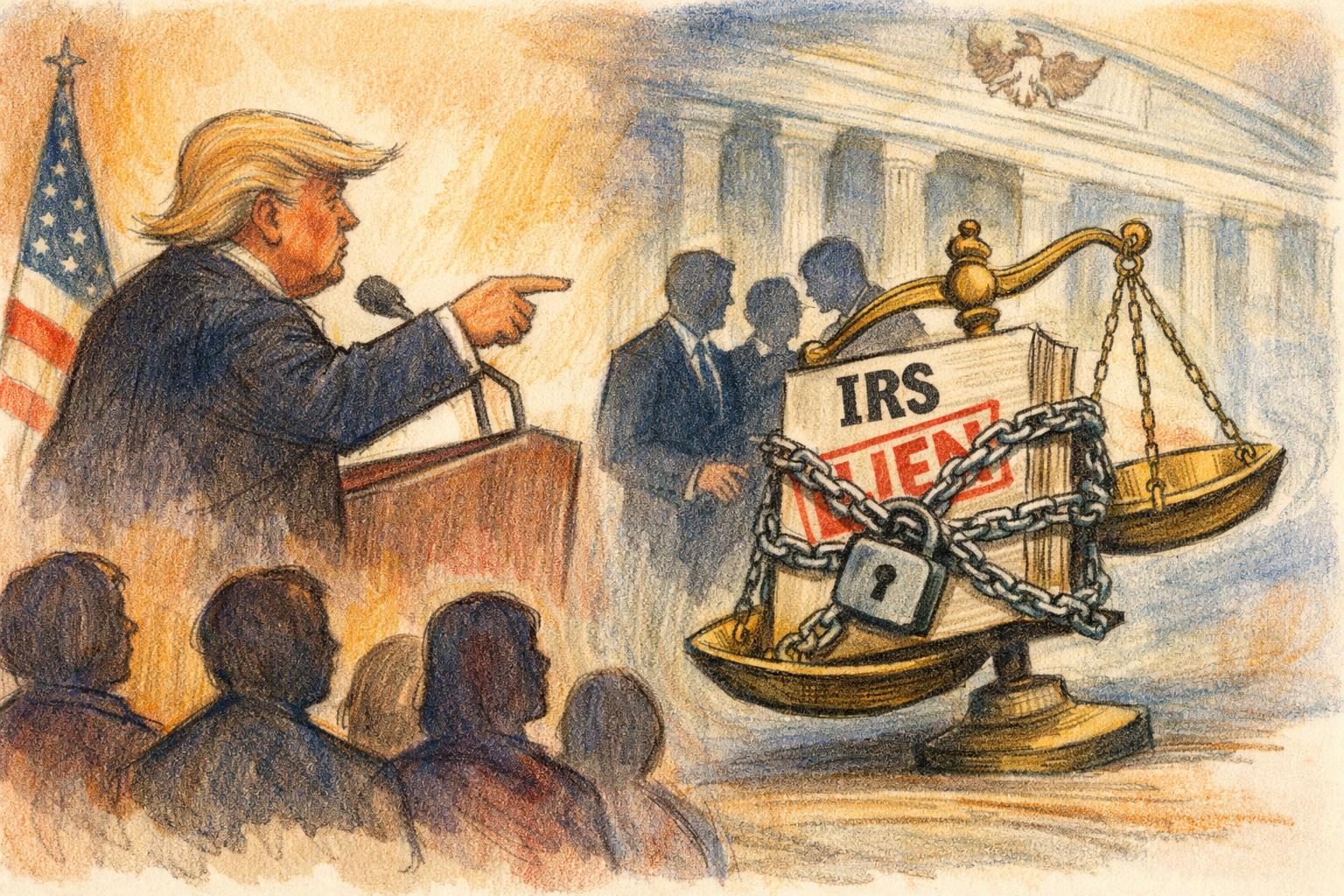
For years, Trump-aligned politics has treated legal jeopardy less as a warning sign than as a badge of honor. A subpoena becomes intimidation, an indictment becomes proof of corruption, and an investigation becomes another entry in the running ledger of supposed persecution. That posture is politically useful because it can absorb nearly any development without forcing a change in the story. If a case drags on, the movement can call it vindication. If it moves forward, the response is that the system is rigged. In that framework, accountability is never simply accountability; it is folded into a larger narrative of grievance, loyalty, and permanent siege. But the public record keeps turning up cases that sit uneasily inside that script, especially when the abuse of legal instruments appears to run in the opposite direction: not from government against its critics, but from private actors or allies against the officials charged with enforcing the law.
That tension sharpened with a July 15 Justice Department indictment accusing a Texas tax-shelter promoter of tax crimes and of filing false retaliatory liens against federal officials. The case, at least as described in the charging papers and the department’s announcement, involves conduct that is both financial and personal in its alleged targets. Prosecutors say the defendant promoted abusive tax shelters and then used the filing system itself as a weapon, recording liens that were not legitimate claims but retaliation aimed at federal employees. The indictment places the matter squarely in the category of legal abuse that federal law is designed to deter. It is one thing to argue in the abstract that the government can overreach, and another to confront allegations that someone used paperwork, property records, or tax structures to threaten or harass public servants. Those are not the same thing, and the distinction matters because it undercuts the idea that all legal conflict is merely political theater.
The Justice Department has lately framed this kind of conduct as part of a broader problem of weaponization, while also claiming a willingness to respond to it. In announcing an anti-weaponization fund, the department said it intended to support efforts against the misuse of legal processes and related forms of retaliation. That creates an awkward but telling contrast with the rhetoric that has often come from Trump-world, where legal exposure is presented as evidence that institutions have become biased against conservatives or against the former president personally. The problem with that framing is not that every defendant is guilty or that every prosecution is automatically righteous. The problem is that it treats all legal accountability as suspect, even when the alleged conduct is exactly the sort of abuse that the law exists to address. A retaliatory lien is not a metaphoric grievance. It is a concrete filing that can burden the target and signal that legal channels are being turned into a pressure tactic. If that allegation is proved, it would be hard to square with claims that the only real abuse in the system comes from prosecutors or regulators.
That is why the case lands awkwardly in the current political climate. Trump and his allies have spent years building a language of lawfare that collapses difficult legal scrutiny into political persecution. The language is elastic enough to cover criminal charges, civil lawsuits, congressional probes, and even routine administrative oversight. It offers a ready-made explanation for why prominent figures face consequences that ordinary citizens sometimes face without fanfare. Yet the same public environment also contains repeated reminders that legal tools can be abused in the other direction, including by people who are not government officials at all. When liens are allegedly filed to retaliate against federal employees, the story is not about an overzealous prosecution seeking to silence dissent. It is about a system of records and filings being allegedly manipulated to exact revenge. That should complicate any honest discussion of lawfare, because it shows the term cannot simply mean “anything that happens to people I support.” It has to mean something more precise if it is going to mean anything at all.
None of this eliminates the possibility that some prosecutions can be excessive, politically timed, or pursued with an eye toward optics. It does not require anyone to accept every Justice Department action as beyond criticism. But it does suggest that blanket claims of persecution are too blunt to describe the world as it actually is. There are real instances of legal abuse, and there are real cases where public officials are targeted through fabricated or retaliatory filings. There are also real investigations into tax crimes, and real indictments that appear to reflect ordinary law enforcement rather than political theater. The challenge for the public, and especially for political movements that have made grievance central to their identity, is to distinguish between those categories instead of collapsing them into one emotionally satisfying story. The July 15 indictment is a reminder that the legal system can be abused in ways that are concrete, documentable, and deeply personal. That reality does not fit neatly inside a persecution narrative. It fits, instead, into the more uncomfortable truth that some of the strongest claims of victimhood are made in a world where the most tangible weaponization is sometimes the one happening in plain sight.
Comments
Threaded replies, voting, and reports are live. New users still go through screening on their first approved comments.
Log in to comment
No comments yet. Be the first reasonably on-topic person here.