
Trump’s shiny AI order may have more ambition than guardrails
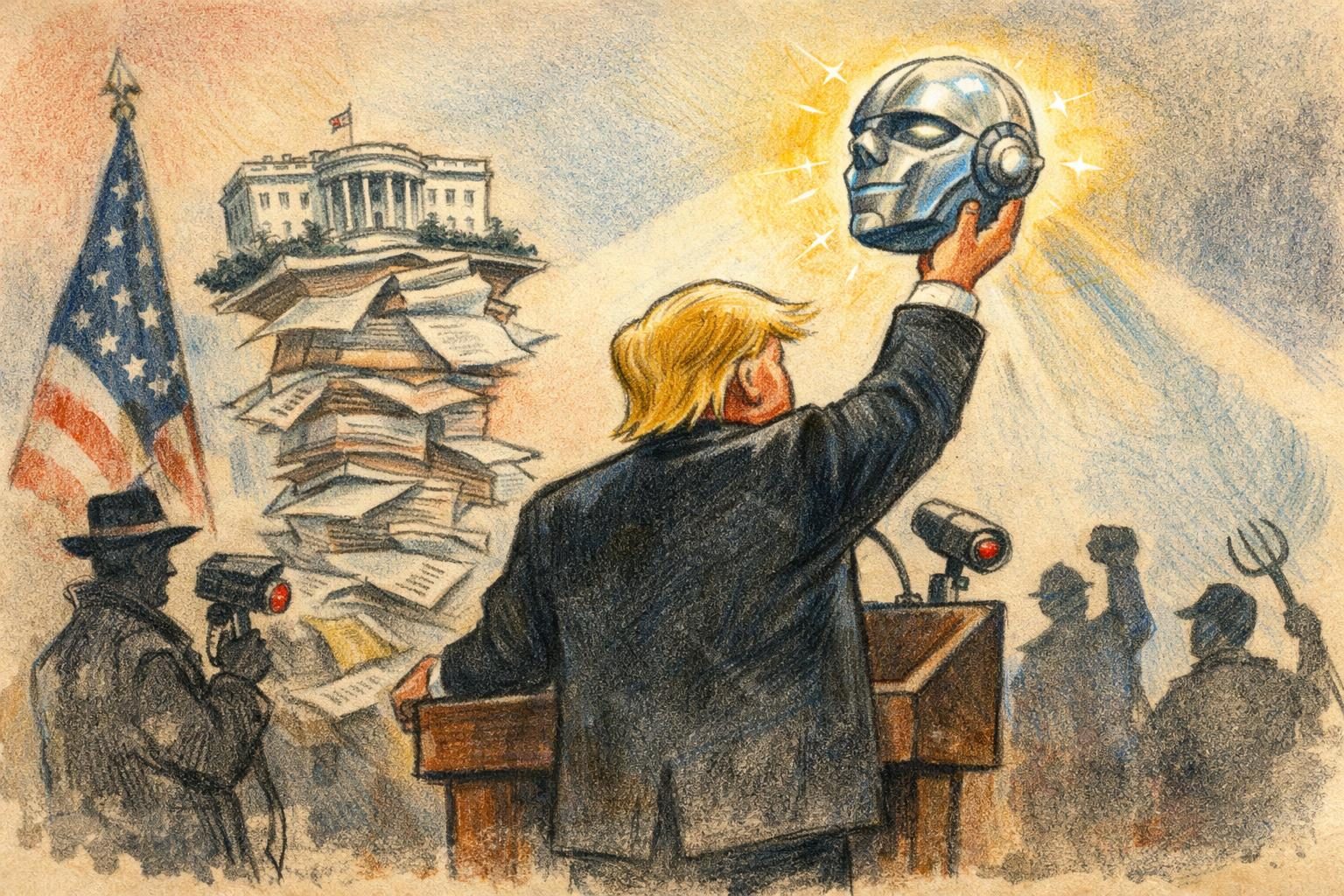
Donald Trump spent June 2 trying to wrap a very old style of governing in a very new piece of packaging: a sweeping executive order on advanced artificial intelligence innovation and security. The White House presented the move as a serious effort to keep the United States ahead in a field that is already reshaping industry, defense, policing, finance, and the basic structure of work. On paper, the order fits neatly into the administration’s preferred language of speed, competition, and national strength. It is easy to see why the White House would want the announcement to land as a forward-looking show of competence rather than a familiar burst of presidential improvisation. But beneath the polished framing sits a more familiar Trump-world instinct: when faced with a complicated policy problem, reach first for executive power, publicity, and centralized control. That instinct may generate a sharp headline, but it does not automatically produce durable governance. And in a field as consequential as AI, the gap between a flashy directive and a real policy framework can be enormous.
The administration’s case for the order is straightforward enough. Officials want to promote advanced AI development while also securing the models, systems, and infrastructure that support it. The White House is also tying the effort to a broader national cyber and security agenda, which makes political sense because AI has become entangled with questions of defense readiness, digital resilience, and industrial competitiveness. Supporters can argue, with some justification, that a federal government that sits still while private firms and foreign competitors race ahead is one that is choosing to be left behind. They can also argue that the executive branch has to do something, even if Congress remains slow, fragmented, or unable to agree on a comprehensive law. Those arguments are not frivolous. The problem is that broad ambition is not the same thing as effective policy architecture. An order can state priorities and direct agencies, but it cannot by itself settle the hard questions about oversight, accountability, enforcement, and limits on presidential discretion. That is where the Trump version of AI policy starts to look less like a strategic framework and more like another exercise in governing by decree. The order may say the right words about innovation and security, but words do not explain how the administration will prevent the machinery of federal power from becoming a blunt instrument.
That concern matters because AI policy is unusually sensitive to overreach. It touches national security, privacy, civil liberties, labor markets, civil rights, and the power of a small number of giant companies that already dominate the digital economy. It also raises very real questions about surveillance, data access, model control, and whether government involvement will encourage transparency or simply concentrate power in fewer hands. A White House that says it wants to secure advanced systems can mean many different things in practice. It could mean sensible procurement standards, stronger infrastructure protections, and clearer rules for public-private coordination. Or it could mean expanded federal leverage with little clarity about who watches the watchers, what limits exist on data collection, and how decisions get reviewed when agencies move quickly. In another administration, that uncertainty would already be a serious issue. Under Trump, it becomes more fraught because of the president’s long habit of treating expertise as negotiable and process as something that gets bulldozed whenever it becomes inconvenient. That history does not prove the order will be abused, but it does make the public reasonably wary of being asked to trust vague assurances about guardrails. When a president with a taste for centralization talks about innovation, critics naturally ask whether the real product is technology policy or a new mechanism for command.
The skepticism is likely to come from several directions at once. Civil liberties advocates will worry about surveillance creep and the temptation to use AI governance as a justification for expanded state monitoring. Technology policy experts will point out that strong industrial ambitions still need clear standards, transparent implementation, and institutions that can outlast one president’s preferred message cycle. Congressional skeptics will notice, as they always do, that executive orders can look decisive while leaving the hardest decisions unresolved and kicking the mess to agencies, courts, and lobbyists. Trump’s allies will almost certainly praise the order as proof that he understands the strategic stakes of AI and is willing to act where others talk. They will say that a president has to be bold in the face of rapid technological change and that waiting for perfect consensus is a luxury the United States cannot afford. Yet the criticism is not that AI lacks importance. It is that a president who thrives on unilateral leverage, fuzzy definitions, and loyalty-based politics is not an obvious steward for a framework that demands restraint, consistency, and public trust. The administration’s own celebration of the order leaves important questions unanswered. How exactly will implementation be measured? What checks will exist on federal discretion? Which agencies will have the final say when the interests of innovation and security collide? And what happens if the order becomes a magnet for lawsuits, lobbying, or bureaucratic turf wars rather than a coherent policy shift? None of those questions are minor. In fact, they are the whole game.
That is why the political risk for Trump is larger than the policy risk. He wants credit for being the anti-bureaucratic president, the one who cuts through red tape and gets things done. But executive action in a domain like AI can just as easily create a new maze of presidential intervention, especially if the order becomes a vehicle for shifting priorities, selective enforcement, or ad hoc discretion. The White House can sell the measure as pro-innovation, and perhaps in some limited sense it is. But innovation is not simply a matter of moving quickly or sounding ambitious. It depends on predictability, standards, trust, and institutions that can survive beyond a single announcement or a single political season. That is where Trump’s broader governing style tends to run into trouble. He favors spectacle over architecture, pressure over process, and personal authority over durable systems. Those habits may play well in a briefing room, where a shiny order can be presented as proof of action. They play less well when the country is left with the job of turning a proclamation into actual governance. The deeper story of this AI order is not that Trump has discovered the future. It is that he is trying to manage a complex and consequential technology the same way he has managed everything else: loudly, centrally, and on his own terms. That may be effective as a performance. It is much less convincing as policy, and in the long run it may be exactly the kind of governance-by-fiat that leaves the biggest mess behind.
Comments
Threaded replies, voting, and reports are live. New users still go through screening on their first approved comments.
Log in to comment
No comments yet. Be the first reasonably on-topic person here.