
Trump’s aircraft trade move leaves tariffs for later
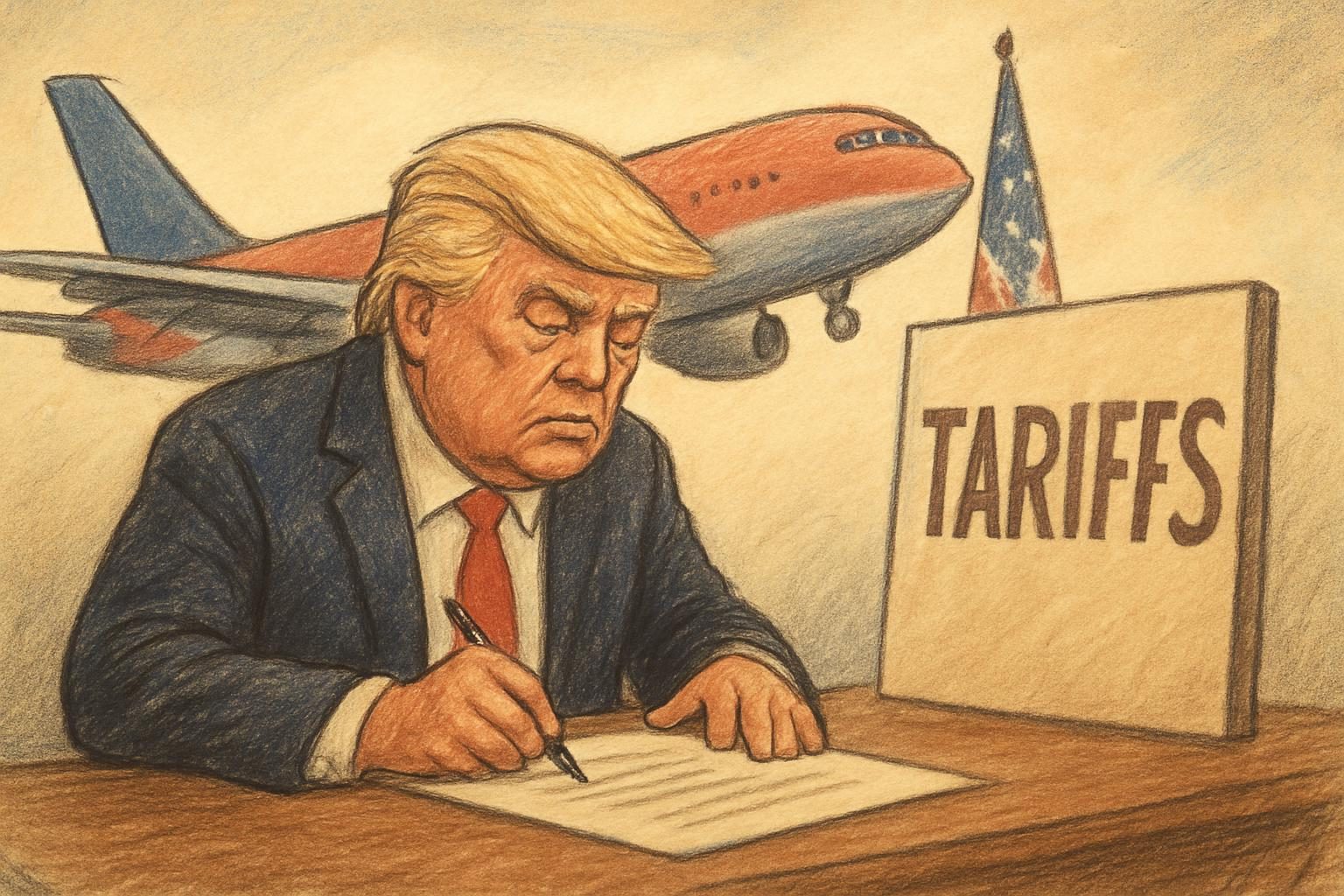
On July 9, the White House took a familiar Trump approach to trade: make the threat loud, make the timetable vague, and let everyone else do the arithmetic. The administration issued a Section 232 proclamation covering commercial aircraft, jet engines, and aircraft and engine parts, but it did not slap immediate tariffs on the sector. Instead, it opened a 180-day window for negotiations and directed the Commerce Department and the U.S. trade representative to keep the president updated as talks continue. For an industry that runs on contracts, certification, and long planning cycles, that is not much of a policy so much as a suspense mechanism. The message to the market is that a tariff could still arrive, but not yet, and maybe not in exactly the form anyone is expecting. The White House is betting that uncertainty itself can do the work of pressure without having to announce the final cost up front.
The administration is framing the move as a national-security measure, which is the legal justification Section 232 is designed to support. According to the White House’s own explanation, aircraft and engine supply chains matter because they are tied to defense operations, emergency response, official travel, and cargo movement. The argument is that foreign government intervention has weakened the domestic aerospace base, making the sector a candidate for trade action under national-security powers. That may be politically useful, and it gives the proclamation a sturdier-sounding rationale than a simple trade dispute. But the practical effect is still the same: airlines, suppliers, and manufacturers are left trying to estimate costs without knowing whether the government will eventually impose tariffs, how steep they might be, or which products would bear the heaviest burden. A known tariff is a headache, but at least it is a measurable one. A deliberately unfinished policy is harder to price, harder to hedge, and harder to explain to boards, lenders, and customers.
That uncertainty matters because aerospace is not a sector that can react on a dime. It depends on long lead times, expensive multi-year contracts, and tightly linked supply chains that cross borders repeatedly before a single aircraft is delivered. Parts inventories are planned well in advance. Maintenance schedules are set with little room for improvisation. Aircraft orders and engine programs are negotiated with assumptions that have to hold for years, not weeks. Certification timelines add another layer of rigidity, because even when companies want to swap suppliers or redesign components, they cannot do so casually. If the administration eventually follows through with tariffs, the result will almost certainly be another round of cost pressure, with buyers and suppliers forced to negotiate over who absorbs the hit. If it does not follow through, then the proclamation may end up functioning mainly as a warning shot designed to force movement at the bargaining table. Either way, the sector is now expected to operate under a cloud of policy ambiguity that did not exist before the proclamation was signed.
That is the deeper Trump trade pattern at work here. The administration likes leverage that can be felt immediately, even if the final policy remains unresolved. By avoiding instant tariffs while keeping the possibility alive, the White House gets to claim momentum without committing all the way to a price tag. Supporters can call that strategic patience. Critics will call it a way of transferring risk from the government to the private sector. The distinction matters less in political messaging than it does in business planning, because companies do not get paid to guess correctly about Washington’s next move. They need stable inputs, predictable rules, and enough certainty to budget capital spending without building in a fresh fear premium every time the president decides to make a point. This proclamation gives them none of that. It tells the industry to wait, while also signaling that waiting may be expensive.
The result is a policy move that looks more like leverage theater than a completed trade decision. Trump has once again placed a major American industry in a holding pattern and asked it to treat uncertainty as a feature rather than a bug. The White House has not yet set the tariff rate because it has not yet chosen whether to impose one at all, but the market is already being told to carry the risk. That helps the administration in the short term because uncertainty can be used as pressure. It hurts everyone else because businesses have to plan around a maybe that can turn into a bill with very little notice. If the goal is to push foreign partners toward acceptable agreements, the strategy may produce some movement. If the goal is to give airlines, suppliers, and manufacturers a clear operating environment, it does the opposite. For now, the aircraft industry gets the Trump version of trade policy: a warning, a countdown clock, and the promise that clarity might be available later, if the White House feels like providing it.
Comments
Threaded replies, voting, and reports are live. New users still go through screening on their first approved comments.
Log in to comment
No comments yet. Be the first reasonably on-topic person here.