Story · July 1, 2026

Justice Department sues California over Glock ban, escalating a fresh gun-rights clash

Gun-rights clash Confidence 4/5
★★★☆☆Fuckup rating 3/5
Major mess Ranked from 1 to 5 stars based on the scale of the screwup and fallout.
Correction: Correction: The Justice Department filed suit on July 1, 2026, seeking to stop California from enforcing its Glock-ban law.
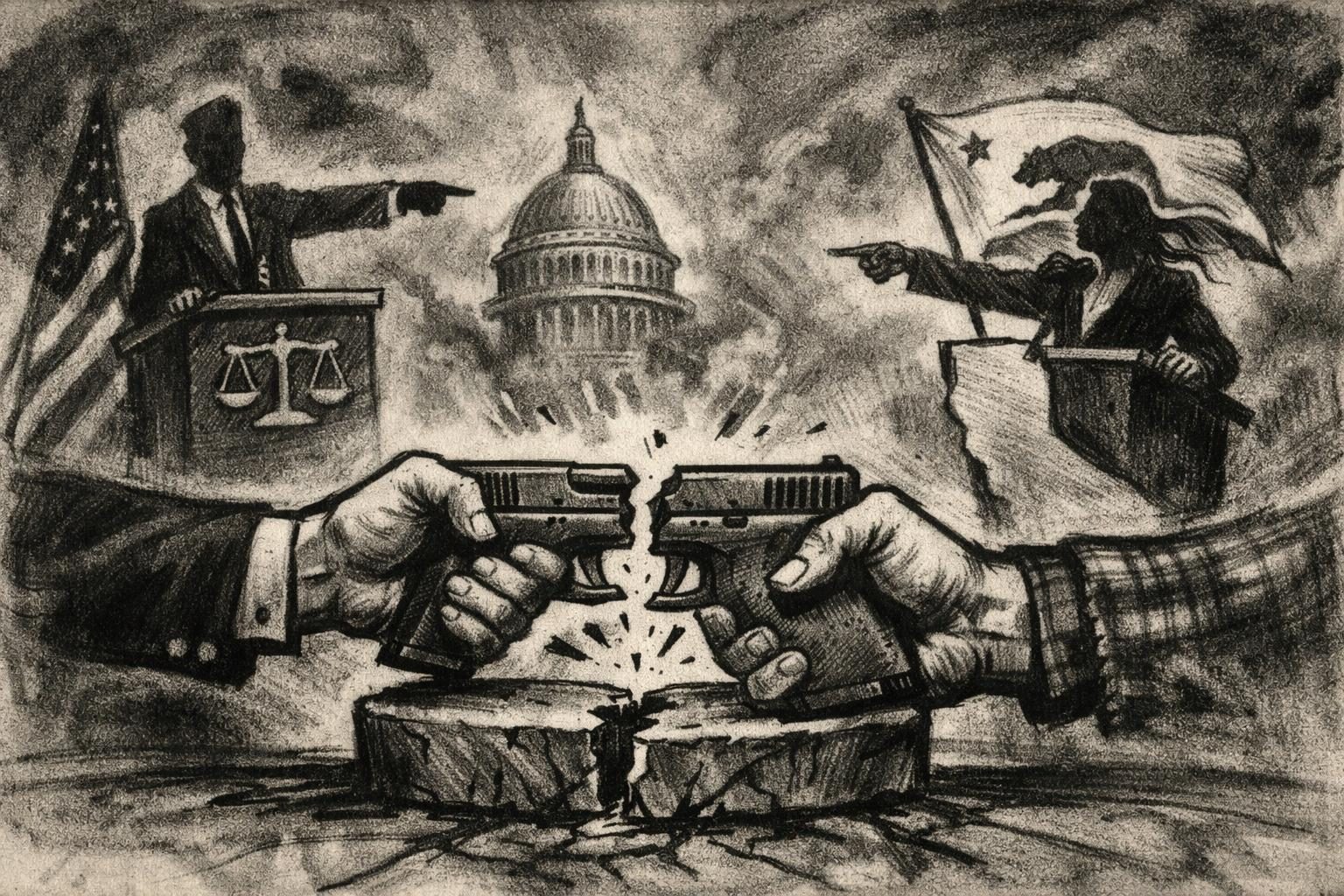
Justice Department sues California over Glock ban, escalating a fresh gun-rights clash reader image
Reader image selected by automatic review and community voting.

The Justice Department opened July with a lawsuit aimed at stopping California from enforcing its ban on Glock-style handguns, setting up another immediate clash between Washington and Sacramento over firearms policy. Filed on July 1, the case turns a state-level restriction into a federal test of how far California can go in regulating a category of guns that has become central to the broader gun-rights fight. The department is framing the move as a defense of lawful gun owners and constitutional rights, not as a narrow regulatory dispute. That framing matters because it places the administration squarely in the middle of a fight that is both legal and cultural. It also makes the stakes easy to understand: California says the ban advances public safety, while the Justice Department says the state has crossed a line. In practical terms, the lawsuit means the argument will now be settled, at least initially, in court rather than through the usual state-federal back-and-forth.

The timing and posture of the filing suggest this was meant to be noticed, not tucked away as a routine legal action. The department did not appear to send a quiet message through a guidance memo or a lower-profile administrative step. Instead, it went straight to court with a public lawsuit that treats the issue as a rights-defense case worth making loudly and immediately. That approach fits a political environment in which gun policy has become one of the most durable flashpoints in national politics. It also reflects a broader habit of using Justice Department power in a way that is visibly strategic, especially when the subject can be reduced to a simple slogan about freedom or overreach. Supporters are likely to see the lawsuit as proof that the federal government is willing to push back against blue-state gun restrictions. Critics will see it as an example of the administration choosing a fight that delivers maximal partisan value. Either way, the filing is not designed to be subtle.

California, for its part, is almost certain to respond by defending the law on public-safety and state-police-power grounds. The state has long argued that it has broad authority to regulate firearms within its borders, particularly when it believes a weapon or weapon design presents a particular risk. That basic conflict is what makes this case so politically useful and legally uncertain at the same time. The Justice Department may believe the ban improperly burdens lawful owners or conflicts with federal constitutional protections, but California will almost certainly insist that its law is a legitimate exercise of state authority. That means the lawsuit is not just about one product or one category of firearm. It is about whether a blue state can draw its own line on gun regulation without being overridden by a federal administration that sees the issue as a test of principle. If the administration loses, it will not only absorb a legal setback; it will also hand opponents a ready-made example of overreach. If it wins, it will have delivered a major symbolic victory to gun-rights advocates while potentially opening the door to more aggressive federal challenges elsewhere.

The bigger political pattern is hard to miss. In this administration’s second term, Justice Department actions have increasingly doubled as public signals about what kind of government it wants to be. The cases that seem to draw the most enthusiasm are the ones that can be described quickly, cast as common sense, and tied to a clearly defined audience. Gun rights is especially valuable in that sense because it comes wrapped in constitutional language and a deep reservoir of partisan emotion. But turning DOJ into a vehicle for ideological combat always comes with tradeoffs. Every headline-grabbing filing invites questions about whether the department is choosing cases for their legal merit or their political usefulness. Every high-profile fight also creates the risk that the legal theory will prove thinner than the rhetoric surrounding it. And if that happens, the administration does not just lose a case; it gives critics a chance to argue that federal law enforcement is being used as a stage prop for culture-war politics. That criticism may not bother the White House much if the fight animates supporters, but it does underscore how much the administration seems to prefer confrontation over quiet governance. For now, the lawsuit guarantees more litigation, more political noise, and another round of arguments over whether the federal government is protecting rights or simply escalating a familiar feud because it knows the audience will respond.

Support the work

Help keep this site going

If this story was useful, help support The Daily Fuckup. Reader donations help pay for hosting, archives, publishing, email, and AI costs.

Donate

Reader action

What can you do about this?

Check the official docket, read the source documents, and submit a public comment when the agency opens or updates the rulemaking record. Share the primary documents, not just commentary.

Timing: Before the public-comment deadline.

This card only appears on stories where there is a concrete, lawful, worthwhile step a reader can actually take.

Reader images

Upload a relevant meme, screenshot, or photo. Automatic review rejects spam, ads, and unrelated junk. The top-rated approved image becomes the story's main image.

Log in to upload and vote on story images.

Justice Department sues California over Glock ban, escalating a fresh gun-rights clash reader image 1
Score: 95 AI / 0 community
By: mike
Current main image

Comments

Threaded replies, voting, and reports are live. New users still go through screening on their first approved comments.

Log in to comment


No comments yet. Be the first reasonably on-topic person here.